


Prediction: Tesla's Share Price Dip Will Prove an Excellent Buying Opportunity
Key Points
Tesla's share price drop is likely due to a delayed robotaxi rollout and higher costs.
Management is prioritizing FSD software development over rapid robotaxi expansion in terms of cities or an unsupervised robotaxi fleet.
- These 10 stocks could mint the next wave of millionaires ›
Tesla's (NASDAQ: TSLA) share price is down 30% this year, and it's hardly surprising, given the shifting near-term narrative over the stock. Still, the company's long-term growth prospects remain undiminished, and now that investors' expectations over the robotaxi rollout have been reset, this could prove an excellent opportunity for long-term-focused investors.
Why Tesla's stock crashed in 2026
It isn't the recent sell-off in AI stocks or any other market-related issue; the reality is that expectations for near-term earnings and margin expectations have been driven lower by a pincer-like movement of higher costs and high capital spending from the bottom up, and a combination of lower-than-expected revenue per EV and pushout of expectations for robotaxi revenue from the top down.
Where to invest $1,000 right now? Our analyst team just revealed what they believe are the 10 best stocks to buy right now, when you join Stock Advisor. See the stocks »
This stands in contrast to where many investors might have expected the company to be at the start of the year. Buoyed by expectations of an exponentially growing robotaxi rollout, not least due to CEO Elon Musk's overly optimistic pronouncements; a recovery in electric vehicle (EV) sales driven by lapping the Model Y refresh; and the release of newer, lower-cost models, investors were expecting a different outcome.
Fast-forward to August 2026, and the situation is different:
- Capital spending is expected to be in excess of $25 billion in 2026 and is forecast to grow over the next two or three years
- Cost increases are in play due to raw material prices, the cost of providing financing for EV sales, and research and development, including preproduction ramp-up costs for new products like the Semi truck, Optimus, Cybercab, and other AI initiatives, according to CFO Vaibhav Taneja on the earnings call.
- Management is resetting expectations for the robotaxi rollout by emphasizing a safety-first approach and the importance of releasing its next version of full self-driving (FSD) software, v15, before a wide-scale ramp-up.
- Lower-than-expected average revenue per unit (EV) due to discounting and an unfavorable sales mix (more sales of lower-priced models).
Image source: Tesla.
Capital spending and cost increases
Increased capital spending and associated research and development costs shouldn't be an issue in themselves. In fact, it's arguably a positive, as investors want Tesla to invest in growth initiatives such as robotaxi and Optimus. Meanwhile, the investments in securing its supply chain (lithium refinery, lithium iron phosphate batteries, semiconductor fabrication) and ramping production (Semi truck, Cybercab, Optimus, megapack) will de-risk the company and fuel growth.
As for the increased cost of financing to spur EV sales, it aligns with Tesla's strategy to aggressively expand production and win market share in EVs. It also contributed to the 56% year-over-year increase in FSD subscriptions.
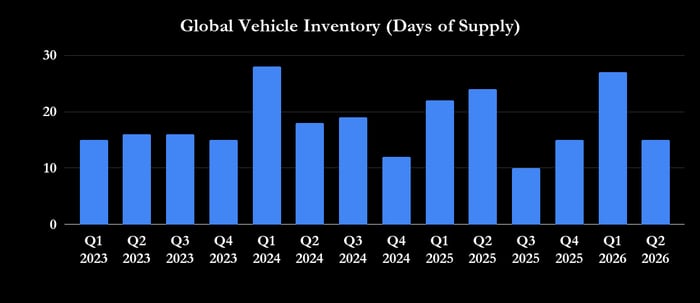
In addition, Tesla's aggressive paying for financial inducements may stem from ending the first quarter with relatively high inventory; now that it's cleared, Tesla's discounting and incentives may be less aggressive, and its pricing power may well improve.
Data source: Tesla presentations. Chart by author.
Robotaxi expectations reset
Arguably, the real issue here is the pushout in expectations for the rollout. In truth, back in April, on the previous earnings call, Musk said there wouldn't be a large-scale rollout until the next version of its FSD (v15) software was released. Given that that wasn't expected before the end of 2026 or early 2027, it's unlikely that robotaxi will ramp at anything like the magnitude investors were expecting at the start if the year, or when Tesla first launched robotaxis last year.
While tying growth in the rollout to ensuring the FSD software is perfected makes sense, it doesn't necessarily fit many investors' narratives of monitoring the number of cars in the unsupervised robotaxi fleet or the number of cities with robotaxi. The latter metrics are closely watched by investors, but on the recent earnings call, management downplayed them, with head of AI Ashok Elluswamy noting "relatively less effort on our front" in expanding into new cities. Regarding operational readiness, CFO Vaibhav Tadeja emphasized, "We are able to sort these things out in a smaller fleet in a controlled manner."
Image source: Getty Images.
Why Tesla stock can appreciate
Tesla's management has made it clear it's not cities or fleets that matter now but perfecting FSD v15 and growing miles driven under the developing versions of FSD v15 it's already implementing.
This probably isn't what most investors want to hear, but the reality is now reflected in the price; developments in robotaxis should be more positively received in the future. When that happens, investors will view the increases in capital spending as growth investments rather than a handicap to the stock.
Don’t miss this second chance at a potentially lucrative opportunity
Ever feel like you missed the boat in buying the most successful stocks? Then you’ll want to hear this.
On rare occasions, our expert team of analysts issues a “Double Down” stock recommendation for companies that they think are about to pop. If you’re worried you’ve already missed your chance to invest, now is the best time to buy before it’s too late. And the numbers speak for themselves:
- Nvidia: if you invested $1,000 when we doubled down in 2009, you’d have $569,290!*
- Apple: if you invested $1,000 when we doubled down in 2008, you’d have $59,274!*
- Netflix: if you invested $1,000 when we doubled down in 2004, you’d have $400,155!*
Right now, we’re issuing “Double Down” alerts for three incredible companies, available when you join Stock Advisor, and there may not be another chance like this anytime soon.
See the 3 stocks »
*Stock Advisor returns as of August 6, 2026.
Lee Samaha has no position in any of the stocks mentioned. The Motley Fool has positions in and recommends Tesla. The Motley Fool has a disclosure policy.
Recommended Articles


