


US Stocks Close: Dow Drops 0.85% to End Five-Day Winning Streak; Memory Stocks Slump as Western Digital Falls 13%, SanDisk Drops 6% Post-Earnings
TradingKey - Market trading sentiment weakened as Fed Chairman Warsh is reportedly considering a rate hike in September, and the non-farm payrolls report is set to be released on August 7, Eastern Time; the three major indexes all fell, with memory stocks taking a hit while oil stocks strengthened.
At the close, the Dow Jones Industrial Average fell 0.85% to 53,885.10 points; the Nasdaq Composite Index fell 0.06% to 26,348.35 points; and the S&P 500 Index fell 0.18% to 7,709.96 points.
Technology Stock Performance
SanDisk (SNDK) fell 6.81% post-earnings to $1,258.58.
Western Digital (WDC) fell 13.03% post-earnings to $451.52.
Both SanDisk and Western Digital delivered strong quarterly results, but Goldman Sachs believes that excessively high market expectations make it difficult for the share prices of both companies to benefit from their stellar performance, predicting that both stocks will come under downward pressure after their earnings releases. For investors, there is a need to guard against the risk of sentiment-driven pullbacks in both stocks in the short term. Goldman Sachs also noted that, considering the high overlap in end-market exposure between Micron and SanDisk, the negative market reaction to SanDisk's earnings is expected to spill over to Micron, and investors should remain attentive to the short-term movement of Micron's stock price.
Among mega-cap tech stocks, SpaceX (SPCX) rose 6.14%, Microsoft (MSFT) rose 2.54%, TSMC (TSM) rose 1.01%, Broadcom (AVGO) rose 0.55%, Apple (AAPL) rose 0.45%, and Meta Platforms (META) rose 0.19%. On the decliners' side, Google (GOOGL) fell 1.29%, Tesla (TSLA) fell 0.63%, Amazon (AMZN) fell 0.14%, and Nvidia (NVDA) fell 0.20%.
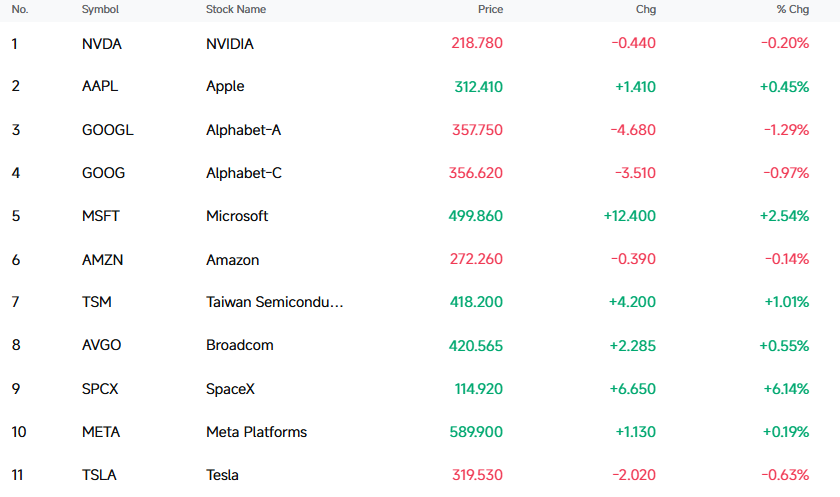
[Source: FutuBull]
The Philadelphia Semiconductor Index rose 0.33% to close at 12,048.69 points. Among its 30 constituent stocks, 30 rose and 12 fell.
Among memory stocks, SanDisk (SNDK) fell 5.40%, Western Digital (WDC) fell 5.36%, SK Hynix (SKHY) fell 2.17%, and Seagate Technology (STX) fell 0.91%.
Corporate News
Microsoft's Fourth Major Data Center Region in India Officially Operational
Microsoft announced that its fourth data center region in India has officially commenced operations in southern Hyderabad. As a core component of its $20.5 billion investment plan in India, the launch of this project marks a shift in the tech giant's long-term commitment to the Indian market from planning to tangible delivery. Microsoft stated that the data center region has secured demand support from several major local Indian enterprises, with Adani Group, Bajaj Finserv, HDFC Bank, and PB Pay already signed on as early-access customers.
SpaceX and Tesla Officially Announce $16.8 Billion Investment, Launching Terafab AI Chip Gigafactory Project
SpaceX and Tesla will make an initial investment of $16.8 billion to build Terafab—an advanced artificial intelligence semiconductor complex in Grimes County, Texas—to secure chip capacity that Musk describes as critical to his companies' futures. The factory aims to bridge the gap between global chip supply and the more than 1 terawatt of computing power SpaceX and Tesla are projected to require over the coming years.
Alphabet Plans to Launch $25 Billion Bond Issuance
Alphabet plans to raise up to $25 billion through a bond issuance. According to reports on the 6th citing sources familiar with the matter, Alphabet's bond sale is split into 10 tranches, with maturities spanning 2 to 40 years, and the initial price guidance spread for the longest maturity tranche is around 155 basis points over U.S. Treasuries. The final size of the offering has not yet been finalized. The reports noted that the latest jumbo bond offering drew approximately $115 billion in orders, indicating renewed investor interest in debt tied to the AI boom following recent sell-offs. According to people familiar with the matter, demand for the bond sale exceeded four times the projected maximum issuance size of $25 billion. This demand surpassed the subscription sizes achieved by recent AI-related bond sales from companies like Amazon and SpaceX. Alphabet offered investors a relatively high new issue concession on this bond sale to attract demand.
Apple Rushes to Secure DRAM Memory with Just Weeks to iPhone 18 Launch
According to a report by independent technology journalist Tim Culpan, Apple and its suppliers are rushing to secure enough memory chips for the upcoming new iPhone models. With less than six weeks left before the expected debut of the highly anticipated foldable iPhone Ultra, as well as the iPhone 18 and iPhone 18 Pro, Apple's assembly supply chain is accelerating coordination of DRAM memory chips. Currently, Apple is heavily dependent on Micron Technology for DRAM supply, though it also sources from SK Hynix and Samsung. However, as AI data center demand continues to crowd out memory resources, global DRAM supply is tightening, and Apple is starting to face supply pressures it rarely encountered in the past.
Nvidia Reportedly Considers Lowering Memory Capacity for Rubin Ultra Chips
According to a report by The Information, Nvidia is considering a major move to address shortages of high-end high-bandwidth memory chips. Nvidia is considering lower-than-planned graphics memory configurations for its next-generation Rubin Ultra graphics processing unit. People familiar with the matter revealed that Nvidia has tested at least three versions of the Rubin Ultra graphics card over the past few weeks, with some versions featuring memory capacities below the originally announced specifications. Part of the reason for this adjustment is that the company may not be able to acquire sufficient high-end memory to meet the supply requirements of the original design. While a memory reduction would impact chip performance, Nvidia could compensate through other means. However, other artificial intelligence companies running large AI models on these memory-reduced chips would need to deploy more chips than originally required.
Industry & Macro News
Proposed Iran-Oman Strait Agreement Faces Dual Obstacles of U.S. Sanctions and Insurance
According to Reuters, four industry sources said a proposed agreement between Iran and Oman would give Tehran control over vessels entering the Gulf via the Strait of Hormuz, but is difficult to implement due to U.S. sanctions and restrictive insurance clauses on any payments. Any toll-charging measures would present significant compliance issues, as the U.S. has imposed sanctions on Iran's 'Persian Gulf Strait Authority,' which is responsible for operating the waterway. The U.S. Treasury Department has also banned U.S. persons from accepting services related to 'guaranteeing safe passage' provided by the Iranian government. Industry sources said any payments could lead to asset freezes. Another complicating factor is that the Lloyd's Market Association introduced a clause at the end of July for use by war risk underwriters. Under the clause, insurance coverage will be terminated if a vessel pays transit fees, tolls, or other charges to pass through the Strait of Hormuz. An insurance industry source said shipping companies are caught in a dilemma, as the Lloyd's Market Association clause prohibits insurers from providing coverage to shipowners who make payments, while Iran wants to collect transit tolls.
U.S. Considers Delaying Tariffs on Polysilicon-Related Products
Trump administration officials are considering delaying the implementation of planned tariffs on solar panels and other polysilicon-containing products by several months. People familiar with the matter said U.S. President Donald Trump could order the tariffs as early as Thursday, but officials are considering establishing a 90-to-120-day transition period. It is understood that this arrangement could prompt companies involved in U.S. renewable energy projects to accelerate imports before the tariffs are officially levied.
U.S. Saudi Crude Imports Drop to Zero in July, First Full-Month Disruption in Over 40 Years
According to preliminary U.S. government data, U.S. crude imports from Saudi Arabia fell to zero in July, marking the first time since 1985 that an entire month went by without any imports of Saudi crude. Data released Wednesday by the U.S. Department of Energy showed that shipments of Saudi crude bound for the U.S. stopped entirely in July. The decline is significant considering that earlier this year, U.S. refiners were purchasing more than 800,000 barrels per day of Saudi crude. U.S. refiners have been seeking alternative supplies to Saudi crude, as the closure of the Strait of Hormuz and other war-related supply disruptions pushed up crude prices linked to the global benchmark. While Saudi crude deliveries to the U.S. have historically dropped to zero in isolated weeks, July was the first time in more than 40 years that they fell to the lowest level for an entire month. According to Kpler data, U.S. crude imports from Saudi Arabia are expected to recover to about 300,000 barrels per day this month, in line with recent historical norms.
Recommended Articles


