


Why SpaceX Shares Fell 7% After Revenue Rose 92% to Beat Estimates in First Post-Listing Report?
TradingKey - SpaceX ( SPCX )'s first quarterly earnings report after going public was overall better than Wall Street expectations. The rapid growth of its Starlink satellite internet and AI computing power businesses drove the company's second-quarter revenue to nearly double, while its net loss also narrowed significantly.
However, the company's investment in AI data centers, Starship, and next-generation satellites is still increasing rapidly. High capital expenditures have prompted investors to re-evaluate its cash burn and long-term returns, causing SpaceX's stock price to fall over 7% in after-hours trading.
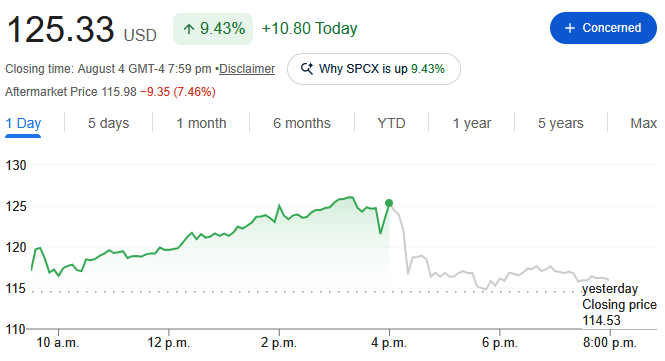
Source: Google Finance
Revenue and Loss Beat Market Expectations as Capital Expenditure Remains Biggest Focus
SpaceX's second-quarter revenue reached $7.81 billion, up 92% year-over-year, significantly higher than Wall Street expectations of approximately $6.8 billion to $6.9 billion. Adjusted EBITDA was $3.5 billion, up approximately 191% year-over-year, also exceeding market forecasts.
The company reported a loss per share of $0.09, narrower than the market expectation of a $0.26 loss. The net loss narrowed to $541 million from approximately $1 billion in the same period last year, while the overall operating loss also decreased from $970 million to $143 million, reflecting that revenue growth is delivering some operating leverage.
Revenue for all three of SpaceX's main business segments exceeded expectations. Connectivity revenue was $4.29 billion, AI revenue was $2.56 billion, and spaceflight revenue was $962 million. Starlink and AI together contributed nearly 90% of the company's revenue, indicating that SpaceX is no longer a company solely dependent on rocket launches.

Source: SpaceX
Management expects that, based on the business scale at the end of the year, the company's annualized revenue could reach $100 billion. Musk also raised the long-term revenue target for the end of this decade to $1 trillion. However, these forecasts are predicated on the rapid expansion of Starlink, AI computing power, and the next-generation satellite network, and actual progress remains dependent on production capacity, customer contracts, and technology implementation.
However, the impressive revenue and profit figures did not fully dispel market concerns. SpaceX's total capital expenditures in the second quarter surged to approximately $18.4 billion from $2.83 billion in the same period last year, with $15.83 billion allocated to AI infrastructure, accounting for 86% of total expenditures. Management expects capital investment to remain at this level over the next two quarters, meaning the company is still in a high-investment phase, and cash burn is unlikely to slow down significantly in the near term.
Musk believes that the capital investment in new AI computing power is expected to be recovered within a year, but the market remains cautious. If SpaceX relies on leasing data center capacity as its primary model in the long run, although it can quickly scale revenue, it may face challenges such as intense competition in the cloud computing industry and constrained profit margins.
Starlink Remains Primary Profit Source as AI Begins to Deliver Commercial Value
The connectivity business, including Starlink, continues to serve as SpaceX's core profit driver. In the second quarter, revenue for this business grew approximately 66% year-on-year to $4.29 billion, beating the market expectation of $3.83 billion; operating profit rose 79% year-on-year to $1.66 billion, with a profit margin of nearly 39%.
As of the end of the quarter, Starlink's user base doubled year-on-year to 12 million, covering individual consumers, enterprises, aviation, maritime, mobile communications, and government clients. Due to the company's accelerated entry into international markets and the launch of lower-priced service plans, average revenue per user (ARPU) declined 22% year-on-year, but subscriber expansion still drove rapid growth in overall revenue and profit.
SpaceX expects to launch at least 1,000 next-generation V3 satellites over the coming year to increase network capacity and improve service quality. Company President Gwynne Shotwell also stated that SpaceX plans to build more ground communication facilities, enabling Starlink to provide more comprehensive mobile services and compete for customers with traditional carriers such as T-Mobile, AT&T, and Verizon.
Meanwhile, AI was the fastest-growing yet highest-spending business this quarter. In the second quarter, AI revenue reached $2.56 billion, up approximately 247% year-on-year, beating the market expectation of $2.18 billion. Growth was primarily driven by cloud service contracts providing computing power to Anthropic, Google, and other AI companies, as well as subscription revenue related to Grok and X.
The AI division's operating loss was $1.26 billion, which was lower than previous market concerns, indicating that the business has begun to generate certain commercial returns. However, in terms of absolute scale, AI remains one of SpaceX's largest sources of loss.
SpaceX to Deepen AI Cooperation With Nvidia
During the earnings call, Musk announced that SpaceX's future AI infrastructure will exclusively use Nvidia systems. He believes Vera Rubin is currently the most competitive AI computing architecture and stated that the two parties will deepen their collaboration in terrestrial data centers and orbital computing.
SpaceX and Nvidia ( NVDA) will also jointly develop the computing payloads for Starmind AI1 satellites. The satellites are planned to be equipped with Vera CPUs and Rubin GPUs, deploying data-center-grade AI computing power to low Earth orbit. Musk expects the first batch of Starmind satellites to begin launching as early as 2027.
Compared with terrestrial data centers, orbital facilities do not require purchasing large amounts of land and can continuously utilize solar power. However, server launches, equipment heat dissipation, in-orbit maintenance, and inter-satellite communications still present complex engineering challenges. Before these technologies achieve large-scale commercial operations, orbital data centers remain more of a long-term growth option rather than a current source of profit.
Why Better-Than-Expected Earnings Failed to Drive Stock Gains
SpaceX's stock price rose 9.4% during regular trading hours ahead of the earnings release, indicating that some capital had already bet in advance on results beating expectations. Following the release of the financial report, the stock price rose briefly before turning downward, dropping about 8% at one point in after-hours trading.
Market concerns do not stem from revenue or earnings missing expectations, but rather from the fact that the company still needs to rely on Starlink's profits to fund the expansion of its AI and aerospace businesses. Although the net loss narrowed significantly in the second quarter, the connectivity business remained the only segment among the three business units to achieve an operating profit.
Capital expenditures have further amplified these concerns. AI revenue grew faster than expected, yet has not generated enough profit to cover the $15.8 billion in quarterly investment. Furthermore, management expects to maintain similar spending levels over the next two quarters, leaving the market temporarily unable to see any signs of an inflection point in cash burn.
In addition, the first batch of restricted shares since SpaceX's listing is set to unlock on Thursday, making insiders and early investors eligible to sell their stock. Under the combined pressure of high valuations, pre-market stock price run-ups, and new share supply, it will be difficult to immediately drive the stock price steadily higher, even if the financial data beat expectations.
Recommended Articles


