


Investors Are Overlooking 1 Catalyst That Could Drive Billions in Profits at Ford and GM
Key Points
Both Ford and GM are putting more emphasis on their defense contract business.
GM secured a multiyear contract to build the U.S. Army's Infantry Squad Vehicle (ISV).
Ford is in talks with defense businesses overseas in Europe.
- 10 stocks we like better than General Motors ›
Interestingly, investors looking for potential future catalysts for both General Motors (NYSE: GM) and Ford Motor Company (NYSE: F) might just find their answers in the past.
While Stellantis is busy refocusing on its core vehicle production strategy and broader turnaround, both Ford and GM are busy diversifying and seeking new and incremental revenue streams. One catalyst with the potential to add billions in revenue and profit is the defense business.
Missed Nvidia in 2009? This Rare Signal Is Flashing Again. In 2009, a "Double Down" signal flashed for a little-known chipmaker called Nvidia. For the first time in years, that same "Total Conviction" signal is flashing for a company 1/100th the size of Nvidia. Continue »
Here's a brief history lesson on GM's and Ford's defense businesses and what reviving them could mean for long-term investors.
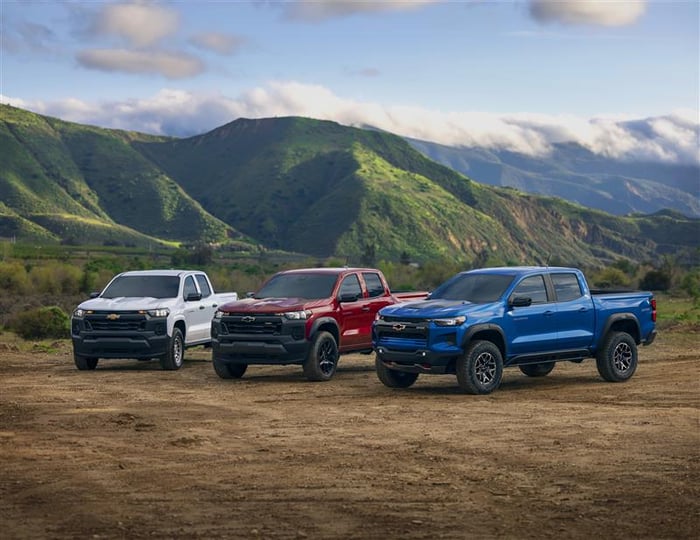
Image source: General Motors.
General Motors and Ford have a history of serving the military
Many forget that GM's defense business delivered over $12.3 billion in war goods during World War II, at the time making it the largest commercial provider of military vehicles. For an automotive industry already frowned upon for its cyclicality, GM's defense business was even more boom or bust and was divested in 2003 to General Dynamics for $1.1 billion. Until 2017, when GM Defense was reestablished, you could say GM's defense business was gone but not forgotten. But GM CEO Mary Barra dropped a hint in the automaker's recent second-quarter letter to shareholders: "Growth businesses like GM Defense and GM Insurance are creating additional avenues for value creation," she wrote.
GM is gearing up for a strategic pivot that could capture billions in defense revenue, and GM Defense has already secured a big multiyear contract to build the U.S. Army's Infantry Squad Vehicle (ISV), which is based on the Chevrolet Colorado ZR2 midsize truck architecture.
Crosstown rival Ford Motor Company got in the mix for the government's ISV-Heavy (ISV-H) program, in which the U.S. Army awarded GM Defense, Ford, and BC Customs firm-fixed-price prototype agreements. Prototypes are due by March 30, 2027.
GM has a head start in reviving its historic defense business, especially considering it has a more mature and dedicated subsidiary, while Ford's defense business is integrated into its Ford Pro operations. GM Defense even recently signed a memorandum of understanding (MOU) with Lockheed Martin to explore opportunities to improve the supply chain and drive manufacturing innovation between the two juggernauts.
While GM has a head start over Ford, the latter is already in negotiations with defense departments in Europe, as well as North America, to supply trucks and software to their armed forces. That said, the talks, which are said to be "productive," have yet to produce a contract with Ford.
What it all means for investors
More broadly, this is a trend investors should remember, as the U.S. Defense Department is aiming to diversify its contractors to improve service and slash costs, and major Detroit automakers were high on that list of companies to work with. While this would certainly be a solid business win for either GM or Ford, let's put some context around the current projections.
For 2026, GM Defense is aiming for about $700 million in revenue and double-digit percentage EBIT (earnings before interest and taxes) margins -- which is good compared to the single-digit margins major automakers typically achieve. Management also expects GM Defense to post a compound annual growth rate (CAGR) of more than 30% over the next several years. While GM Defense could certainly add billions to the company's top line, and, over the long term, to its bottom line, reasonable growth rates would probably put the business as only a small 2% to 3% of the company's EBIT profits by the end of this decade.
Despite being a small percentage of Ford's and GM's overall businesses, there's certainly upside beyond the numbers, such as with GM Defense's MOU with Lockheed Martin that could open up doors to drive efficiencies and lower research and development (R&D) costs, or potentially fill excess production capacity at its truck factories that would only boost margins. Ford and GM's renewed focus on defense business is a smart move, a profitable move, and a development worth watching for multiple reasons, but it won't cause the stocks to soar in the near term. However, as Ford and GM continue to diversify their business and expand margins above historical narratives, these moves all add up for investors.
Should you buy stock in General Motors right now?
Before you buy stock in General Motors, consider this:
The Motley Fool Stock Advisor analyst team just identified what they believe are the 10 best stocks for investors to buy now… and General Motors wasn’t one of them. The 10 stocks that made the cut could produce monster returns in the coming years.
Consider when Netflix made this list on December 17, 2004... if you invested $1,000 at the time of our recommendation, you’d have $395,463!* Or when Nvidia made this list on April 15, 2005... if you invested $1,000 at the time of our recommendation, you’d have $1,268,290!*
Now, it’s worth noting Stock Advisor’s total average return is 927% — a market-crushing outperformance compared to 211% for the S&P 500. Don't miss the latest top 10 list, available with Stock Advisor, and join an investing community built by individual investors for individual investors.
See the 10 stocks »
*Stock Advisor returns as of August 4, 2026.
Daniel Miller has positions in Ford Motor Company and General Motors. The Motley Fool recommends General Motors, Lockheed Martin, and Stellantis. The Motley Fool has a disclosure policy.
Recommended Articles


