

KOSDAQ Futures Rise Over 6% Triggering Trading Halt as Korea Finance Minister Koo Yun-cheol Vows to Stabilize Market

Source Tradingkey

TradingKey - During the Asian trading session on August 4, South Korea's KOSDAQ futures surged over 6% at one point, triggering a five-minute trading halt by the Korea Exchange. As of press time, the KOSDAQ futures index was up 4.58%.
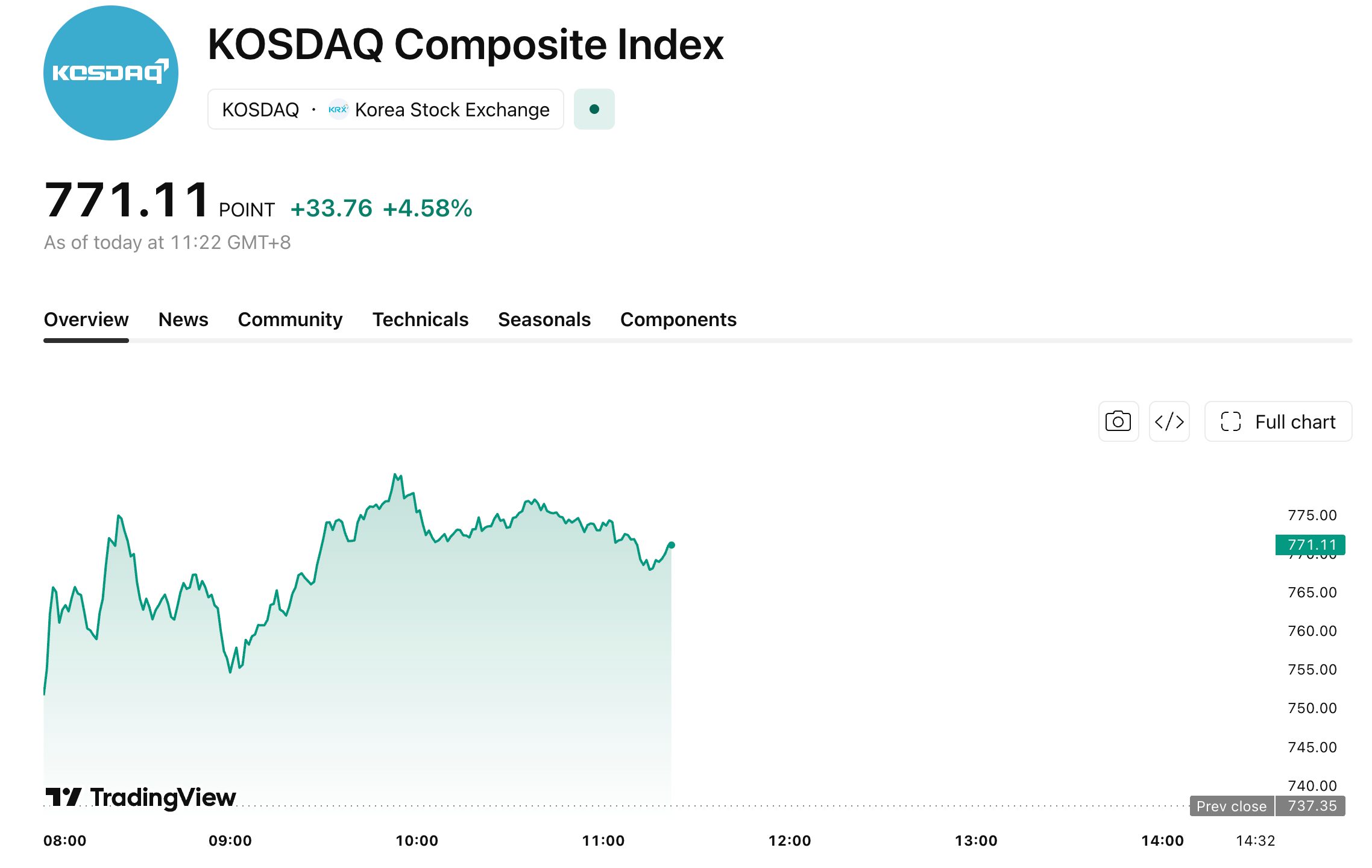
kr-804-bcf141ab7e0a4fe9872667ba42cdc18b

[Source: TradingView]

Almost simultaneously, South Korean Finance Minister Koo Yun-cheol commented on stock market volatility during a cabinet meeting, stating that the government will commit to improving market fundamentals to ease volatility and ensure long-term structural stability. Koo pledged that the Finance Ministry will swiftly implement supplementary measures recently announced for single-stock leveraged ETFs to limit the impact of such products on the market.

Recently, the South Korean stock market has been under continuous pressure due to concentrated rebalancing trades triggered by single-stock leveraged ETFs. According to estimates by the Korea Capital Market Institute, since the listing of such products in May this year, daily rebalancing transactions have reached 700 billion to 2.1 trillion won, concentratedly impacting market liquidity during late-day trading.

To curb the associated risks, the Financial Services Commission of South Korea announced official measures on July 16, raising the minimum margin requirement from 10 million won to 30 million won and banning the listing of new single-stock leveraged products.

Against the backdrop of severe volatility in the semiconductor sector, the South Korean market has frequently triggered circuit breakers. As of August 4, KOSDAQ futures had triggered the sidecar mechanism 29 times this year, hitting a record high in recent years and highlighting that market volatility remains elevated.

Earlier in July, the South Korean stock market experienced its most severe correction since the financial crisis, with the KOSPI Index falling 22% in a single month, marking its largest monthly decline since 2008. Heavyweight SK Hynix fell approximately 35% over the entire month of July, with its maximum intraday drawdown exceeding 50%; Samsung Electronics dropped about 21% in July, with extreme intraday losses nearing 36%. This storm wiped out more than 2,100 trillion won (approximately $2 trillion) in total market capitalization from the South Korean stock market in just two months.

Disclaimer: For information purposes only. Past performance is not indicative of future results.
placeholder
Metaplanet acquires BTC at record pricesMetaplanet added another 797 BTC to its treasury.
Author  Cryptopolitan
Jul 14, 2025
Metaplanet added another 797 BTC to its treasury.
placeholder
Pi Network Price Annual Forecast: PI Heads Into a Volatile 2026 as Utility Questions Collide With Big UnlocksPi Network heads into 2026 after a 90%+ 2025 drawdown from $3.00, with 17.5 million KYC users and a smart-contract-focused Stellar v23 upgrade offering upside potential, but 1.21 billion tokens unlocking and heavy exchange deposits (437 million PI) keeping supply pressure and trust risks firmly in focus.
Author  Mitrade
Dec 19, 2025
Pi Network heads into 2026 after a 90%+ 2025 drawdown from $3.00, with 17.5 million KYC users and a smart-contract-focused Stellar v23 upgrade offering upside potential, but 1.21 billion tokens unlocking and heavy exchange deposits (437 million PI) keeping supply pressure and trust risks firmly in focus.
placeholder
Finding The Best Japan Stocks to Buy? These are Top Japanese Companies to Watch Discover the best Japanese stocks to buy, including AI semiconductor leaders, Buffett-backed trading houses, and undervalued Japan stocks benefiting from corporate reforms and yen trends.
Author  Mitrade
May 29, Fri
Discover the best Japanese stocks to buy, including AI semiconductor leaders, Buffett-backed trading houses, and undervalued Japan stocks benefiting from corporate reforms and yen trends.
placeholder
WTI holds losses around $82.50 on renewed US-Iran diplomatic hopesWest Texas Intermediate (WTI) oil price remains in the negative territory for the second successive day, trading around $82.60 per barrel during the Asian hours on Friday. Crude oil prices have lost ground following renewed hopes for a diplomatic solution to the US-Iran conflict.
Author  FXStreet
Jul 31, Fri
West Texas Intermediate (WTI) oil price remains in the negative territory for the second successive day, trading around $82.60 per barrel during the Asian hours on Friday. Crude oil prices have lost ground following renewed hopes for a diplomatic solution to the US-Iran conflict.
placeholder
WTI trades with positive bias below mid-$79.00s on Iran uncertainty, supply concernsWest Texas Intermediate (WTI) – the benchmark US Crude Oil price – edges higher during the Asian session on Tuesday and looks to build on the overnight bounce following an intraday slump to levels below mid-$77.00s.
Author  FXStreet
3 hours ago
West Texas Intermediate (WTI) – the benchmark US Crude Oil price – edges higher during the Asian session on Tuesday and looks to build on the overnight bounce following an intraday slump to levels below mid-$77.00s.
goTop
quote