


USD/JPY Price Forecast: A short-term respite likely to near 160.00
- USD/JPY rises to near 157.60 as the Japanese Yen faces profit booking.
- US-Japan joint intervention strengthened the Japanese Yen.
- Investors await key US JOLTS Job Openings data for June.
The Japanese Yen (JPY) trades lower against its major currency peers on Tuesday after a rare juggernaut outperformance in the last few trading days. In the Asian session, the Japanese currency is down 0.25% to near 157.60 against the US Dollar (USD).
Japanese Yen Price Today
The table below shows the percentage change of Japanese Yen (JPY) against listed major currencies today. Japanese Yen was the weakest against the Australian Dollar.
| USD | EUR | GBP | JPY | CAD | AUD | NZD | CHF | |
|---|---|---|---|---|---|---|---|---|
| USD | -0.00% | 0.07% | 0.27% | -0.01% | -0.25% | 0.12% | -0.02% | |
| EUR | 0.00% | 0.06% | 0.29% | -0.02% | -0.27% | 0.10% | -0.01% | |
| GBP | -0.07% | -0.06% | 0.23% | -0.07% | -0.32% | 0.05% | -0.07% | |
| JPY | -0.27% | -0.29% | -0.23% | -0.29% | -0.53% | -0.19% | -0.18% | |
| CAD | 0.00% | 0.02% | 0.07% | 0.29% | -0.24% | 0.11% | 0.00% | |
| AUD | 0.25% | 0.27% | 0.32% | 0.53% | 0.24% | 0.36% | 0.25% | |
| NZD | -0.12% | -0.10% | -0.05% | 0.19% | -0.11% | -0.36% | -0.10% | |
| CHF | 0.02% | 0.00% | 0.07% | 0.18% | -0.00% | -0.25% | 0.10% |
The heat map shows percentage changes of major currencies against each other. The base currency is picked from the left column, while the quote currency is picked from the top row. For example, if you pick the Japanese Yen from the left column and move along the horizontal line to the US Dollar, the percentage change displayed in the box will represent JPY (base)/USD (quote).
The Asia-Pacific currency outperformed due to rare joint intervention by the United States (US) and Japan to support the Yen.
Japan and US step in as Yen hits weakest level since 1986
BNY notes that Japan’s finance ministry and the US Treasury have moved to shore up the Yen, jointly intervening in the foreign exchange market after the currency fell to its lowest level against the Dollar since 1986. Japanese Finance Minister Satsuki Katayama said the coordinated action was aimed at countering “excessive volatility and disorderly movements in recent months.” She underscored that Tokyo “would not hesitate to carry out further joint intervention if needed,” signaling that the authorities remain ready to defend the currency should renewed pressure emerge.
Meanwhile, the US Dollar (USD) holds onto its Monday’s recovery move, with investors awaiting key US economic data, notably the Nonfarm Payrolls (NFP), releasing this week. As of writing, the US Dollar Index (DXY), which gauges the Greenback’s value against six major currencies, trades firmly near 100.00.
In Tuesday’s session, investors will focus on the JOLTS Job Openings data for June, which will be published at 14:00 GMT. The US economy is expected to have posted 7.45 million fresh jobs, slightly lower than 7.594 million in May.
USD/JPY technical outlook
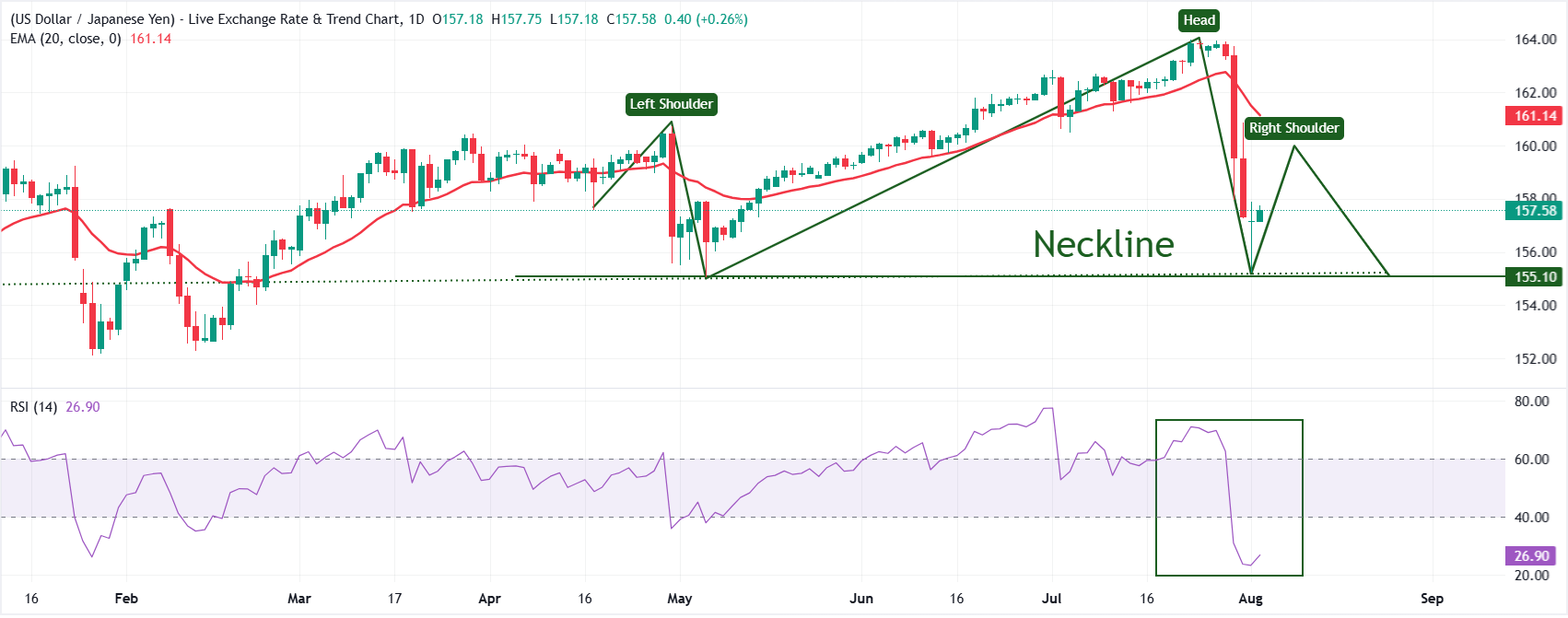
USD/JPY trades at around 157.58 at press time, retaining a bearish near-term bias as spot holds well below the 20-day exponential moving average (EMA) at 161.14. The chart structure of the pair reflects a Head and Shoulders pattern in the making, whose right shoulder is yet to be formed, likely near 160.00, suggesting a respite is highly likely after a juggernaut fall.
The pair has retreated from recent highs, and the Relative Strength Index (RSI) at 26.90 sits in oversold territory, which hints that downside momentum is stretched but does not yet show a clear reversal signal.
Going forward, a "Sell on Rise" strategy appears optimal in these conditions, and the round level of 160.00 would be a key barrier. After that, the pair might retest the neckline at around 155.10.
On the contrary, the pair would regain a bullish bias if it manages to extend the recovery above the July 16 low near 162.00. The pair would aim to revisit the multi-decade high at around 164.00 if it manages to break above 162.00.
(The technical analysis of this story was written with the help of an AI tool. Know more.)
Japanese Yen FAQs
The Japanese Yen (JPY) is one of the world’s most traded currencies. Its value is broadly determined by the performance of the Japanese economy, but more specifically by the Bank of Japan’s policy, the differential between Japanese and US bond yields, or risk sentiment among traders, among other factors.
One of the Bank of Japan’s mandates is currency control, so its moves are key for the Yen. The BoJ has directly intervened in currency markets sometimes, generally to lower the value of the Yen, although it refrains from doing it often due to political concerns of its main trading partners. The BoJ ultra-loose monetary policy between 2013 and 2024 caused the Yen to depreciate against its main currency peers due to an increasing policy divergence between the Bank of Japan and other main central banks. More recently, the gradually unwinding of this ultra-loose policy has given some support to the Yen.
Over the last decade, the BoJ’s stance of sticking to ultra-loose monetary policy has led to a widening policy divergence with other central banks, particularly with the US Federal Reserve. This supported a widening of the differential between the 10-year US and Japanese bonds, which favored the US Dollar against the Japanese Yen. The BoJ decision in 2024 to gradually abandon the ultra-loose policy, coupled with interest-rate cuts in other major central banks, is narrowing this differential.
The Japanese Yen is often seen as a safe-haven investment. This means that in times of market stress, investors are more likely to put their money in the Japanese currency due to its supposed reliability and stability. Turbulent times are likely to strengthen the Yen’s value against other currencies seen as more risky to invest in.
Recommended Articles


