


Intel Stock Price Forecast: After Over 30% July Drop, Will Shares Fall Further?
TradingKey - As of July 29, Eastern Time, Intel ( INTC )'s stock price has corrected more than 30% cumulatively from its late-June peak, entering a technical correction territory. Although the company's recently released second-quarter fiscal 2026 financial results beat market expectations across the board and raised its third-quarter guidance, the stock price failed to extend its previous rally and instead continued to face pressure.
Why Is Intel Stock Falling?
Intel's stock price has corrected significantly since July, primarily driven by the market's reassessment of the company's future profitability, progress in its foundry business, and the AI competitive landscape.
First, Intel's stock price had previously recorded significant gains, as the market priced in expectations for the company's AI transformation and manufacturing business improvements ahead of time. Since early 2026, Intel's stock price had once risen sharply, with investors betting that the company would undergo a valuation re-rating driven by AI servers, advanced process technologies, and policy support for domestic US semiconductor manufacturing. However, as the stock price surged, the market began focusing more on the speed of earnings materialization, leading to recent profit-taking pressure.
Second, the profitability of the foundry business remains a key focus for the market. Although Intel's foundry revenue grew 31% year-on-year to $5.8 billion in the second quarter, the business remains unprofitable, posting a single-quarter operating loss of approximately $2.1 billion. What the market wants to see is not just revenue growth, but also customer onboarding for advanced process nodes and improved profitability. If the foundry business requires sustained, high capital expenditures to maintain expansion over the long term, it could limit the room for improvement in the company's overall profit margins.
Additionally, Intel's continuously increasing capital expenditures have also raised market concerns over cash flow pressure. To advance its 14A advanced process node, expand advanced packaging capacity, and build US manufacturing bases, the company has continued to invest substantial capital. While these investments help enhance long-term competitiveness, they increase depreciation costs and cash flow pressure in the short term. Investors are currently focusing more on whether these capital commitments can translate into actual orders and profit growth.
Meanwhile, competition in the AI chip market remains intense. Although Intel's Datacenter and AI segment revenue grew 59% year-on-year to $6.3 billion in the second quarter, compared with Nvidia's leading position in the AI GPU market and AMD ( AMD) continuing to expand its share in the datacenter GPU market, Intel still needs to prove that its AI product portfolio can gain wider adoption among large-scale customers.
On the institutional front, some analysts believe that Intel's recent correction primarily reflects the market's re-pricing of the company's long-term transformation pace, rather than a deterioration in performance. Wall Street firms pointed out that Intel's revenue and profit guidance in its earnings report remained stronger than expected, but the market is waiting for more concrete progress on advanced process node mass production, external foundry customers, and AI business growth.
Will Intel’s Stock Price Fall Further?
In the medium to long term, AI remains a key thesis supporting Intel's valuation.
As global AI infrastructure continues to expand, demand for data center servers, AI PCs, and enterprise-grade computing power keeps growing. In the second quarter, Intel's Data Center and AI business grew 59% year-over-year, indicating that the company is once again benefiting from the AI server buildout cycle. Meanwhile, the company stated that several customers have already adopted its 14A advanced process node and plan to achieve high-volume manufacturing by 2028, implying that its foundry strategy is making steady progress.
Meanwhile, Intel continues to advance its product pipeline across CPUs, AI accelerators, ASICs, and advanced packaging, aiming to build a comprehensive product portfolio covering AI infrastructure rather than relying solely on its traditional PC processor business.
Institutions generally believe that Intel's profitability is in a recovery phase. The company's second-quarter revenue, earnings, and third-quarter guidance all significantly beat Wall Street expectations, reflecting that AI server demand is driving improvements in its fundamentals.
However, the market's primary concerns remain focused on two areas.
First, when the foundry business will be able to achieve sustainable profitability. If it fails to secure more major customers over the next two years, elevated capital expenditures may continue to weigh on free cash flow and profit margins.
Second, competition in AI chips remains fierce. Nvidia ( NVDA ), AMD, and TSMC ( TSM) still hold significant advantages in AI GPUs and advanced manufacturing. Intel must continuously prove its product competitiveness and process execution capabilities to further lift its market valuation.
Overall, Intel may remain subject to valuation adjustments in the short term. However, if its data center business continues to grow rapidly, foundry losses continue to narrow, and more advanced node orders are secured over the coming quarters, the stock will still have the foundation for a recovery.
Technical Analysis of Intel Stock Price
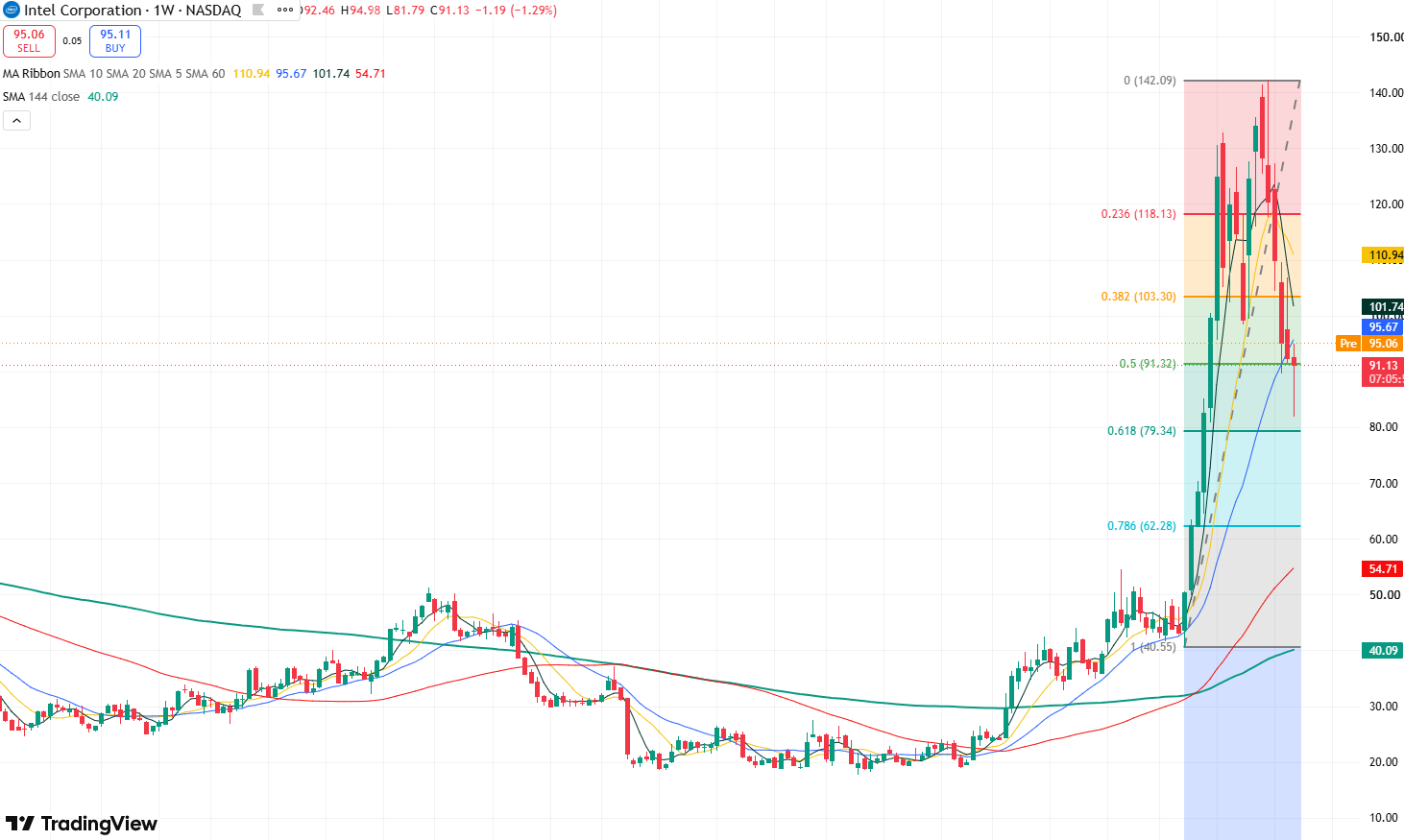
Intel weekly stock chart, Source: TradingView
According to Intel's weekly stock chart, the stock has been pulling back since hitting an all-time high at the end of June, posting six consecutive weeks of losses with a cumulative decline of over 30%. As short-term moving averages begin to turn downward, market sentiment has clearly weakened.
Currently, the stock price has fallen below its 20-week moving average, further boosting bearish momentum, and the likelihood of continued short-term declines has increased significantly.
On the downside, the primary target for the declining stock price will be to test support near $80. If this level fails to hold, the stock could pull back further toward $60.
On the upside, the primary resistance level to watch is near $90. If breached, the stock will test the $100 mark, with the next level up at $107.
Recommended Articles


