


SCHD and VYM Are Crushing the S&P 500 and Nasdaq-100. Here's the Better ETF of the 2 to Buy for Passive Income in August.
Key Points
The Schwab U.S. Dividend Equity ETF has a higher yield than the Vanguard High Dividend Yield ETF.
The Vanguard High Dividend Yield ETF has greater exposure to growth and cyclical stocks.
Both ETFs offer compelling ways to participate in the stock market while generating passive income.
- 10 stocks we like better than Schwab U.S. Dividend Equity ETF ›
The Schwab U.S. Dividend Equity ETF (NYSEMKT: SCHD) and Vanguard High Dividend Yield ETF (NYSEMKT: VYM) have no shortage of similarities. They have almost identical net assets around $96 billion, dirt cheap expense ratios of 0.06% and 0.04%, respectively, and dividend yields of 3.3% and 2.3%, respectively.
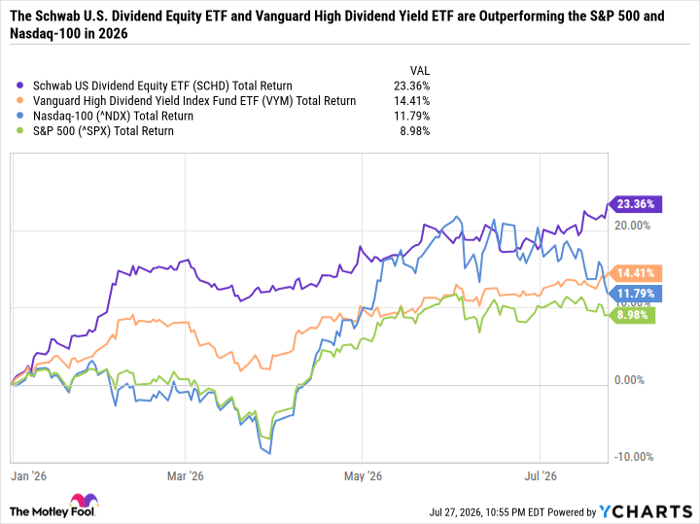
They are also crushing the S&P 500 (SNPINDEX: ^GSPC) and Nasdaq-100 this year. The Nasdaq-100 is the 100 largest non-financial companies by market cap listed on the Nasdaq stock exchange.
Where to invest $1,000 right now? Our analyst team just revealed what they believe are the 10 best stocks to buy right now, when you join Stock Advisor. See the stocks »
Here's the better choice between these two ETFs for income investors to buy in August.

Image source: Getty Images.
Key differences between SCHD and VYM
Unlike covered call ETFs, the Schwab U.S. Dividend Equity ETF and Vanguard High Dividend Yield ETF do not cap their upside. Rather, they invest in a basket of dividend-paying stocks. But there are some distinct differences between the ETFs that investors should pay attention to.
The biggest difference is that the Schwab U.S. Dividend Equity ETF focuses more on current dividend yield, whereas the Vanguard High Dividend Yield ETF emphasizes both dividend growth and yield.
This distinction is apparent in the sector weights of both ETFs.
|
Sector |
Schwab U.S. Dividend Equity ETF |
Vanguard High Dividend Yield ETF |
|---|---|---|
|
Healthcare |
20.7% |
12.4% |
|
Consumer staples |
20.4% |
8.5% |
|
Technology and communication services |
15.4% |
18.6% |
|
Energy |
14.1% |
8.5% |
|
Industrials and materials |
11.6% |
17.4% |
|
Financials |
10.1% |
20.7% |
|
Consumer discretionary |
7.7% |
7.9% |
|
Utilities |
0.1% |
6% |
Data sources: Charles Schwab, Vanguard.
A staggering 41.1% of the Schwab U.S. Dividend Equity ETF is in healthcare and consumer staples stocks, whereas industrials, materials, and financials dominate the Vanguard High Dividend Yield ETF. Both ETFs have significant exposure to tech and communication stocks, but the way they approach that exposure differs.
The Schwab U.S. Dividend Equity ETF has significant holdings in Verizon Communications, Comcast, Texas Instruments, and Qualcomm. In contrast, the Vanguard High Dividend Yield ETF's largest holding is Broadcom at 7.3%. Cisco Systems is also a top 10 holding in the fund.
The Schwab U.S. Dividend Equity ETF is outperforming the Vanguard High Dividend Yield ETF in 2026, largely thanks to its outsize exposure to energy stocks.
SCHD Total Return Level data by YCharts
Despite the Schwab U.S. Dividend Equity ETF's emphasis on value-focused sectors, capital gains rather than dividends have still been the key driver of its long-term performance -- just like the Vanguard High Dividend Yield ETF. The Schwab U.S. Dividend Equity ETF has produced a 225.7% total return over the past decade compared to 199.2% for the Vanguard High Dividend Yield ETF.
The better buy for income investors
The Schwab U.S. Dividend Equity ETF is a better overall ETF for generating dividend income from stocks than the Vanguard High Dividend Yield ETF. Its superior 3.3% dividend yield and balanced exposure to value-focused sectors make it a far more appealing option for risk-averse investors. And although it does have a high weighting to the energy sector -- which can be volatile -- that weighting is anchored in Chevron and ConocoPhillips, which both have excellent assets that can generate high free cash flow even at lower oil and gas prices.
By comparison, the Vanguard High Dividend Yield ETF focuses more on quality dividend-growth companies, which can be a better fit for investors who don't mind the lower 2.3% yield and want diversified exposure to sectors like financials and artificial intelligence leaders such as Broadcom.
Should you buy stock in Schwab U.S. Dividend Equity ETF right now?
Before you buy stock in Schwab U.S. Dividend Equity ETF, consider this:
The Motley Fool Stock Advisor analyst team just identified what they believe are the 10 best stocks for investors to buy now… and Schwab U.S. Dividend Equity ETF wasn’t one of them. The 10 stocks that made the cut could produce monster returns in the coming years.
Consider when Netflix made this list on December 17, 2004... if you invested $1,000 at the time of our recommendation, you’d have $390,394!* Or when Nvidia made this list on April 15, 2005... if you invested $1,000 at the time of our recommendation, you’d have $1,209,184!*
Now, it’s worth noting Stock Advisor’s total average return is 899% — a market-crushing outperformance compared to 206% for the S&P 500. Don't miss the latest top 10 list, available with Stock Advisor, and join an investing community built by individual investors for individual investors.
See the 10 stocks »
*Stock Advisor returns as of July 30, 2026.
Charles Schwab is an advertising partner of Motley Fool Money. Daniel Foelber has positions in Broadcom and Schwab U.S. Dividend Equity ETF. The Motley Fool has positions in and recommends Broadcom, Chevron, Cisco Systems, Qualcomm, Texas Instruments, and Vanguard High Dividend Yield ETF. The Motley Fool recommends Charles Schwab, Comcast, ConocoPhillips, and Verizon Communications and recommends the following options: short September 2026 $95 calls on Charles Schwab. The Motley Fool has a disclosure policy.
Recommended Articles


