


Boeing Stock Falls 4% Despite Strong Q2 Revenue as Analysts Stay Bullish on Recovery
TradingKey - Boeing (NYSE: BA) is selling off Wednesday after rallying strongly following Tuesday July 28 earnings when shares rallied 4.76% to $221.56 after reporting Q2 2026 earnings. The recent chip sector selloff and renewed Fed hawkishness are keeping Boeing under pressure in today's trading session.
While Boeing’s Q2 2026 results offered mixed signals, with revenue coming in at $24.56 billion, beating some estimates while missing others, adjusted net loss of $0.67 per share versus $0.92 last year, and the FAA restoring Boeing’s self-certification rights for the 737 MAX and 787 on July 20, the stock managed to rally strongly following the report. At 171 aircraft delivered, Boeing achieved its best quarterly delivery rate since 2018. While analysts aren’t uniformly bullish on Boeing following the earnings report, the average target price remains at $270.08.
Here’s what you need to know about the company’s Q2 2026 report:
What Boeing Actually Reported in Q2 2026
Boeing reported Q2 2026 revenue of $24.56 billion on Tuesday July 28 pre-market open. That figure was about 1.2% above consensus but below another consensus estimate of $24.97 billion. The GAAP net loss was $428 million, or $0.67 per share, versus a loss of $612 million, or $0.92 per share, in Q2 2025. Adjusted net loss was $0.76 per share, versus a consensus estimate of about $0.31 per share. This discrepancy was mainly due to a $280 million charge for Boeing’s VC-25B presidential aircraft program, replacing Air Force One. Boeing said it will continue to face challenges in completing the aircraft.
Operating margin came in at 0.6%, and free cash flow was $631 million. Cash and marketable securities at the end of the quarter stood at around $20 billion. The company’s debt-to-assets ratio decreased from 42% to 28% after management reduced its debt burden by $6.95 billion in Q1 2026. The backlog currently stands at $695 billion, more than four times Boeing’s current market cap of approximately $174 billion. Recent commercial orders from SMBC Aviation Capital, Riyadh Air, Philippine Airlines and AerCap have added to the backlog since the beginning of 2026.
The FAA Self-Certification Restoration Is the Most Underappreciated Development
Perhaps the most important development in Boeing’s Q2 earnings that went largely unnoticed in earnings coverage was the FAA’s restoration of Boeing’s self-certification rights for newly produced 737 MAX and 787 jets, effective July 20. Boeing lost its self-certification rights following the 2024 manufacturing quality scandal, which forced the FAA to perform final airworthiness certification itself, a process that slowed aircraft deliveries and put a drag on cash flow. Restoring Boeing’s self-certification rights helps the company move faster through the production pipeline, increasing both deliveries and cash conversion rates from its existing backlog. Boeing is currently producing 737 aircraft at an output rate of 47 per month during the summer, and it expects to deliver 500 aircraft this year.
Meanwhile, Boeing’s defense and space segment posted an operating margin of 3.5%, excluding the VC-25B charge. Boeing Global Services generated margins exceeding 18%. Boeing won a $213 million Department of Defense contract to modify four P-8A Poseidon maritime patrol aircraft for a foreign military customer.
The FY2027 DoD budget totals about $1.45 trillion, representing a 42% annual increase, with airpower spending up 26%. The Pentagon’s spending priorities should continue to provide a tailwind to Boeing’s defense businesses, particularly its Patriot missile seeker business, which is ramping production from 650 to 850 this year.
Analyst Targets: How Can Boeing Hit $10 Billion in FCF? Wall Street is still bullish on Boeing even after the quarterly miss. Baird maintained an Outperform rating with a $300 price target, noting that “Boeing’s segment profitability continues to grow while management projects $1B – $3B of free cash flow in 2026. We believe Boeing could generate over $10B of annual free cash flow by 2028 if the delivery ramp continues.” UBS also kept its Buy rating with a $285 price target, observing that “Boeing is transitioning from near-term headwinds to a long-term earnings growth story.”
The mean analyst price target is $270.08 versus Boeing’s pre-Wednesday closing price of $221.56. Consensus fiscal 2027 EPS has Boeing returning to profitability at $4.06 per share, compared to a net loss of $0.10 per share expected for fiscal 2026.
Boeing (BA) Stocks Technical Analysis
In a 4-hour time frame, BA is trying to find a bottom after bouncing off $204.90 support. After Tuesday’s 4.76% rally to $221.56, the 4-hour chart shows a bearish rejection candle forming around the 50-period EMA at $214.50 and the 200-period EMA at $218.60, both of which congregate with the triangle’s descending upper boundary at $223.50 as resistance. The RSI is now at 56, which is healthy and not overbought. A daily close above $218.60 will set up a move to $223.50 and then to $235.90. If the price breaks below $214.10, then $204.90 is the next level to watch.
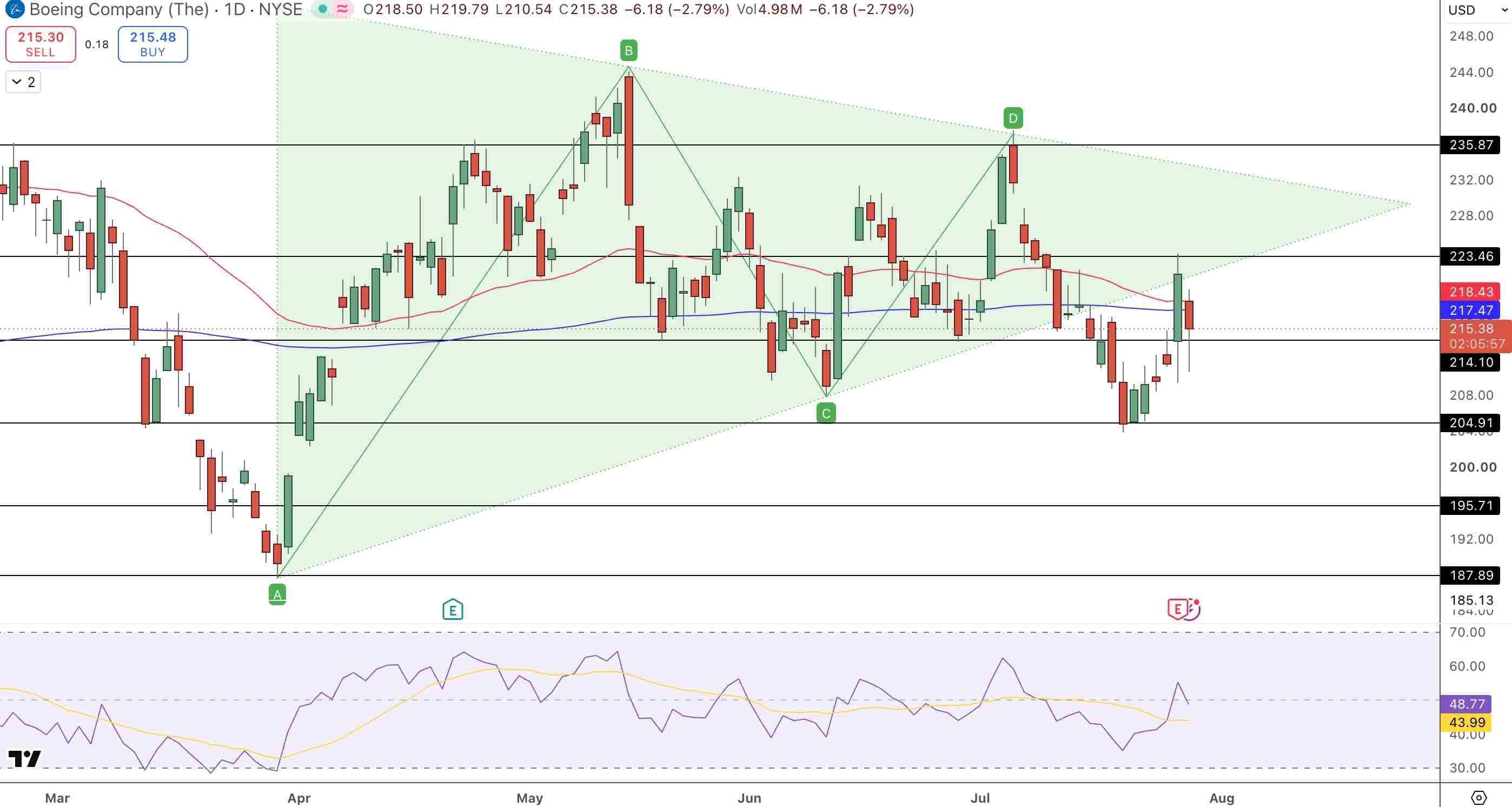
Boeing (BA) Stocks Price Chart - Source: TradingView
Boeing Q2 Financial Data
- Boeing Q2 Revenue: $24.56B
- Boeing Q2 Adj EPS: -$0.76/share
- Boeing Q2 Net Loss: -$0.67/share
- Boeing Q2 Free Cash Flow: $631 million
- Boeing Q2 Aircraft Deliveries: 171 (highest since 2018), targeting 500 deliveries for the full year 2026
- FAA Milestone: Self-certification restored for all 737 MAX and 787 jets on July 20
- Boeing Backlog: $695B Total, Market Cap ~$174B, Debt-to-Assets ratio dropped from 42% to 28%
- Analyst Price Targets: Average target: $270.08, Baird: $300, UBS: $285, 21 Buy ratings vs. 1 Sell
- EMA Resistance Levels: $218.60 (200 EMA), $223.50 (triangle upper). Next targets above: $235.90
- Key Support Levels: $214.10, $204.90, $195.70
Why did Boeing stock drop today after rising 4.76% yesterday?
Boeing stock jumped 4.76% on Tuesday, July 28 after Boeing reported Q2 results showing improved deliveries, smaller losses, and the FAA restoring its self-certification authority. The drop on Wednesday has nothing to do with Boeing’s Q2 earnings, instead, it is due to a broader sell-off that is being driven by weakness in semiconductors and has spread out to growth and industrial stocks alike.
NVIDIA dropped 5.5% and Micron dropped 9.7% Tuesday as well, and the sentiment from chip stocks continued into Wednesday. Boeing went into Wednesday at $221.56, after having already seen the post-earnings price move, and the Wednesday softness is a result of sector rotation rather than any reaction to earnings data.
What is the 777X certification and why does it matter?
The Boeing 777X is a new wide-body aircraft that has seen multiple years of delays related to its certification. The FAA must grant the aircraft its type certification before it can fly commercially. UBS noted that 777X certification is the largest remaining catalyst for the Boeing stock beyond the 737 ramp. Once the 777X receives its certification, it will be open to airline deliveries, which would provide additional revenue streams for Boeing.
The company also expects its 737-7 and 737-10 MAX variants to go into service in 2027. SPEEA engineering union negotiations are another factor that could influence workforce availability and Boeing’s ability to execute on these programs.
Bottom Line
Boeing’s Q2 earnings saw deliveries of 171 aircraft, which is the highest number since 2018, along with free cash flow of $631 million, and the stock rallied 4.76% on Tuesday. The Wednesday pullback is sector-driven and not earnings-related. The FAA restored self-certification authority on July 20, which removes one of the major operational roadblocks to increased deliveries.
Baird sets a $300 price target, UBS sets a $285 price target, and the consensus target is $270.08. With $695 billion in backlog against a $174 billion market cap, the fundamental setup looks promising. The EMA cluster at $218.60 to $223.50 is the first hurdle.
The next support floor is at $204.90. The 777X certification, the 737 production ramp, and Boeing’s 2026 FCF guidance of $1 billion to $3 billion are the primary catalysts that will drive Boeing’s recovery going forward.
Recommended Articles


