


US Market Close: Three Major Indices Extend Losses After Fed Meeting; Nasdaq Composite Index Falls for Sixth Day as PHLX Semiconductor Index Drops Over 5%; Memory Stocks Lead Declines While Software Stocks Find Support; Micron Tumbles Over 10%
TradingKey - Three regional Fed officials supporting rate hikes at the policy meeting, along with U.S. President Trump's comments that the U.S. military would launch a strong counterattack against Iran, depressed market trading sentiment. The three major U.S. stock indexes extended losses after the policy meeting, with memory and chip stocks leading the declines, while software stocks found support against the trend.
At the close, the Dow Jones Industrial Average fell 2.19% to 51,594.14; the Nasdaq Composite Index fell 1.74% to 24,442.94; and the S&P 500 Index fell 1.52% to 7,316.15.
Tech Stock Performance
Micron (MU) fell 9.94% to $739.
Bloomberg Intelligence's assessment suggests that Q2 2026 may be the peak of this memory shortage, but this does not mean prices are about to reverse; rather, it indicates that the steepest phase of undersupply may have passed. Lee Coppersmith, a top trader at Goldman Sachs, stated that after this correction, the logic of viewing "crowding" as the biggest risk for the AI sector is rapidly weakening. Prime Brokerage data showed that last Friday and this Monday, the global information technology sector recorded its largest two-day long liquidation since January 2021, which was also the second-largest concentrated deleveraging in the past decade; global memory chip stocks suffered their most brutal sell-off on record, and tech stock fund flows also fell into one of their weakest historical ranges.
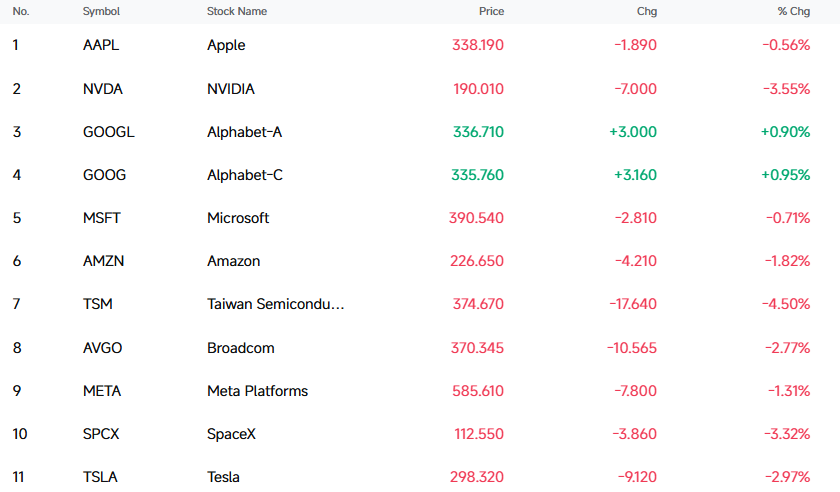
Among mega-cap tech stocks, Google (GOOGL) rose 0.90%; on the downside, Nvidia (NVDA) fell 3.55%, SpaceX (SPCX) fell 3.32%, Tesla (TSLA) fell 2.97%, Broadcom (AVGO) fell 2.77%, Amazon (AMZN) fell 1.82%, Meta Platforms (META) fell 1.31%, Microsoft (MSFT) fell 0.71%, and Apple (AAPL) fell 0.56%.
[Source: FutuBull]
The Philadelphia Semiconductor Index fell 5.33% to $10,447.49. All 30 constituent stocks declined.
Memory stocks suffered heavy losses, with Micron Technology (MU) down 9.94%, SanDisk (SNDK) down 7.32%, SK Hynix (SKHY) down 2.60%, and Western Digital (WDC) down 0.32%.
Chip stocks extended their losses, with Arm Holdings (ARM) falling 8.11%, Nvidia (NVDA) falling 5.55%, AMD (AMD) falling 5.51%, Intel (INTC) falling 5.12%, and Qualcomm (QCOM) falling 4.42%.
Company News
Bloom Energy Q2 Revenue Up 165% YoY
Bloom Energy's second-quarter revenue reached $1.065 billion, up 165% year-over-year, far exceeding market expectations of $826 million, marking the first time the company's single-quarter revenue surpassed the $1 billion mark. Second-quarter earnings per share rose to $0.78, surging 680% from the same period last year. Bloom Energy raised its full-year 2026 revenue guidance to between $3.9 billion and $4.2 billion, and its full-year EPS guidance to between $2.55 and $2.85.
SpaceX's xAI Sues Minnesota Over "Nudify Apps" Ban
SpaceX's xAI has formally sued the Minnesota Attorney General, challenging the state's upcoming ban on "nudify apps." Following a lawsuit in California, this marks another legal challenge by the company against local AI content regulations. xAI argues that the regulation has obvious legal flaws. First, the scope of the bill's restrictions on content is overly broad, directly targeting visual expression tools themselves, which violates the First Amendment's protection of free speech. Second, the severity of the penalties is unrealistic; under a per-violation fine model, companies could face tens of billions of dollars in astronomical fines in the event of large-scale user-generated content, dealing an excessively heavy blow to the development of the AI industry. xAI also emphasized that it has established technical blocking mechanisms to prohibit non-compliant content and has filed lawsuits against users who bypassed the rules, rather than turning a blind eye to violations.
Qualcomm Completes Acquisition of AI Software Infrastructure Startup Modular
Qualcomm announced that it has completed the acquisition of Modular, an AI software infrastructure startup. The transaction aims to strengthen Qualcomm's AI software foundation to meet the demand for generative and agentic AI from the cloud to edge computing. The core of the deal is acquiring Modular's AI-native software platform. This platform enables AI models to run efficiently on various hardware architectures without the need to rewrite code for different processors, thereby providing developers with the flexibility of "build once, deploy anywhere" and a lower total cost of ownership. Cristiano Amon, President and CEO of Qualcomm, stated that the acquisition is a key step in the company's strategic transition toward a "developer-first, horizontal platform," aimed at providing customers with true choice in how and where they deploy AI.
GlobalFoundries Secures $300 Million in US Government Support
The United States announced a letter of intent for an $874 million semiconductor R&D investment to further strengthen domestic chip technology research and development capabilities. Meanwhile, the U.S. announced that pure-play foundry GlobalFoundries will receive up to $300 million in government funding to accelerate the development of next-generation silicon photonics technology.
It is understood that this grant originates from the R&D incentive portion of the U.S. CHIPS and Science Act, representing the latest move by the Trump administration to direct chip R&D funding toward key frontier technologies. Prior to this, the U.S. government had successively committed $150 million to semiconductor manufacturing equipment and $2 billion to quantum computing. Notably, as part of the funding agreement, the U.S. Department of Commerce will acquire an approximate 1% equity stake in GlobalFoundries.
Industry & Macro News
Trump: Will Order Heavy Strikes Against Iran
U.S. President Donald Trump said that Iran "will be hit hard" after Iran's Islamic Revolutionary Guard Corps fired ballistic missiles at U.S. forces. U.S. Central Command posted on X that the attack originated from Iran, but all missiles were intercepted. "Islamic Revolutionary Guard Corps forces fired multiple ballistic missiles from Iran in an attempt to launch a surprise attack on U.S. forces stationed in the Middle East."
Fed Keeps Rates Unchanged in July, with Three Members Voting for a Hike
The Federal Reserve kept its benchmark interest rate unchanged at 3.50%-3.75%, holding steady for the fifth consecutive meeting. The vote was 9-3, with three members voting in favor of a rate hike. Dissenting from this monetary policy action were Beth M. Hammack, Neel Kashkari, and Lorie K. Logan, who preferred to raise the target range for the federal funds rate by 25 basis points at this meeting.
Fed Chair Warsh: June Core CPI Data Had Little Impact on Decision
Fed Chair Warsh said at the press conference: "Today's three dissenting votes do not fully reflect the substance of the discussion, and the decision we made is supported by the vast majority. The June core CPI data had little impact on the decision, and we will communicate with the inflation working group in a few weeks. We have obtained some encouraging inflation data, which we will monitor closely in the coming period; what matters is the inflation trend. In the coming period, we will face important decisions."
JPMorgan: Model Price War Could Reshape Industry Landscape
Michael Cembalest, Chairman of Market and Investment Strategy for JPMorgan Asset Management, said that AI continues to drive capital expenditures, technology corporate profits, and semiconductor stocks higher, but a clear divergence has emerged within the industry chain: companies responsible for selling chips and equipment continue to thrive, while hyperscalers, who shoulder massive investments and are responsible for converting AI into revenue, are beginning to see pressure on their stock prices and free cash flows. Meanwhile, a new generation of low-cost models from China and the U.S. is rapidly closing the performance gap with OpenAI and Anthropic. As model prices continue to fall and enterprises' self-training capabilities strengthen, foundation models and tokens may gradually become commoditized, which could reshape the profit distribution landscape of the AI industry.
Recommended Articles


