


Tesla Stock Price Forecast: Shares Fall Below $300 Mark as Banks Cut Targets; Can the Stock Rebound?
Tradingkey - On July 29, Eastern Time, Tesla ( TSLA) fell below the $300 threshold, hitting a new low in nearly a year. Reportedly, Tesla executives, when outlining key takeaways from the earnings call, stated that the Optimus humanoid robot's Fremont production line will begin production by the end of 2026, with a long-term planned annual capacity of 1 million units, while the second production line in Texas has a long-term goal of 10 million units in total annual capacity.
However, Ross Gerber, CEO of investment firm Gerber Kawasaki, warned that it could take a long time for Elon Musk to achieve commercial success with Tesla's Optimus robot, as it is not only difficult to manufacture but also unlikely to generate revenue in the short term.
Gerber stated that the biggest obstacle in manufacturing humanoid robots is replicating humans' unique physical capabilities. He added that, historically, robots using wheels, tracks, and other systems have been easier to manufacture than robots designed to walk like humans.
Gerber said, "Spending a trillion dollars to develop a robot that folds clothes makes absolutely no sense to me." He pointed out that humanoid robots make more sense in military, aerospace, and industrial applications, but Tesla is "spending enormous amounts of money without generating short-term revenue." Meanwhile, Tesla's second-quarter earnings report showed that due to massive capital expenditures, the company's free cash flow turned negative for the first time in more than two years.
A JPMorgan research report stated that the Optimus supply chain ramp-up is progressing smoothly, with mass production drawing closer. However, management cautioned that due to highly innovative components and the lack of an existing supply chain, the initial stage of the S-curve ramp-up will be slow and flat.
The firm further noted that Tesla's capital expenditures remain high, and management reiterated its 2026 capital expenditure target of over $25 billion. Regarding a potential merger with SpaceX, Musk made no explicit statement but clearly pointed out the strategic overlap between the two companies.
Overall, the bank believes that Tesla's stock price may remain volatile in the short term, as market estimates for the future are still undergoing downward revisions, and investment is still ramping up. Consequently, the bank lowered its price target from $475 to $450.
In addition, Tesla had its price targets lowered by several investment banks following its quarterly earnings report. Daiwa Capital Markets lowered its price target from $395 to $345; Deutsche Bank lowered its price target from $465 to $420; RBC Capital lowered its price target from $500 to $480.
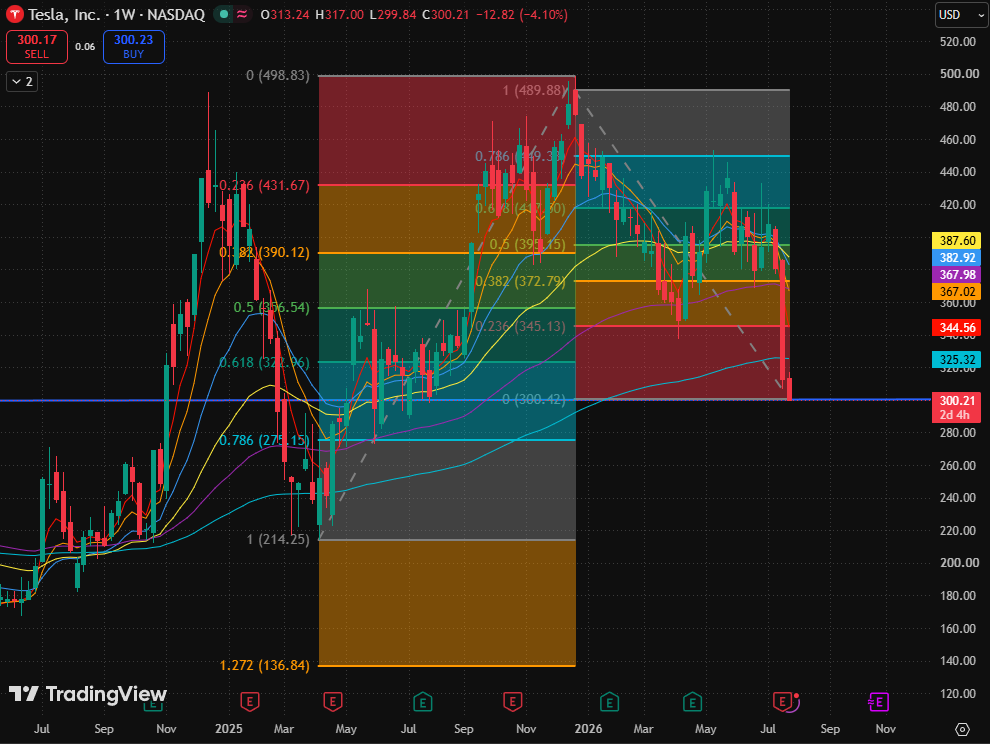
Tesla Weekly Chart, Source: TradingView
According to Tesla's stock price chart, the stock touched a local high near $498.83 in December 2025 and has since dropped to the current $300, representing a cumulative retracement of nearly 40%, far exceeding the 30% bear market threshold.
The current price has already broken below several key Fibonacci support levels—the 0.618 level ($329.39) and the 0.5 level ($359.75). It is currently in a "deep retracement zone" above the 0.786 level ($275.15). This weekly-level retracement magnitude has already established a technical bear market pattern.
Currently, all moving averages are above the price, presenting a typical bearish alignment. If the psychological round-number level ($300) is decisively broken, the downside room will open up to the 0.786 Fibonacci level ($275.15), with a potential decline of 8.3%.
If the stock price can stabilize above $300, a rebound rally is expected to begin. The first target price for the rebound is to reclaim the 0.618 Fibonacci level ($329.39), which is key to determining whether this is a "bearish trend reversal" or a "downward continuation."
Recommended Articles


