


Oracle Stock Just Hit a 52-Week Low: 20 Billion Reasons NOT to Buy the Dip
Key Points
The data management giant currently boasts a record backlog of $638 billion.
However, Oracle's capex spending is taking a toll on free cash flow.
Oracle is issuing a lot of debt and may dilute shareholders through an equity offering.
- 10 stocks we like better than Oracle ›
Oracle (NYSE: ORCL) stock has navigated a volatile path throughout 2026. Shares began the year around $196, eventually climbing to a high of $248 amid optimism around artificial intelligence (AI) cloud contracts.
However, over the last couple of months, Oracle stock has cratered -- plummeting more than 50% and collapsing to a 52-week low. This recent trough may invite speculation that the dip is buyable, but the combination of extraordinary spending needs and uncertainties around external financing environments suggests otherwise.
Where to invest $1,000 right now? Our analyst team just revealed what they believe are the 10 best stocks to buy right now, when you join Stock Advisor. See the stocks »
Image source: The Motley Fool.
Oracle is generating record growth, but...
Oracle's fiscal fourth-quarter 2026 results showcased remarkable expansion in its AI business. Total revenue during the quarter reached $19.2 billion, up 21% year over year. Sales from cloud infrastructure surged to $5.8 billion, a 93% increase year over year. For the full fiscal year, revenue climbed 17% to $67.4 billion while total cloud (infrastructure services and application software) advanced 39% to $34.0 billion.
Remaining performance obligations were the real standout, soaring to $638 billion -- up 363% year over year. These deals continue to be fueled by massive multi-year AI training and inference deals with AI developers.
While these figures are staggering by any measure, Oracle has continued to fall. The reason is simple: Investors are less focused on the company's backlog and more concerned about the capital intensity required to deliver it.
...the costs of infrastructure are mounting, and...
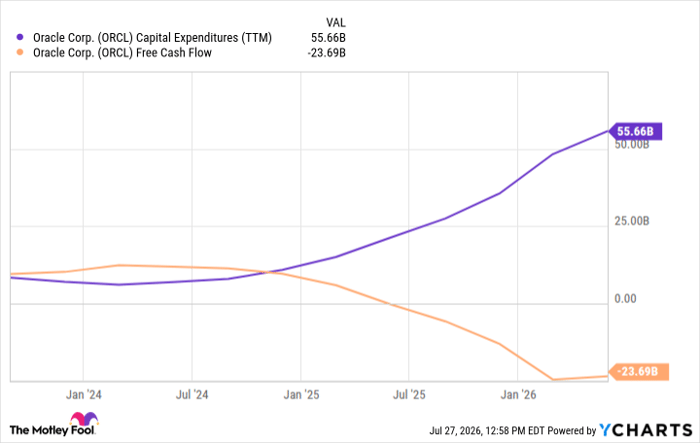
Oracle's capital expenditures (capex) tell the real story behind the company's AI-driven growth. Fiscal 2026 capex ballooned to $55.7 billion, more than doubling the prior year's $21.2 billion outlay. The surge is driven almost exclusively by the accelerating build-outs of AI data centers and the acquisition of high-performance computing clusters needed to support the cloud backlog.
ORCL Capital Expenditures (TTM) data by YCharts
These investments produced a severe cash-flow deficit. Free cash flow for fiscal 2026 turned negative at $23.7 billion, even as operating cash flow itself rose 54% to $32.0 billion. The disparity between robust operating cash and negative free cash flow leaves Oracle heavily dependent on external capital markets to keep its infrastructure program on track.
...Fed Chair Kevin Warsh may throw cold water on the AI revolution
In principle, Oracle must spend aggressively to convert its backlog into realized revenue. The scale and method of funding, however, introduce meaningful risk for shareholders.
During fiscal 2026, Oracle issued $43 billion of debt. Looking ahead, management has signaled plans to raise roughly $40 billion more in fiscal 2027, including a $20 billion at-the-market (ATM) equity program authorized back in February. This ATM facility creates a mechanism for dilution whenever the share price recovers.
Another layer of uncertainty comes from interest rate dynamics. While some economists still anticipate possible rate cuts later this year, new Federal Reserve Chair Kevin Warsh may have other plans. Rate hikes are very much on the table, and any sustained period of rising interest rates would increase the cost of Oracle's already substantial debt load.
This could potentially force a slowdown in the company's data center expansion. In turn, a deceleration in capital spending would delay the conversion of Oracle's infrastructure backlog into growth, undermining the very narrative supporting the bull thesis.
For this reason, Oracle's plummeting share price reflects more than temporary pessimism -- it prices in the elevated risk that the path to converting record backlog into sustainable profitability remains expensive, dilutive, and contingent on favorable financing conditions.
Should you buy stock in Oracle right now?
Before you buy stock in Oracle, consider this:
The Motley Fool Stock Advisor analyst team just identified what they believe are the 10 best stocks for investors to buy now… and Oracle wasn’t one of them. The 10 stocks that made the cut could produce monster returns in the coming years.
Consider when Netflix made this list on December 17, 2004... if you invested $1,000 at the time of our recommendation, you’d have $390,394!* Or when Nvidia made this list on April 15, 2005... if you invested $1,000 at the time of our recommendation, you’d have $1,209,184!*
Now, it’s worth noting Stock Advisor’s total average return is 899% — a market-crushing outperformance compared to 206% for the S&P 500. Don't miss the latest top 10 list, available with Stock Advisor, and join an investing community built by individual investors for individual investors.
See the 10 stocks »
*Stock Advisor returns as of July 29, 2026.
Adam Spatacco has no position in any of the stocks mentioned. The Motley Fool has positions in and recommends Oracle. The Motley Fool has a disclosure policy.
Recommended Articles


