


SK Hynix Drops Over 9% as Q2 Profit Misses Estimates Despite Sixfold Jump; Rebuts AI Slowdown Fears
TradingKey - During the Asian session on July 29, SK Hynix ( SKHY) reported record second-quarter earnings, but the stock still experienced volatility as the results missed market expectations. However, addressing widespread market skepticism over the sustainability of AI infrastructure investment, the memory giant offered a firm rebuttal during its earnings call.
According to the financial report, driven by strong demand for AI server memory, SK Hynix's second-quarter revenue surged 257% year-on-year to 79.32 trillion won (equivalent to $54.3 billion), and operating profit skyrocketed 557% year-on-year to 60.54 trillion won (equivalent to $42 billion), with both hitting historic quarterly highs. However, the operating profit fell slightly short of analysts' expectations of 64.22 trillion won (approximately $44 billion).
Following the earnings release, SK Hynix's ADR plummeted over 8% in US after-hours trading, but subsequently clawed back losses and turned positive, before diving again during night trading to fall over 6%. After the Korean market opened, the stock price rose slightly before turning downward. As of press time, SK Hynix's Korean shares had fallen over 9% to 1.407 million won (equivalent to $966).
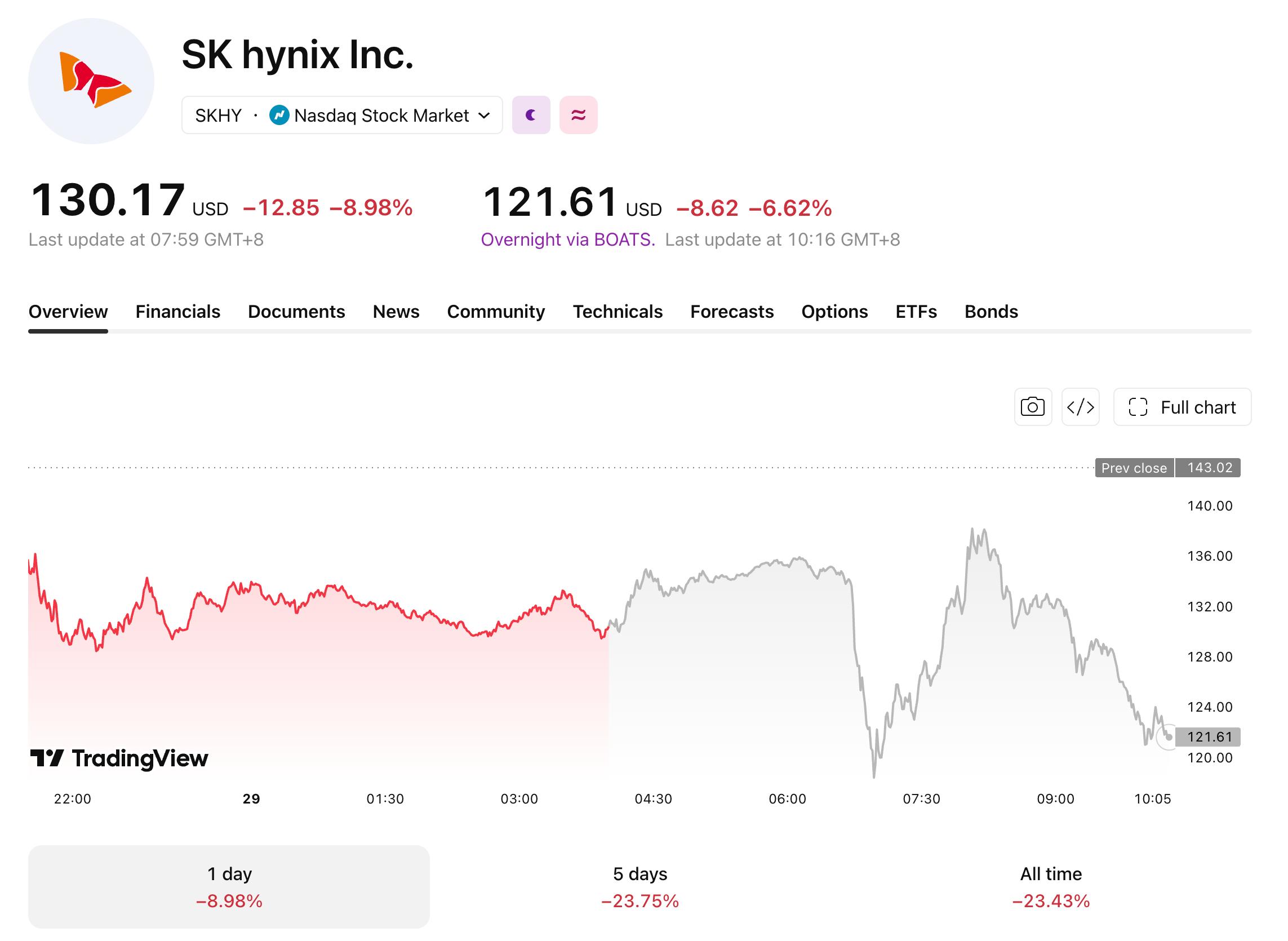
[SK Hynix ADR Price Performance, Source: TradingView]
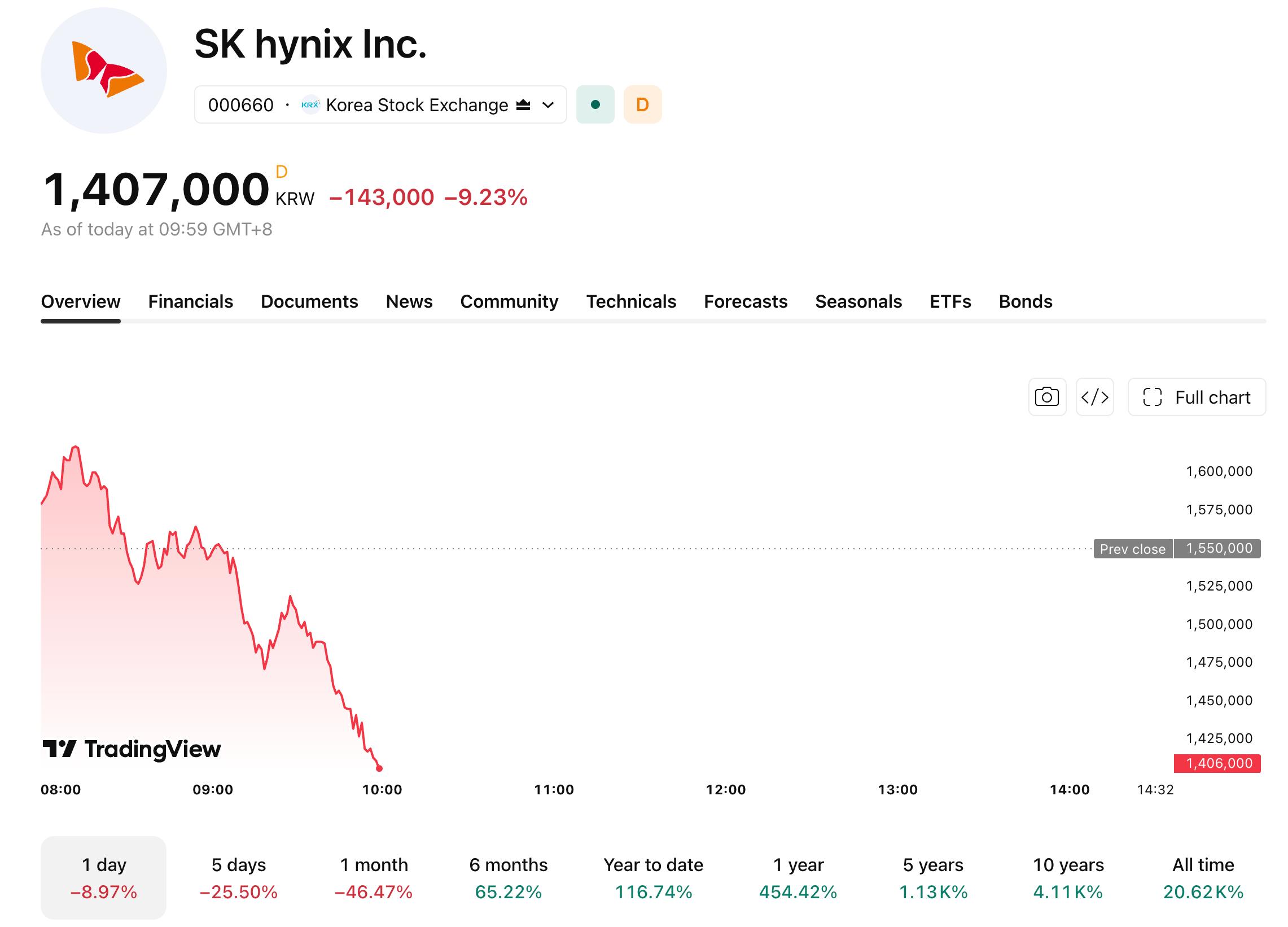 [SK Hynix Korean Shares, Source: TradingView]
SK Hynix's Q2 results missed expectations, which analysts attribute to two factors. First, the company's business is highly concentrated in HBM, while the largest price increases in this cycle actually occurred in conventional commodity memory (DRAM/NAND), with HBM seeing relatively modest gains. Second, the price growth of commodity memory is also slowing, with DRAM and NAND increases in the second quarter at around 30% and 50%-60% respectively, a clear drop from the first quarter (60%/70%), further squeezing profit margins.
Recent market concerns over a potential slowdown in AI investment stem primarily from two signals: some tech giants are reassessing the scale of their data center leases, and the emergence of highly efficient AI models has sparked speculation about whether demand for computing power has peaked.
SK Hynix explicitly countered this view during its earnings call. The company believes that efficient models will actually lower the barrier to entry for AI applications, driving overall usage expansion and thereby fueling greater memory demand. According to the company, long-term communication with major customers has confirmed that AI infrastructure investment will remain robust beyond 2027.
On the business front, SK Hynix has signed long-term agreements (LTAs) with around 10 major customers, further locking in the predictability of its medium- to long-term performance. In addition, mass production and shipment of HBM4 was initiated in the second quarter, and the company plans to significantly expand production in the second half of the year; samples of HBM4E have also been delivered to major customers.
Recommended Articles


