


SK Hynix Q2 Earnings Preview: Profit May Hit Record High as AI Memory Supercycle Faces Key Validation
TradingKey - The new memory upcycle driven by artificial intelligence continues, and as the leading manufacturer of high-bandwidth memory (HBM), SK Hynix ( SKHY) is ushering in one of the most profitable quarters in its history.
SK Hynix is scheduled to announce its second-quarter 2026 financial results on July 29. According to a consensus of 14 brokerages compiled by South Korean financial information provider Yonhap Infomax, the company's second-quarter revenue is expected to be approximately 84.1 trillion won (about $57.6 billion), and operating profit is projected to reach 64.1 trillion won, with both figures set to hit record highs.
If the final results meet market expectations, the operating profit generated in the second quarter alone will surpass the company's full-year 2025 level of 47.2 trillion won.
However, after a previous rapid rally, SK Hynix's stock price has recently undergone a significant correction, falling over 30% in the past month, with the market closely watching whether this earnings report can restore market confidence.
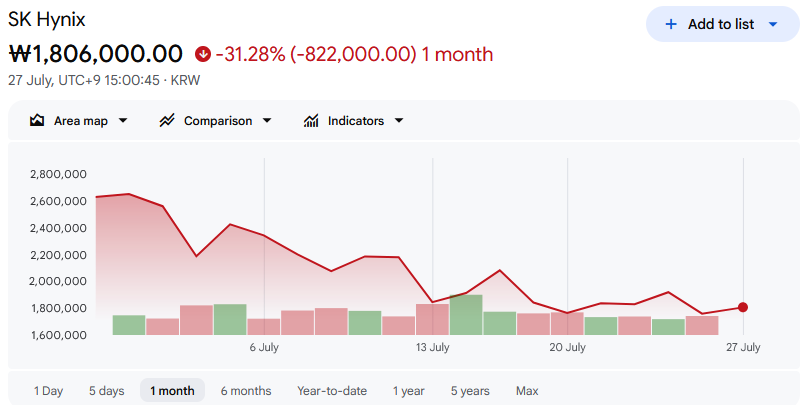
Source: Google Finance
HBM Remains Growth Core As AI Customer Contribution Continues to Rise
The market consensus suggests that the core driver of this round of earnings growth remains investment in AI infrastructure.
Continuous improvement in traditional DRAM prices, along with robust demand for high-bandwidth memory (HBM) and enterprise SSDs, are becoming the main drivers of profit growth. As global cloud computing providers continue to expand AI data centers and increase their procurement of high-performance memory products, SK Hynix's product mix is also steadily shifting toward higher-margin AI memory.
South Korean brokerage KB Securities expects that in the second quarter of this year, revenue from global tech giants and AI data center operators is projected to account for approximately 70% of SK Hynix's total sales, representing a significant increase from previous years.
Analysts believe that as more HBM capacity comes online, the new supply of traditional DRAM will be somewhat constrained. Meanwhile, the rising share of long-term agreements (LTAs) is also providing greater predictability for the company's future revenue.
Compared to its past reliance on the volatility of the consumer electronics market, SK Hynix now increasingly relies on large enterprise clients and AI infrastructure orders, bringing about a structural improvement in its earnings stability.
Industry expectations suggest that by around 2027, the revenue share of the company's B2B business is projected to rise to approximately 70%, far higher than the levels seen during the previous memory cycle. This implies that the growth logic of this AI-driven cycle differs significantly from past traditional memory cycles.
Profitability Continues to Improve as Cash Flow Advantage Further Expands
According to market consensus, the company's second-quarter operating margin is expected to reach 75% to 77%, higher than first-quarter levels, and will continue to lead most semiconductor manufacturers globally. If the forecast materializes, it means that for every 100 Korean won of products sold, approximately 75 Korean won will be converted into operating profit, which is extremely rare in the manufacturing industry.
Meanwhile, the company's financial position continues to improve. Since returning to a net cash position last year, SK Hynix's cash reserves have been steadily increasing.
At the end of the first quarter of this year, the company's net cash balance reached approximately 35 trillion Korean won. The market expects it to continue expanding in the second quarter, providing more ample funding support for subsequent capital expenditures, HBM capacity expansion, and R&D of next-generation products.
As profits continue to grow, employee performance bonuses are also expected to remain high. According to South Korean media reports, SK Hynix plans to distribute productivity incentive (PI) bonuses for the first half of the year by the end of July, which are expected to reach the maximum payout standard stipulated by its system.
ADR Premium Exceeds 50% Triggering Market Concerns as Long-Term Contract Model Faces Risks
Although earnings forecasts continue to hit record highs, market sentiment is not universally optimistic. Recently, SK Hynix's stock price has pulled back significantly from its peak, with its American Depositary Receipts (ADRs) at one point trading at a premium of up to 51% over its Korean common shares, prompting Wall Street to warn that the AI trade may be overheating.
Generally speaking, if a significant price gap opens up between a company's shares listed in different markets, arbitrage capital typically drives the prices back toward convergence. However, the prolonged high premium on SK Hynix ADRs reflects the willingness of U.S. investors to pay a valuation premium for the AI memory leader.
However, against the backdrop of continuously rising market expectations, high valuations could also amplify stock price volatility if financial results or management guidance fail to meet investor expectations.
In addition, there are market concerns regarding the sustainability of long-term supply agreements (LTAs) in the memory industry. In its latest annual economic report, the Bank for International Settlements (BIS) warned that temporary shortages in the AI supply chain are magnifying the risk of overinvestment, and companies securing future capacity through long-term contracts may face greater risk exposure if demand reverses.
Similar views have also become a key reason for some investors' recent concerns over valuations across the AI industry chain. Previously, the U.S. memory and semiconductor sectors underwent a noticeable correction as the market began to reassess the sustainability of AI infrastructure investment and whether the pace of data center construction will slow down in the coming years.
However, optimistic institutions still believe that there has been no significant change in the current supply-demand dynamics.
Morgan Stanley analyst Joseph Moore recently noted that, after speaking with procurement heads at several data centers, HBM and high-end memory products remain in short supply, with memory prices expected to rise by at least another 25% in the third quarter. He believes the recent correction in memory stock prices reflects market sentiment rather than deteriorating fundamentals, and the tight supply in the industry could potentially last until 2028.
Therefore, beyond validating record earnings for the second quarter, the earnings report to be released by SK Hynix this week is more important for management's latest assessment of HBM demand, long-term orders, capital expenditures, and the industry outlook for the second half of the year. This information will not only affect SK Hynix's subsequent stock performance but is also expected to serve as a key bellwether for whether the global AI memory supercycle is still ongoing.
Recommended Articles


