


American Express Cardholders Spent $455.8 Billion Last Quarter. Here's What That Means for the Stock.
Key Points
American Express stock took a hit after it missed consensus estimates on revenue.
However, spending data continues to look strong.
The company also raised full-year revenue guidance.
- 10 stocks we like better than American Express ›
Spending by American Express (NYSE:AXP) cardholders continues to rage, as the company just posted its largest quarter of billed business over the past year.
Billed business volume was $455.8 billion in the second quarter, up 10% year over year and roughly 6.5% from the prior quarter.
Where to invest $1,000 right now? Our analyst team just revealed what they believe are the 10 best stocks to buy right now, when you join Stock Advisor. See the stocks »
Despite strong spending data, American Express stock traded roughly 5% lower, as of 12:42 p.m. ET, after posting second-quarter results.
Amex reported $4.53 earnings per share, ahead of Wall Street consensus estimates. Revenue of $19.64 billion missed consensus by about $50 million.
The company also reiterated its full-year EPS guide of $17.30 to $17.90 and then raised its full-year revenue guide from up 9% to 10% to just 10% year over year.
Here’s what this all means for the stock.

Image source: Getty Images.
Investors likely had high expectations
Of all the credit card players, Amex is viewed as best-in-breed.
Not only does the company operate a closed-loop payment system that generates strong annual recurring fee income, but the company also has the highest-quality cardholders from a credit perspective.
Amex’s card base caters to a higher-net-worth population that tends to be more resilient through the economic cycle. The sell-off can likely be attributed to high expectations entering the quarter.
“Overall, the quarter was marked by a top-line shortfall,” Evercore ISI analyst John Pancari wrote in a research note earlier on July 24.
Expenses in the quarter also jumped 12% year over year and 4.4% from the prior quarter, which could also be pressuring shares.
Management attributed the step-up in expenses to investments made to refresh its U.S. platinum card offerings, in which the company continues to win new customers.
Amex added 3 million new card members in the second quarter, about in line with what it has done over the past five quarters.
“Retention rates remain very high and we continue to attract a large number of high credit worthy customers with 65% of new consumer accounts coming from Millennials and Gen Zs,” Amex’s CEO Stephen Squeri said on the company’s earnings call.
Meanwhile, the company earlier this year raised the subscription fee on its platinum card from $695 per year to $895.
Is the stock a buy?
American Express has retreated from all-time highs made at the end of 2025 and is now down about 13.3% this year.
There is certainly some cyclicality in the stock, as it depends on consumer spending and strong consumer credit quality, which could struggle if there is an eventual recession.
But right now, the data doesn’t support that, as spending data continues to come in strong.
Furthermore, despite the top-line miss in the second quarter, the company maintained EPS guidance and increased full-year revenue guidance.
On a price-to-tangible-book basis, the stock currently trades at a high valuation, but still not too far above its five-year average. Amex also now trades below its two-year average forward-earnings multiple.
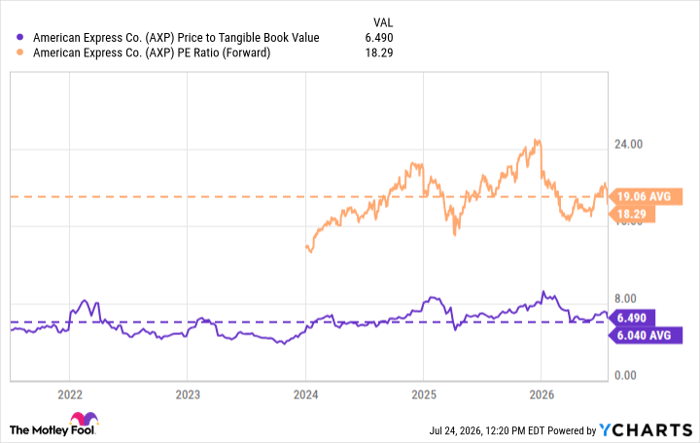
AXP Price to Tangible Book Value data by YCharts
I think long-term investors can continue to buy the stock and enjoy solid returns. Not only is the Amex brand incredibly powerful, but the stock also has some ability to hedge inflation.
While it’s not immune to a slowdown in the economy, Amex can charge higher interest rates on credit cards when rates rise, and its payment network collects fees based on a percentage of each transaction, so fees will increase when transactions get more expensive.
Should you buy stock in American Express right now?
Before you buy stock in American Express, consider this:
The Motley Fool Stock Advisor analyst team just identified what they believe are the 10 best stocks for investors to buy now… and American Express wasn’t one of them. The 10 stocks that made the cut could produce monster returns in the coming years.
Consider when Netflix made this list on December 17, 2004... if you invested $1,000 at the time of our recommendation, you’d have $371,519!* Or when Nvidia made this list on April 15, 2005... if you invested $1,000 at the time of our recommendation, you’d have $1,281,302!*
Now, it’s worth noting Stock Advisor’s total average return is 892% — a market-crushing outperformance compared to 206% for the S&P 500. Don't miss the latest top 10 list, available with Stock Advisor, and join an investing community built by individual investors for individual investors.
See the 10 stocks »
*Stock Advisor returns as of July 24, 2026.
American Express is an advertising partner of Motley Fool Money. Bram Berkowitz has no position in any of the stocks mentioned. The Motley Fool has positions in and recommends American Express. The Motley Fool has a disclosure policy.
Recommended Articles


