


Tesla's Per-Car Profit Fell Another 8% Last Quarter, and I Fear This May Be the New Norm
Key Points
Tesla's second-quarter earnings miss isn't a concern, given all of its developmental spending.
Its shrinking per-car profit, however, points to a waning degree of pricing power within the EV marketplace.
Being an established electric vehicle maker as well as a future AI technology outfit makes it difficult to evaluate and then appropriately price this company's stock.
- These 10 stocks could mint the next wave of millionaires ›
Earlier this month, drastically improved second-quarter delivery numbers rekindled hope that electric vehicle (EV) maker Tesla (NASDAQ: TSLA) was back on track. The company's fiscal second-quarter results, reported after Wednesday's close, however, tainted those strong delivery figures. Here's a closer look.
Profitability pressure
Yes, despite beating analysts' top-line expectations, Tesla's Q2 earnings fell short of estimates. The company turned $28.2 billion in revenue into a per-share profit of $0.33, versus analysts' consensus forecasts of $26.3 billion and $0.50, respectively.
Where to invest $1,000 right now? Our analyst team just revealed what they believe are the 10 best stocks to buy right now, when you join Stock Advisor. See the stocks »
Granted, the company is establishing or growing several different businesses with unpredictable developmental costs. These include solar panels and energy storage batteries, of course, but also robotaxis and, soon, humanoid robotics. That's why the earnings miss doesn't necessarily mean a great deal.

Image source: Getty Images.
The fact that its breadwinning electric vehicle business is showing signs of marketability strain, though, is a concern. Tesla might not be able to support the ongoing development of these other ventures from its EV operation as well as previously expected.
The graphic below tells the tale. Last quarter's total EV deliveries bounced back to 480,126 units. But these cars generated an average of $2,613 less revenue than they did just a quarter earlier. The production cost for each of the vehicles manufactured in Q2, meanwhile, grew by more than $6,000 apiece, and even ticked a bit higher based on last quarter's surging deliveries.
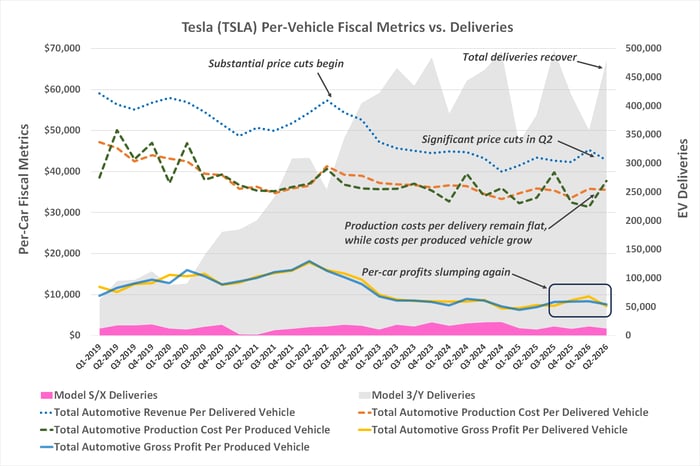
Data source: Tesla quarterly reports. Chart by author.
Connect the dots. Tesla is spending more to make less money on every car it manufactures or delivers.
Blame competition, mostly
OK, it's not quite as alarming as last quarter's per-car metrics imply. The company was still bringing some of its capacity back online during this time, particularly in Europe, which can incur costs that don't result in immediate revenue. I'll want to see at least another quarter's worth of data before jumping to conclusions.
There's no denying, however, that Tesla has a pricing-power problem that can't simply be chalked up to selling fewer of its more expensive Model S and Model X EVs. Last quarter's price cuts coincide with the expanded availability of other electric vehicles... especially those made by China's BYD (OTC: BYDDY), which delivered 557,090 battery-electric vehicles of its own in Q2, with many of them suddenly being shipped to Europe, where Tesla previously dominated. It would be naïve to believe the availability of these alternatives isn't taking a toll on the relative marketability -- and therefore pricing power -- of Tesla-made electric vehicles.
It's not like these rivals are suddenly going to back down either, now that they're finally finding their full stride. Look for the pricing pressure Tesla is now facing to persist.
Just tread lightly
This doesn't necessarily mean Tesla's shares are un-ownable. As has been frequently pointed out, this stock is now being priced as much on its AI robotics potential as it is its electric vehicle business. This, of course, creates and maintains a premium.
It also invites volatility, though, in addition to setting the stage for poor performance if the company's robotics ambitions don't pay off as well or as soon as hoped.
In other words, there's more than a little that could go wrong for this stock. Tread lightly.
Don’t miss this second chance at a potentially lucrative opportunity
Ever feel like you missed the boat in buying the most successful stocks? Then you’ll want to hear this.
On rare occasions, our expert team of analysts issues a “Double Down” stock recommendation for companies that they think are about to pop. If you’re worried you’ve already missed your chance to invest, now is the best time to buy before it’s too late. And the numbers speak for themselves:
- Nvidia: if you invested $1,000 when we doubled down in 2009, you’d have $542,126!*
- Apple: if you invested $1,000 when we doubled down in 2008, you’d have $61,306!*
- Netflix: if you invested $1,000 when we doubled down in 2004, you’d have $371,519!*
Right now, we’re issuing “Double Down” alerts for three incredible companies, available when you join Stock Advisor, and there may not be another chance like this anytime soon.
See the 3 stocks »
*Stock Advisor returns as of July 24, 2026.
James Brumley has no position in any of the stocks mentioned. The Motley Fool has positions in and recommends Tesla. The Motley Fool recommends BYD Company. The Motley Fool has a disclosure policy.
Recommended Articles


