


How Much Could a $5,000 Investment in SpaceX Be Worth By 2030? Here's Why This Industrial Stock May Be a Better Buy Today.
Key Points
SpaceX could still produce strong returns by 2030, but at a $1.5 trillion valuation, much of that optimism is already reflected in the price.
Northrop Grumman offers exposure to many of the same long-term space and defense trends but with profits, dividends, and a far lower valuation.
The decision comes down to risk versus price.
- 10 stocks we like better than Space Exploration Technologies ›
Now that Elon Musk's rocket company trades publicly, it is fair to ask what a modest stake might become. So how much could $5,000 in Space Exploration Technologies (NASDAQ: SPCX) be worth by 2030? It depends almost entirely on a valuation that is already sky-high.
And that concern is exactly why I think a much cheaper, profitable space company, Northrop Grumman (NYSE: NOC), may be the smarter buy right now.
Where to invest $1,000 right now? Our analyst team just revealed what they believe are the 10 best stocks to buy right now, when you join Stock Advisor. See the stocks »
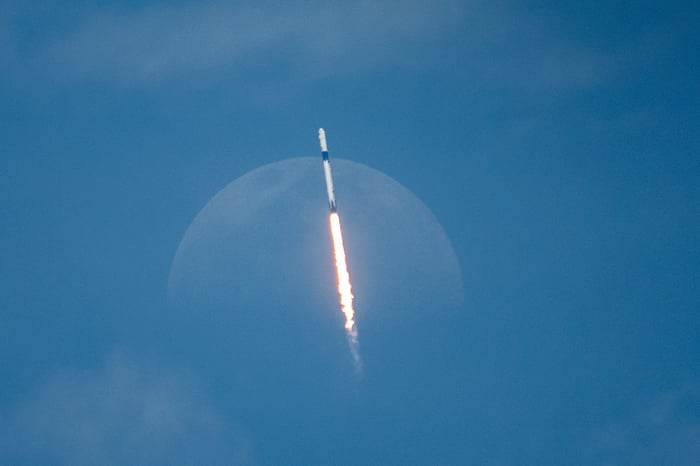
Image source: Getty Images.
The SpaceX math, and the catch
Start with the numbers. SpaceX (as Musk's company is also known) carries a market value of about $1.5 trillion, which works out to roughly 80 times annual sales, a hefty multiple even for a fast grower.
For $5,000 to become meaningful money by 2030, the stock would essentially need to double, lifting SpaceX toward $3 trillion. That is possible if Starlink, its satellite internet provider, keeps growing and Starship finally hits its stride, in which case your $5,000 could easily grow to roughly $10,000.
But here is the catch: At 80 times sales, SpaceX revenue has to increase enormously simply to justify today's price, let alone double it. If that premium multiple compresses even modestly, as rich valuations often do, the stock could tread water or fall even while the business grows. And that is precisely what has happened lately, with the shares slipping below their offering price. You are betting on a flawless five years and a market willing to keep paying a steep premium the whole way.
Why Northrop Grumman may be the better buy today
Now, consider the alternative: Northrop Grumman is not a hype stock; it is one of the largest space companies. It builds satellites, launch vehicles, rocket motors, and missile-defense systems, and it has missile-tracking and defense satellites on order, plus a central role in the B-21 Stealth Bomber. Its order backlog recently hit a record of almost $105 billion, giving it years of work, and generating billions of dollars in real free cash flow every year.
The valuation is where it gets compelling. Northrop trades at roughly 16 times earnings, a fraction of SpaceX's multiple, and it pays a growing dividend on top of that. With global defense budgets climbing to records and initiatives like the Golden Dome missile shield ramping up, it is riding many of the same space and security tailwinds as SpaceX.
But you are buying proven profits at a sensible price rather than paying up for a promise. That combination gives your $5,000 a genuine margin of safety, something SpaceX simply cannot offer at recent prices
The trade-offs worth naming
I will be fair to SpaceX because it has the higher ceiling. Starlink's consumer reach, direct-to-cell ambitions, and the sheer scale of Starship are things Northrop will never match, and if those bets pay off, SpaceX could deliver returns a defense contractor cannot.
Northrop, for its part, grows more slowly, in the mid-single-digit percentages, and has a history of occasional costly charges on complex programs. This is a choice between a high-ceiling, high-price bet and a lower-ceiling, lower-price one.
Could $5,000 in SpaceX roughly double by 2030? Perhaps, if many things breaks right. But you would be paying one of the richest valuations in the market for that hope, with real risk of disappointment along the way.
Northrop Grumman offers a cheaper, profitable, dividend-paying way to invest in the same space and defense boom, with much more downside protection. It's for investors who care about the price they pay. And over a five-year horizon, they should consider the unglamorous industrial as the better buy today. Sometimes the smartest way to bet on the future is to avoid overpaying for it.
Should you buy stock in Space Exploration Technologies right now?
Before you buy stock in Space Exploration Technologies, consider this:
The Motley Fool Stock Advisor analyst team just identified what they believe are the 10 best stocks for investors to buy now… and Space Exploration Technologies wasn’t one of them. The 10 stocks that made the cut could produce monster returns in the coming years.
Consider when Netflix made this list on December 17, 2004... if you invested $1,000 at the time of our recommendation, you’d have $369,577!* Or when Nvidia made this list on April 15, 2005... if you invested $1,000 at the time of our recommendation, you’d have $1,301,557!*
Now, it’s worth noting Stock Advisor’s total average return is 908% — a market-crushing outperformance compared to 208% for the S&P 500. Don't miss the latest top 10 list, available with Stock Advisor, and join an investing community built by individual investors for individual investors.
See the 10 stocks »
*Stock Advisor returns as of July 24, 2026.
Micah Zimmerman has no position in any of the stocks mentioned. The Motley Fool has no position in any of the stocks mentioned. The Motley Fool has a disclosure policy.
Recommended Articles


