


Tesla's Operating Margin Just Fell to 1.4% and Free Cash Flow Went Negative. Here's Where the Money Is Going.
Key Points
Tesla's second-quarter operating margin fell to 1.4% from 4.1% a year earlier, even as revenue rose 26%.
Capital expenditures more than doubled from a year ago to $5.8 billion, pushing free cash flow to negative $1.1 billion.
Management expects capital expenditures to exceed $25 billion in 2026.
- These 10 stocks could mint the next wave of millionaires ›
Tesla (NASDAQ: TSLA) investors got both halves of the company's story in one report on Wednesday, and they pulled in opposite directions. Revenue rose 26% year over year to $28.2 billion, powered by record second-quarter deliveries of 480,126 vehicles. The company even crossed $100 billion in trailing-12-month revenue for the first time.
But operating income fell 57% year over year to $398 million, leaving an operating margin of just 1.4%. A year ago, that figure was 4.1%.
Where to invest $1,000 right now? Our analyst team just revealed what they believe are the 10 best stocks to buy right now, when you join Stock Advisor. See the stocks »
The market didn't take it well. Shares of the electric carmaker sank about 14% Thursday as of this writing.
So is the business deteriorating? I don't think that's quite what the numbers show. What they show is a company deliberately converting nearly all of its operating profit into capacity for AI (artificial intelligence) and robotics, at a pace the income statement can no longer hide.
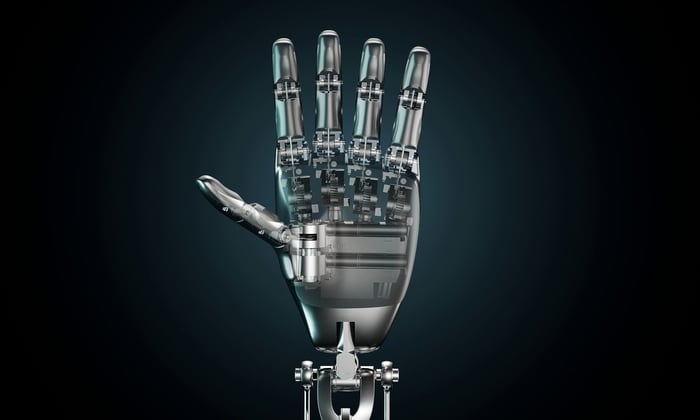
Image source: Tesla.
Where the margin went
Tesla's problem wasn't the economics of selling cars. Gross margin slipped only modestly, to 16.8% (versus 17.2% in the year-ago quarter).
The bigger swing came below that line. Operating expenses jumped 47% year over year to $4.4 billion, driven by AI and other research and development projects, stock-based compensation (including expenses tied to CEO Elon Musk's 2025 performance award), and higher selling, general, and administrative costs. The company also absorbed lower regulatory credit revenue, lower average selling prices, and an energy warranty charge tied to a vendor's battery cell issue. Add it up, and the biggest second quarter for deliveries in Tesla's history produced less operating income than any quarter in the past year.
Net income held up better, falling 5% year over year to $1.1 billion.
And then there's the cash. Capital expenditures more than doubled from a year ago to $5.8 billion (a step-up of $3.3 billion from the first quarter alone). That pushed free cash flow to negative $1.1 billion, compared with a positive $146 million in the year-ago period, and Tesla's cash and investments dipped $1.2 billion during the quarter to $43.5 billion.
Of course, the balance sheet can absorb spending like this for now. But the direction has changed. Tesla used to fund its ambitions from profits, and it is now funding them from the vault.
What the money is buying
Tesla's quarterly update lists the projects. Cybercab, the company's purpose-built autonomous vehicle, began production at Gigafactory Texas during the quarter. Tesla decommissioned its Model S and X lines at the Fremont Factory to install the first production lines for Optimus, its humanoid robot. And the company more than doubled its AI training compute in Texas during the first half of 2026, continued work on a semiconductor fab in Austin, and kept ramping battery cell production and lithium refining.
Even more, the spending is set to accelerate. Chief financial officer Vaibhav Taneja has told investors to expect capital expenditures above $25 billion this year -- guidance he laid out back in April -- and he said on Wednesday's call that operating expenses will keep growing in 2026 and beyond.
To the company's credit, some of the payoff is already measurable. Robotaxi service is now live in seven U.S. metros, with unsupervised rides launched in Miami, Orlando, and Tampa in July. Full Self-Driving (Supervised) subscriptions climbed 56% year over year to 1.48 million. More than 55% of new North American deliveries included FSD subscriptions, a record attach rate. And services and other revenue grew 50% year over year, with a record $648 million of gross profit at a 14% margin.
But those returns are still small next to the bill.
Which brings up the stock. Even after Thursday's drop, Tesla commands a market capitalization of about $1.2 trillion, and shares trade at more than 300 times earnings. A valuation like that assumes the robotaxi and Optimus bets eventually produce enormous profits -- and the 1.4% operating margin means shareholders are funding those bets almost entirely out of what used to be the company's earnings.
If the build-out works, this stretch will likely look like the price of admission. If it doesn't, investors will have paid a premium valuation for a company that spent its margin.
Personally, I'll keep watching from the sidelines. What could change my mind is the operating margin turning back up while the spending continues -- evidence the core business can carry the build-out instead of being consumed by it.
Don’t miss this second chance at a potentially lucrative opportunity
Ever feel like you missed the boat in buying the most successful stocks? Then you’ll want to hear this.
On rare occasions, our expert team of analysts issues a “Double Down” stock recommendation for companies that they think are about to pop. If you’re worried you’ve already missed your chance to invest, now is the best time to buy before it’s too late. And the numbers speak for themselves:
- Nvidia: if you invested $1,000 when we doubled down in 2009, you’d have $550,696!*
- Apple: if you invested $1,000 when we doubled down in 2008, you’d have $62,112!*
- Netflix: if you invested $1,000 when we doubled down in 2004, you’d have $369,577!*
Right now, we’re issuing “Double Down” alerts for three incredible companies, available when you join Stock Advisor, and there may not be another chance like this anytime soon.
See the 3 stocks »
*Stock Advisor returns as of July 23, 2026.
Daniel Sparks has clients with positions in Tesla. The Motley Fool has positions in and recommends Tesla. The Motley Fool has a disclosure policy.
Recommended Articles


