

2 Hidden AI Infrustructure Stocks Up Over 100% in the Past Year

Source The Motley Fool

Key Points

  • Comfort Systems and Vertiv are both tied to AI data center build-outs but through different roles.

  • First-quarter 2026 results show rapid revenue and profit growth for both companies.

  • Comfort Systems looks cheaper on earnings and has a record backlog supporting demand.

  • These 10 stocks could mint the next wave of millionaires ›

What do an HVAC company and a power-and-cooling equipment supplier have in common? Comfort Systems USA (NYSE: FIX) and Vertiv Holdings (NYSE: VRT) are both riding the artificial intelligence (AI) boom thanks to the data center build-out happening behind the scenes.

The market has noticed. Over the past year, Comfort Systems' stock has risen 214%, while Vertiv's has risen 131%. They're tied to AI infrastructure in very different ways, which matters when you're trying to figure out what's really driving the gains.

Where to invest $1,000 right now? Our analyst team just revealed what they believe are the 10 best stocks to buy right now, when you join Stock Advisor. See the stocks »

Two under-the-radar infrastructure plays have already more than doubled. The question now is whether the fundamentals still support the story. Let's find out.
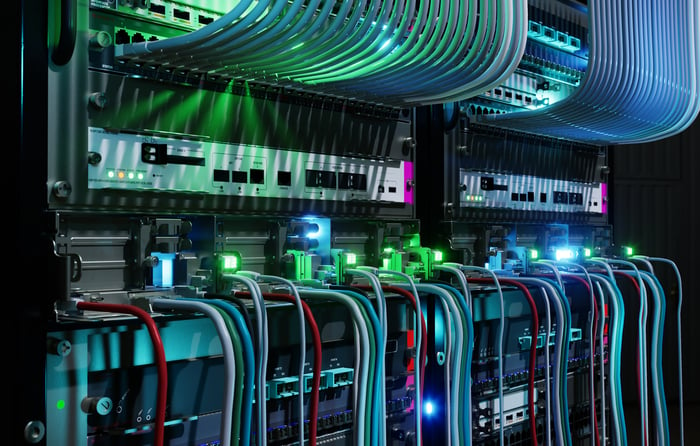
Servers with network cabling.

Image source: Getty Images.

What Comfort Systems and Vertiv actually do for AI data centers

Comfort Systems is a specialized construction and building services company focused on the systems that make large facilities function. That includes mechanical, electrical, plumbing, HVAC, piping, controls, modular construction, monitoring, and fire-protection services.

Vertiv, on the other hand, sells critical digital infrastructure for data centers. Its products and services help data centers, communication networks, and industrial facilities stay powered, cooled, connected, and running reliably. That includes power-management equipment, thermal-management systems, racks, enclosures, monitoring software, and services that support the full life cycle of a data center.

Why the AI data center boom needs cooling, power, and building systems

Vertiv is the more obvious AI infrastructure pick at first glance. It supplies much of the equipment a data center needs to operate, especially around power and cooling. Comfort Systems takes a step back from the server floor, but it's still in the flow of the same trend.

Data centers generate enormous amounts of heat, and they need effective cooling and building systems to keep uptime high. As hyperscalers build and expand, they turn to companies that can design, install, and service those systems at scale. Comfort Systems has long been a leader in commercial HVAC, and it appears to be one of the biggest players in that market.

Q1 2026 results: The AI build-out is already showing up in earnings

The latest results from both companies suggest the AI data center build-out is showing up in financial performance, not just stock charts.

Comfort Systems reported first-quarter 2026 revenue of about $2.9 billion, up 57% year over year. Net income rose 119% to about $370 million. In its Q1 investor presentation, the company pointed to data centers and chip manufacturing as its strongest end markets, followed by life sciences and pharmaceuticals. It also reported a $12.4 billion backlog, up 81% from $6.9 billion last year.

Vertiv also posted strong growth. Q1 2026 revenue increased 30% to about $2.65 billion, and net income climbed 137% to around $390 million. CEO Giordano Albertazzi said the company's ability to meet evolving AI-related demands is driving the growth.

Taken together, these results suggest AI infrastructure spending is already translating into real business momentum for both companies.

Comfort Systems vs. Vertiv: Which AI infrastructure stock looks better now?

So which stock looks more compelling today? At the moment, Comfort Systems appears cheaper, trading at a price-to-earnings ratio of about 49 compared to Vertiv's multiple of about 73. Those are still high multiples, and it's fair to ask whether enthusiasm for AI infrastructure is pushing prices ahead of fundamentals.

The counterpoint is that this has been a common pattern across many AI-adjacent stocks. The bigger question is whether earnings can keep growing fast enough to catch up. If the AI infrastructure build-out stays strong for years, today's valuations may not look so extreme in hindsight.

Wall Street clearly likes both names. Each carries a "strong buy" consensus rating, and both sets of price targets imply roughly 45% to 50% upside over the next year. If I had to choose, Comfort Systems has the edge. It trades at a lower valuation while posting faster revenue and earnings growth than Vertiv, and that record backlog suggests data center-related demand could stay healthy for a while.

After all, when two "hidden" AI infrastructure stocks are already up triple digits in a year, the next move depends less on hype and more on whether the build-out keeps translating into backlog, revenue, and earnings.

Don’t miss this second chance at a potentially lucrative opportunity

Ever feel like you missed the boat in buying the most successful stocks? Then you’ll want to hear this.

On rare occasions, our expert team of analysts issues a “Double Down” stock recommendation for companies that they think are about to pop. If you’re worried you’ve already missed your chance to invest, now is the best time to buy before it’s too late. And the numbers speak for themselves:

  • Nvidia: if you invested $1,000 when we doubled down in 2009, you’d have $550,696!*
  • Apple: if you invested $1,000 when we doubled down in 2008, you’d have $62,112!*
  • Netflix: if you invested $1,000 when we doubled down in 2004, you’d have $369,577!*

Right now, we’re issuing “Double Down” alerts for three incredible companies, available when you join Stock Advisor, and there may not be another chance like this anytime soon.

See the 3 stocks »

*Stock Advisor returns as of July 23, 2026.

Rick Orford has no position in any of the stocks mentioned. The Motley Fool has positions in and recommends Comfort Systems USA and Vertiv. The Motley Fool has a disclosure policy.

Disclaimer: For information purposes only. Past performance is not indicative of future results.
placeholder
Bitcoin CME gaps at $35,000, $27,000 and $21,000, which one gets filled first?Prioritize filling the $27,000 gap and even try higher.
Author  FXStreet
Aug 22, 2023
Prioritize filling the $27,000 gap and even try higher.
placeholder
Pinduoduo Earnings Incoming: Morgan Stanley Sees Long-Term Profit Potential​Insights – On November 21, Chinese e-commerce giant Pinduoduo (PDD) will release its Q3 2024 earnings.
Author  Mitrade
Nov 20, 2024
​Insights – On November 21, Chinese e-commerce giant Pinduoduo (PDD) will release its Q3 2024 earnings.
placeholder
Bitcoin briefly loses 2025 gains as crypto plunges over the weekend.Bitcoin experienced a sharp decline this weekend, briefly erasing its 2025 gains and dipping below its year-opening value of $93,507. The cryptocurrency fell to a low of $93,029 on Sunday, representing a 25% drop from its all-time high in October. Although it has rebounded slightly to around $94,209, the pressures on the market remain significant. The downturn occurred despite the reopening of the U.S. government on Thursday, which many had hoped would provide essential support for crypto markets. This year initially appeared promising for cryptocurrencies, particularly after the inauguration of President Donald Trump, who has established the most pro-crypto administration thus far. However, ongoing political tensions—including Trump's tariff strategies and the recent government shutdown, lasting a historic 43 days—have contributed to several rapid price pullbacks for Bitcoin throughout the year. Market dynamics are also being influenced by Bitcoin whales—investors holding large amounts of Bitcoin—who have been offloading portions of their assets, consequently stalling price rallies even as positive regulatory developments emerge. Despite these sell-offs, analysts from Glassnode argue that this behavior aligns with typical patterns seen among long-term investors during the concluding stages of bull markets, suggesting it is not indicative of a mass exodus. Notably, Bitcoin is not alone in its struggles, as Ethereum and Solana have also recorded declines of 7.95% and 28.3%, respectively, since the start of the year, while numerous altcoins have faced even steeper losses. Looking ahead, questions linger regarding the viability of the four-year cycle thesis, particularly given the increasing institutional support and regulatory frameworks now in place in the crypto landscape. Matt Hougan, chief investment officer at Bitwise, remains optimistic, suggesting a potential Bitcoin resurgence in 2026 driven by the “debasement trade” thesis and a broader trend toward increased adoption of stablecoins, tokenization, and decentralized finance. Hougan emphasized the soundness of the underlying fundamentals, pointing to a positive outlook for the sector in the longer term.
Author  Mitrade
Nov 17, 2025
Bitcoin experienced a sharp decline this weekend, briefly erasing its 2025 gains and dipping below its year-opening value of $93,507. The cryptocurrency fell to a low of $93,029 on Sunday, representing a 25% drop from its all-time high in October. Although it has rebounded slightly to around $94,209, the pressures on the market remain significant. The downturn occurred despite the reopening of the U.S. government on Thursday, which many had hoped would provide essential support for crypto markets. This year initially appeared promising for cryptocurrencies, particularly after the inauguration of President Donald Trump, who has established the most pro-crypto administration thus far. However, ongoing political tensions—including Trump's tariff strategies and the recent government shutdown, lasting a historic 43 days—have contributed to several rapid price pullbacks for Bitcoin throughout the year. Market dynamics are also being influenced by Bitcoin whales—investors holding large amounts of Bitcoin—who have been offloading portions of their assets, consequently stalling price rallies even as positive regulatory developments emerge. Despite these sell-offs, analysts from Glassnode argue that this behavior aligns with typical patterns seen among long-term investors during the concluding stages of bull markets, suggesting it is not indicative of a mass exodus. Notably, Bitcoin is not alone in its struggles, as Ethereum and Solana have also recorded declines of 7.95% and 28.3%, respectively, since the start of the year, while numerous altcoins have faced even steeper losses. Looking ahead, questions linger regarding the viability of the four-year cycle thesis, particularly given the increasing institutional support and regulatory frameworks now in place in the crypto landscape. Matt Hougan, chief investment officer at Bitwise, remains optimistic, suggesting a potential Bitcoin resurgence in 2026 driven by the “debasement trade” thesis and a broader trend toward increased adoption of stablecoins, tokenization, and decentralized finance. Hougan emphasized the soundness of the underlying fundamentals, pointing to a positive outlook for the sector in the longer term.
placeholder
Japanese Yen bears turn cautious near four-decade low amid looming intervention risksThe USD/JPY enters a bullish consolidation phase during the Asian session on Wednesday and holds steady above the 163.00 mark, near its highest level since 1986 set the previous day.
Author  FXStreet
Yesterday 01: 18
The USD/JPY enters a bullish consolidation phase during the Asian session on Wednesday and holds steady above the 163.00 mark, near its highest level since 1986 set the previous day.
placeholder
Gold rallies to over two-week high, eyes $4,150 as traders track US-Iran diplomacy effortsGold (XAU/USD) rallies to an over two-week high, around the $4,140-$4,141 area, during the Asian session on Wednesday amid hopes that US-Iran diplomacy could ease energy prices and temper hawkish US Federal Reserve (Fed) expectations.
Author  FXStreet
Yesterday 09: 52
Gold (XAU/USD) rallies to an over two-week high, around the $4,140-$4,141 area, during the Asian session on Wednesday amid hopes that US-Iran diplomacy could ease energy prices and temper hawkish US Federal Reserve (Fed) expectations.
goTop
quote