


Here's the Biggest Risk Facing SpaceX (Hint: It's Not Another Failed Starship Launch)
Key Points
One of the most bullish analysts on Wall Street regarding Space Exploration Technologies has clarified a major risk for the stock.
SpaceX will require a tremendous amount of additional capital over the next decade.
- 10 stocks we like better than Space Exploration Technologies ›
Space Exploration Technologies (NASDAQ: SPCX) had to abort its 13th Starship test flight after some of its engines failed to ignite. Starship is SpaceX's fully reusable super-heavy-lift vehicle, and once it's ready to operate commercially, it could significantly reduce the cost of putting payloads into space, such as Starlink satellites or orbital data center satellites. Getting it off the ground (pun intended) will be key to the company achieving revenue growth and earnings that meet the market's high expectations.
SpaceX will have another go at the Starship test launch, and many more tests and launches will come over the next few years. A single aborted launch does not significantly impact the company's long-term viability.
Where to invest $1,000 right now? Our analyst team just revealed what they believe are the 10 best stocks to buy right now, when you join Stock Advisor. See the stocks »
The bigger risk to SpaceX and its investors involves what will happen if it successfully brings Starship into service: The company will need to raise massive amounts of capital over the better part of the next decade, even based on some of the most bullish outlooks for the business.
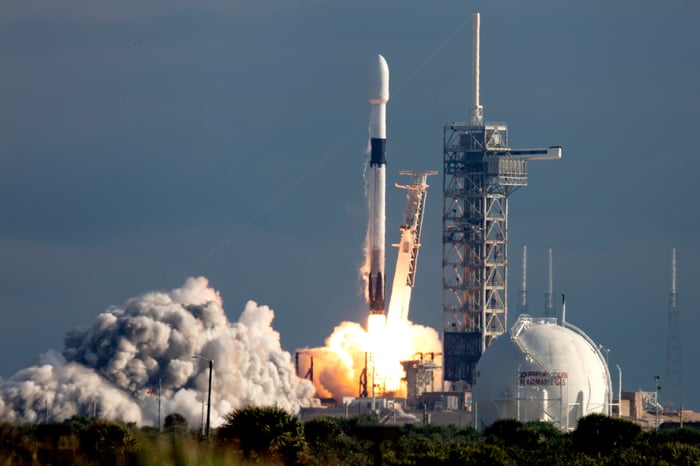
Image source: Getty Images.
This SpaceX bull just highlighted a major risk to the stock
Morgan Stanley analysts have put a $300 price target on SpaceX stock. They cite its "near-monopoly launch economics," which will enable its satellite connectivity and AI businesses to scale up at a cost advantage.
Indeed, SpaceX can already launch its low earth orbit satellites for Starlink at a lower cost than any rival. And its technology also enables it to launch rockets at a higher cadence than anyone else. It can build faster and cheaper than anyone in the rocket launch industry.
But SpaceX is competing with terrestrial telecom companies and data centers. That's why Starship, which can carry much larger payloads and can be rebuilt and relaunched faster than SpaceX's current Falcon rockets, will be essential to scaling the business further.
Morgan Stanley sees Starship opening the door to serious revenue growth, but it will also require substantial capital to scale that business to the levels its analysts estimate. In fact, the analysts don't expect SpaceX to produce positive free cash flow until 2035. They estimate the company's average cash burn at $84 billion per year between 2027 and 2034, with capital expenditures peaking in 2031 at $300 billion.
In other words, SpaceX will need to raise about $700 billion in additional capital. "If debt markets cannot absorb this financing need, SpaceX may need to issue equity, reduce growth investment, or slow deployment," lead analyst Adam Jonas wrote in his note to investors.
Importantly, SpaceX isn't the only tech company with significant financial demands. We've seen the major hyperscalers issue both debt and equity this year to raise cash to fund their AI data center build-outs. Meanwhile, the Federal Reserve is considering raising interest rates this year due to elevated inflation.
As a result, the cost of capital is rising. That could mean SpaceX will have to pay higher interest rates on whatever bonds it issues. Or, if the bond market cannot absorb another $700 billion of SpaceX's debt, its stock price will likely decline as it dilutes shareholders by raising funds via new equity issues.
The other option would be for SpaceX to raise less capital and slow its Starship, Starlink, and orbital data center build-outs. But that will lead to slower growth and, subsequently, a lower stock price.
SpaceX's capital requirements are a huge overhang on the stock, no matter how it raises that cash. Investors need to be aware of that risk, even if they're bullish on the technology.
Should you buy stock in Space Exploration Technologies right now?
Before you buy stock in Space Exploration Technologies, consider this:
The Motley Fool Stock Advisor analyst team just identified what they believe are the 10 best stocks for investors to buy now… and Space Exploration Technologies wasn’t one of them. The 10 stocks that made the cut could produce monster returns in the coming years.
Consider when Netflix made this list on December 17, 2004... if you invested $1,000 at the time of our recommendation, you’d have $369,577!* Or when Nvidia made this list on April 15, 2005... if you invested $1,000 at the time of our recommendation, you’d have $1,301,557!*
Now, it’s worth noting Stock Advisor’s total average return is 908% — a market-crushing outperformance compared to 208% for the S&P 500. Don't miss the latest top 10 list, available with Stock Advisor, and join an investing community built by individual investors for individual investors.
See the 10 stocks »
*Stock Advisor returns as of July 23, 2026.
Adam Levy has no position in any of the stocks mentioned. The Motley Fool has no position in any of the stocks mentioned. The Motley Fool has a disclosure policy.
Recommended Articles


