


Fed Chair Kevin Warsh Just Threw Cold Water on Investors Who Thought the Worst of Inflation Was Over
Key Points
Thus far, the Dow Jones Industrial Average, S&P 500, and Nasdaq Composite have successfully climbed the inflationary wall of worry.
Though June headline inflation fell from a three-year high in May, evidence is mounting that inflation is becoming more broad-based.
The door remains open for the Federal Reserve to hike interest rates, which may prove devastating to a historically pricey stock market.
- 10 stocks we like better than S&P 500 Index ›
Throughout history, the stock market has made a habit of climbing the proverbial wall of worry -- and 2026 has, thus far, been no exception. Despite the Iran war approaching its fifth month, the Dow Jones Industrial Average (DJINDICES: ^DJI), S&P 500 (SNPINDEX: ^GSPC), and Nasdaq Composite (NASDAQINDEX: ^IXIC) have all exploded to record highs this year.
But bull markets aren't indefinite, and above-average inflation is a formidable foe.
Missed Nvidia in 2009? This Rare Signal Is Flashing Again. In 2009, a "Double Down" signal flashed for a little-known chipmaker called Nvidia. For the first time in years, that same "Total Conviction" signal is flashing for a company 1/100th the size of Nvidia. Continue »
While a favorable inflation report for June has some investors celebrating as if the worst of the Iran-war-driven inflation is over, Fed Chair Kevin Warsh just stamped out any idea of putting this concern in the rearview mirror.
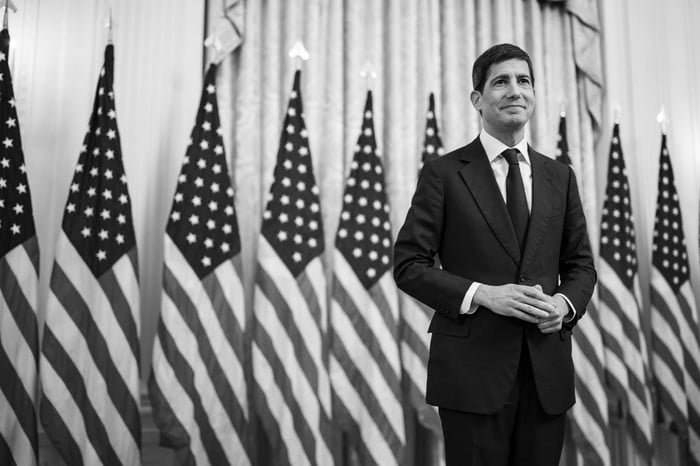
Fed Chair Kevin Warsh has promised to deliver price stability. Image source: Official White House Photo by Daniel Torok.
The June inflation report's silver lining isn't all it's cracked up to be
The primary inflation driver of the Iran war has been Iran's closure of the Strait of Hormuz. Choking off the flow of maritime traffic has essentially halted the movement of a fifth of the world's liquid petroleum demand and sent fuel prices soaring. Within weeks, gas prices rose at the fastest pace in more than 30 years, resulting in trailing 12-month (TTM) inflation reaching 4.2% in May (a three-year high).
The June inflation report offered a silver lining. With peace talks between the U.S. and Iran advancing throughout the month, crude oil prices plunged. While fuel prices often take their sweet time declining after an energy supply shock is resolved, this notable drop in crude oil prices pushed TTM inflation down to 3.5%.
About an hour and 40 minutes into this hearing, someone asked Kevin Warsh about the June CPI:
-- Nick Timiraos (@NickTimiraos) July 14, 2026
"It's one data point.... I don't want to overread or cherry pick data.
"There might be some who look at this morning's data and say, 'Well, mission accomplished, everything is swell.'...
However, Fed Chair Kevin Warsh wasn't rushing to declare victory over inflation. On July 14, while testifying before the House Financial Services Committee, a member questioned Warsh about the significant month-over-month decline in inflation, to which he responded:
There might be some who look at this morning's data and say, 'Well, mission accomplished, everything is swell.' That is not my view.
Warsh's response has two qualifiers. To begin with, his Federal Open Market Committee (FOMC) voting record (February 2006 – March 2011) shows him to be a monetary hawk. Put simply, he prefers higher interest rates as the preferred tool to suppress inflation. A month-to-month drop of TTM inflation from 4.2% to 3.5% won't register as a victory in Warsh's eyes when headline inflation has topped the FOMC's long-term target of 2% for 63 consecutive months.
Secondly, the new Fed chair likely recognizes that Trumpflation (i.e., inflation driven by President Donald Trump's policies) has entered a new phase. Whereas headline inflation declined in June, Core Personal Consumption Expenditures (PCE), which excludes volatile food and energy costs, isn't forecast to fall much, if at all. This suggests that Iran-war-driven inflation has become a broad-based issue that extends well beyond just the energy sector.
BREAKING: US May PCE inflation, the Fed's preferred inflation metric, rises to 4.1%, the highest reading since April 2023.
-- The Kobeissi Letter (@KobeissiLetter) June 25, 2026
Core PCE inflation rose to 3.4%, its highest since October 2023.
US inflation is now officially running at more than double the Fed's 2% target.
Persistently high, broad-based inflation is considerably more challenging to tackle than energy-based supply shocks alone. In other words, Warsh's statement firmly leaves the door open for interest rate hikes, even with June's headline inflation figure falling.
An FOMC rate hike remains one of the top threats to the Dow's, S&P 500's, and Nasdaq Composite's breakneck rallies. Many of Wall Street's most influential businesses are relying on debt to finance the artificial intelligence (AI) data center build-out. If the cost to borrow rises and this expansion meaningfully slows, the subsequent rerating of growth rates and otherworldly AI stock valuations may prove disastrous for the stock market.
Should you buy stock in S&P 500 Index right now?
Before you buy stock in S&P 500 Index, consider this:
The Motley Fool Stock Advisor analyst team just identified what they believe are the 10 best stocks for investors to buy now… and S&P 500 Index wasn’t one of them. The 10 stocks that made the cut could produce monster returns in the coming years.
Consider when Netflix made this list on December 17, 2004... if you invested $1,000 at the time of our recommendation, you’d have $370,332!* Or when Nvidia made this list on April 15, 2005... if you invested $1,000 at the time of our recommendation, you’d have $1,272,280!*
Now, it’s worth noting Stock Advisor’s total average return is 904% — a market-crushing outperformance compared to 208% for the S&P 500. Don't miss the latest top 10 list, available with Stock Advisor, and join an investing community built by individual investors for individual investors.
See the 10 stocks »
*Stock Advisor returns as of July 23, 2026.
Sean Williams has no position in any of the stocks mentioned. The Motley Fool has no position in any of the stocks mentioned. The Motley Fool has a disclosure policy.
Recommended Articles


