


Rocket Lab (RKLB) Down 55% From Peak - $266M Air Force Win, Aug 6 Earnings
TradingKey - Rocket Lab (NASDAQ: RKLB) is trading today in the $81 to $86 range on July 22, roughly 55% off its all-time high of $151 reached May 27, 2026, after a broad space sector selloff. Fundamentally, however, the situation has improved significantly in the past few days: July 20 saw the award of a $266M US Air Force contract for Rocket Lab and, the prior day, July 19, its naming among seven firms awarded a Space Force contract with a $17B ceiling. The company also recently announced an $8B cash and stock purchase of Iridium Communications, a deal Morgan Stanley viewed as a path widening. Next earnings date is Aug. 6. The average analyst price target is $116.57.
The 55% Pullback - What Caused It and What Has Changed
RKLB's 55% pullback from the peak at $151 reflects more a sector rotation than a company specific deterioration. The pullback appears to have been driven by both a SpaceX IPO pulling capital towards bigger space stocks as well as the broader AI and chip selloff.
Fundamentally the situation has improved in the past three trading days: the company has been named among seven in a $17B Space Force contract ceiling, and has won an Air Force contract worth $266M. The latter contract is meaningful for a company that reported Q1 2026 revenue of $147M.
RKLB also had an ending backlog in Q1 of $1.42B; the company therefore has more certainty in its revenue from government contracts than its stock price might imply in the current environment.
The Iridium Acquisition - What an $8 Billion Deal Means
Rocket Lab's $8B cash and stock deal for Iridium Communications would materially expand its scale and mix. Iridium maintains a global voice/data/positioning system of 66 satellites in low-earth orbit, giving Rocket Lab more immediate access to a recurring revenue satellite communications business in addition to launch and satellite manufacturing.
Morgan Stanley was the first to weigh in on the deal, noting that it widens the growth path for Rocket Lab, the most definitive strategic assessment to date. The $8B deal will also change the financial profile of the business, as Iridium had approximately $756M in revenue in 2025 and was profitable, and Rocket Lab ended Q1 with $515M in cash and marketable securities.
The gap in the financials will mean meaningful debt and equity financing and will likely involve some dilution, but will also mean Rocket Lab is closer to being an integrated space infrastructure business with the potential for operating cash flows in the future.
Management is expected to comment on the timing for integration and the financing mix at the August 6, 2026 Q2 earnings announcement which will be the next event to monitor for investors.
RKLB Technical Setup - Fibonacci Recovery, 50 EMA at $77.89, Key Levels
On the 4H chart, RKLB has bounced off major support at $63.69 and has recovered to $73.95 to $80.47. The 50-period EMA at $77.89 and the 100 EMA at $92.58 are above the current price. The RSI is now approximately at 53 and has recovered from its oversold level.
First resistance at $80.47 which is the 38.2% Fibonacci recovery level from the lows, after which the next resistance levels are $85.53 and $90.73 (the 61.8% Fib level). On the downside support is $73.40 to $74.00 and then the key support is $63.69 from prior lows.
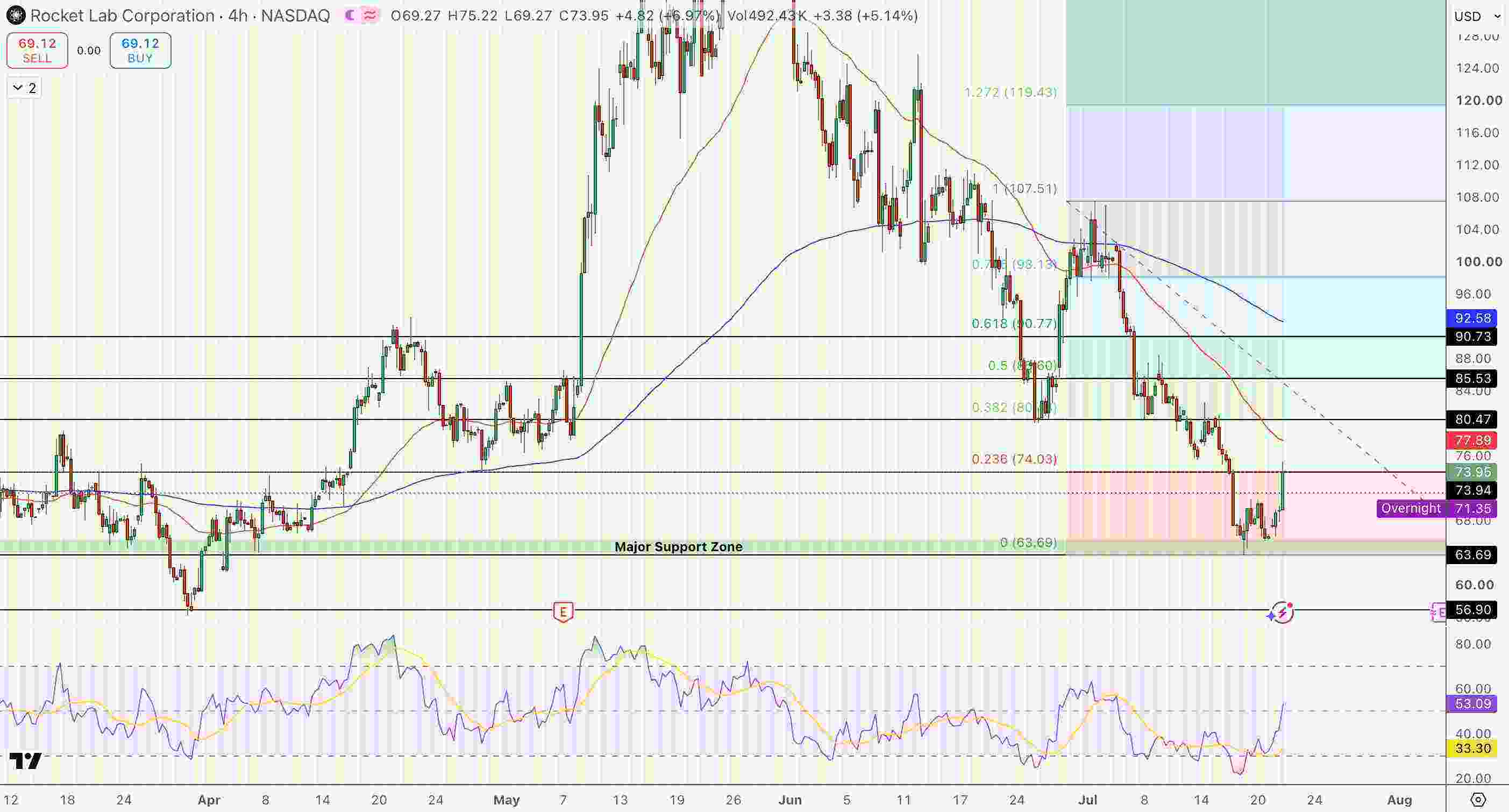
Rocket Lab (RKLB) Price Chart - Source: Tradingview
The stock is currently trading in the $81 to $86.50 range today, implying it has already tested the $80.47 resistance level.
- Current price: Today's session is in the range of $81.00 to $86.50
- All-time high: $151 on May 27, 2026. It is 55% from that peak.
- Contract wins: The Air Force awarded a $266M contract on July 20 to RKLB. It is one of seven companies awarded contracts from the US Air Force with a total ceiling of $17B; that announcement was on July 19.
- Iridium deal: RKLB announced an $8B cash and stock acquisition of Iridium Communications. The consensus from the sell-side so far has viewed the Iridium deal as a positive, growth enhancing move for RKLB, although it will require debt/equity financing and will likely cause some dilution.
- Q1 2026 results: RKLB reported Q1 2026 revenues of $147M, up 32% year over year (YoY). The company has a backlog as of the end of the first quarter of $1.42B. Rocket Lab ends its first quarter with $515M in cash.
- Next earnings: August 6, 2026. Management guided Q2 revenue at $155M to $165M.
- Analyst targets: $116.57 average, Buy consensus from 16 analysts. High of $38 to low of $22.
Why Has Rocket Lab Fallen 55% From Its Peak Despite Winning Major Contracts?
The recent dip from $151 down to the $81 to $86 band is really about the sector, not Rocket Lab itself. The SpaceX IPO siphoned investment to the bigger space players, and a wider AI-semiconductor rout hurt high-growth names in the bargain. Even so, Rocket Lab has been signing big-ticket awards, including a $266 million U.S. Air Force contract on July 20, a $17 billion ceiling deal with the U.S. Space Force on July 19, and a win with Iridium.
What Is the Iridium Acquisition and What Does It Mean for Rocket Lab?
Rocket Lab just announced it’s acquiring Iridium Communications for $8 billion in cash and stock. Iridium runs a constellation of 66 LEO satellites and brought in roughly $756 million of revenue in 2025. The company was profitable, so adding its results could help Rocket Lab hit break-even sooner on a pro forma basis. Morgan Stanley said the deal opens the door for even faster growth.
What Is Rocket Lab's Backlog and Why Does It Matter?
The company’s backlog came in at $1.42 billion at the end of Q1 2026, up from $1.07 billion a year earlier. Based on Q1’s $147 million revenue run rate, that backlog translates to roughly 2.4 years of revenue visibility. Additional backlog from the Air Force and Space Force awards should start to flow through once the contracts are recognized.
Bottom Line
As of July 22, Rocket Lab is changelessly trading between $81 and $86.50, down about 55% from its $151 all-time high established on May 27 largely because of the rotation away from space stocks following the SpaceX IPO. On the other hand, the fundamentals have been getting a lot stronger, including the new $266 million U.S. Air Force contract, the $17 billion U.S. Space Force ceiling deal, and the acquisition of Iridium for $8 billion. Support in the $73.40 to $74 range is the immediate support; the stock is challenging Fibonacci resistance at $80.47 today. The consensus price target is $116.57. Q2 earnings come up August 6, which will be the first earnings call with details from Iridium.
Recommended Articles


