


I'm Officially Sounding the Alarm on GE Vernova: Here's What Investors Should Buy Instead
Key Points
GE Vernova remains an excellent business, but its premium valuation leaves less room for mistakes.
Quanta Services offers essential electrification exposure with stronger valuation support and a durable labor advantage.
Grid infrastructure builders may provide a smarter long-term AI power investment than expensive equipment manufacturers.
- 10 stocks we like better than GE Vernova ›
Let me be clear up front: GE Vernova (NYSE: GEV) is a terrific business. Its power-generation and grid equipment sit at the heart of the electrification boom, and its record backlog is real. But the stock has become overvalued, and I am officially sounding the alarm. If you want exposure to the same powerful trend without the sky-high risk, I would buy Quanta Services (NYSE: PWR) instead.
Why I'm alarmed on GE Vernova
Here's the specific problem: the price. GE Vernova trades near $1,071 a share (as of July 20), and against the average analyst forecast for 2027 earnings of about $24.40 per share, that works out to roughly 44 times forward earnings. The stock has soared more than 60% this year alone, and that kind of run leaves a valuation priced for perfection. When expectations get that stretched, even good news can fail to move the stock, while any disappointment tends to hit hard.
Missed Nvidia in 2009? This Rare Signal Is Flashing Again. In 2009, a "Double Down" signal flashed for a little-known chipmaker called Nvidia. For the first time in years, that same "Total Conviction" signal is flashing for a company 1/100th the size of Nvidia. Continue »
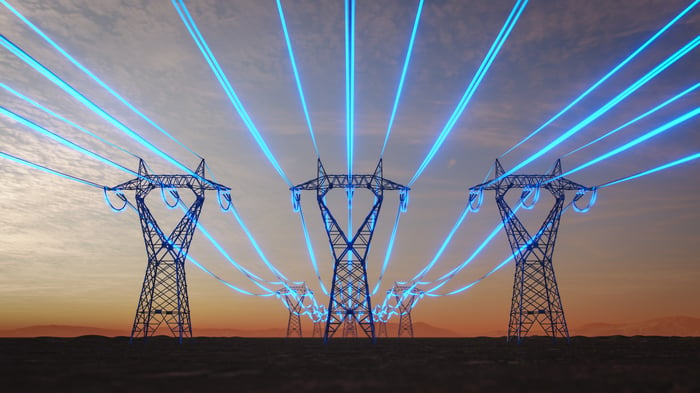
Image source: Getty Images.
And there's a concrete reason disappointment is a real risk. GE Vernova's headline number is its enormous order backlog, but a backlog is only a promise until it converts into actual revenue. That conversion is running into genuine obstacles: The U.S. electric grid is congested and slow to upgrade, supply chains for heavy power equipment are bottlenecked, and building and connecting new capacity takes years. If those data center and grid projects slip, or if artificial intelligence (AI)-driven power demand cools even slightly, the revenue the market is counting on could arrive later and messier than expected. At 44 times earnings, the market is already assuming years of flawless execution, which leaves very little cushion. There is simply very little buffer if anything goes wrong.
To be fair, GE Vernova could keep climbing if the build-out stays red-hot. I'm not saying the business is broken. I am saying the risk-reward at this price is badly skewed against new buyers.
What to buy instead: Quanta Services
Quanta Services offers a smarter way to play the identical trend. It's the picks-and-shovels company of electrification, providing the crews, transmission lines, substations, and interconnections that physically link power plants and data centers to the grid. Put simply, you can't deploy all of GE Vernova's turbines without a company like Quanta to wire everything together.
The setup is compelling. Quanta carries a record backlog of its own, near $48.5 billion, and management frames its opportunity as a $2.4 trillion addressable market through the end of the decade. It also owns a rare competitive edge: It trains its own skilled workers through its line worker schools, which matters enormously when labor is the true bottleneck in the entire build-out. At about $630 a share and a 2027 earnings forecast near $16.50, Quanta trades at roughly 38 times forward earnings. That is cheaper than GE Vernova, which means you're paying a more reasonable price for a business that's just as essential to the electrification story.
Quanta isn't risk-free either. Labor shortages could cap its growth, big projects can be delayed, and its stock isn't exactly cheap after its own strong run.
The takeaway for investors
Both companies win if electricity demand keeps surging, so this is not a bet against the theme. It is a bet on risk and reward at today's prices. GE Vernova is a great business whose stock has gotten ahead of itself, while Quanta Services offers the same tailwind at a somewhat lower multiple, with recurring revenue and a genuine labor moat. My honest advice is to resist chasing GE Vernova here and favor the grid builder that makes the whole boom possible.
Another underappreciated detail: A large share of Quanta's work comes through recurring master service agreements rather than one-off projects, giving it steadier, more predictable revenue than a typical contractor. It's also become one of the largest builders of renewable-energy infrastructure, from solar farms to battery storage, so it profits no matter which type of power generation wins.
Should you buy stock in GE Vernova right now?
Before you buy stock in GE Vernova, consider this:
The Motley Fool Stock Advisor analyst team just identified what they believe are the 10 best stocks for investors to buy now… and GE Vernova wasn’t one of them. The 10 stocks that made the cut could produce monster returns in the coming years.
Consider when Netflix made this list on December 17, 2004... if you invested $1,000 at the time of our recommendation, you’d have $364,562!* Or when Nvidia made this list on April 15, 2005... if you invested $1,000 at the time of our recommendation, you’d have $1,247,668!*
Now, it’s worth noting Stock Advisor’s total average return is 894% — a market-crushing outperformance compared to 207% for the S&P 500. Don't miss the latest top 10 list, available with Stock Advisor, and join an investing community built by individual investors for individual investors.
See the 10 stocks »
*Stock Advisor returns as of July 22, 2026.
Micah Zimmerman has no position in any of the stocks mentioned. The Motley Fool has positions in and recommends GE Vernova and Quanta Services. The Motley Fool has a disclosure policy.
Recommended Articles


