


Prediction: U.S. Small-Cap Stocks Will Beat Large Caps for 10 Years
Key Points
Vanguard and Fidelity research suggests that U.S. small-cap stocks might keep outperforming large-cap stocks.
Two popular small-cap ETFs have both outperformed the S&P 500 and Nasdaq-100 in the past year.
- 10 stocks we like better than iShares Trust - iShares Russell 2000 ETF ›
The same types of stocks don't always keep winning forever. For most of the past 15 years, U.S. large-cap growth stocks (such as major tech companies) have been some of the best places to invest. But that might not be true in the future.
According to Vanguard's latest market forecast, U.S. small-cap stocks will deliver annualized returns of 5.8% to 7.8% for the next 10 years, outperforming U.S. large-cap stocks (which are expected to return 4.8% to 6.8%). Other recent research from Fidelity shows that small-cap stocks have been demonstrating stronger earnings and cheap valuations. That all could add up to stronger performance in the long run.
Where to invest $1,000 right now? Our analyst team just revealed what they believe are the 10 best stocks to buy right now, when you join Stock Advisor. See the stocks »

Image source: Getty Images.
If you want to buy small-cap stocks to fit this strategy, which exchange-traded funds (ETFs) should you choose? Let's look at two popular ETFs: the iShares Russell 2000 ETF (NYSEMKT: IWM) and the Vanguard Small-Cap Value ETF (NYSEMKT: VBR). Both small-cap ETFs have outperformed the S&P 500 index and the tech-heavy Nasdaq-100 index year to date.
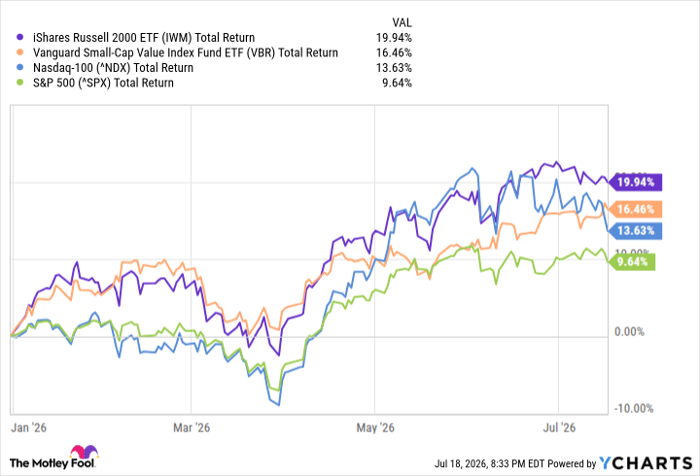
IWM Total Return Level data by YCharts
Let's take a closer look at these small-cap ETFs and see which could be the best choice for long-term investors in the next 10 years.
iShares Russell 2000 ETF (IWM): 1,974 stocks, 8.7% annualized returns for 26 years
The iShares Russell 2000 ETF (IWM) could be a good choice because it's simple and broadly diversified. It lets you buy "all" the small caps at once. This fund owns 1,974 stocks and intends to track the performance of the Russell 2000 index. During the last 26 years, since the fund's inception in May 2000, it has delivered average annual returns of 8.7%. In the past three years, it's delivered 18%, and in the past year, it's delivered a return of about 41%.
This fund charges an expense ratio of 0.19%, which is a bit higher than most low-cost index funds. But it ranks on the list of best small-cap ETFs and could be worth considering for long-term investors who want exposure to a diversified portfolio of small-cap stocks.
Vanguard Small-Cap Value ETF (VBR): 840 stocks, 26 years of 9.51% annualized returns
The Vanguard Small-Cap Value ETF is a targeted way to invest in value-oriented small-cap stocks. This ETF could also be a good bet based on other Vanguard research projections, which show U.S. value stocks outperforming growth stocks for the next 10 years.
The Vanguard Small-Cap Value ETF holds 840 stocks. That's a lot fewer stocks than the Russell 2000 fund, but still well diversified. This Vanguard ETF has been available since January 2004, and it has delivered average annual returns (by net asset value) of 9.5%.
In the past three years, it's delivered annualized returns of about 16%, and in the past year, it's delivered a return of about 27%.
This Vanguard ETF charges lower fees than the Russell 2000 fund, with an expense ratio of only 0.05%. It currently does not make the list of best value ETFs, but it could be worth considering if you want exposure to small-cap value stocks.
Why buy IWM or VBR
Here's a quick head-to-head breakdown of these two small-cap ETFs:
|
Metric |
iShares Russell 2000 ETF (IWM) |
Vanguard Small-Cap Value ETF (VBR) |
|---|---|---|
|
Number of Stocks |
1,974 |
840 |
|
Top sector holdings |
Healthcare: 19.94% of fund Financials: 19.3% Industrials: 14.4% Information technology: 12.75% Consumer discretionary: 9.6% |
Industrials: 20.8% of fund Financials: 18.1% Consumer discretionary: 14.6% Real estate: 10.2% Technology: 8.5% |
|
Top five stock holdings |
Brightspring Health Services: 0.35% of fund Moog: 0.34% UMB Financial Corp.: 0.34% Cytokinetics: 0.33% Old National Bancorp: 0.30% |
Jabil: 0.87% of fund NRG Energy: 0.66% Tapestry: 0.63% Atmos Energy: 0.61% Williams-Sonoma: 0.58% |
|
Price-to-earnings (P/E) ratio |
18.2 |
18 |
|
Trailing-12-month dividend yield |
0.88% |
1.78% |
|
Expense ratio |
0.19% |
0.05% |
Data sources: iShares, Vanguard, Yahoo! Finance.
Choosing the best small-cap stocks can be especially complex and risky. Some of these stocks are the up-and-coming large companies of the future, but some are less profitable and more likely to fail. With that in mind, if I had to choose between these small-cap ETFs, I would buy the iShares Russell 2000 ETF (IWM) because it has a more diversified portfolio. Even though it charges a higher fee, this iShares fund could be a better buy for most long-term investors.
Should you buy stock in iShares Trust - iShares Russell 2000 ETF right now?
Before you buy stock in iShares Trust - iShares Russell 2000 ETF, consider this:
The Motley Fool Stock Advisor analyst team just identified what they believe are the 10 best stocks for investors to buy now… and iShares Trust - iShares Russell 2000 ETF wasn’t one of them. The 10 stocks that made the cut could produce monster returns in the coming years.
Consider when Netflix made this list on December 17, 2004... if you invested $1,000 at the time of our recommendation, you’d have $371,842!* Or when Nvidia made this list on April 15, 2005... if you invested $1,000 at the time of our recommendation, you’d have $1,244,783!*
Now, it’s worth noting Stock Advisor’s total average return is 900% — a market-crushing outperformance compared to 207% for the S&P 500. Don't miss the latest top 10 list, available with Stock Advisor, and join an investing community built by individual investors for individual investors.
See the 10 stocks »
*Stock Advisor returns as of July 21, 2026.
Ben Gran has no position in any of the stocks mentioned. The Motley Fool has positions in and recommends Cytokinetics, Moog, NRG Energy, and Williams-Sonoma. The Motley Fool recommends Tapestry. The Motley Fool has a disclosure policy.
Recommended Articles


