


If a Stock Market Crash Is on the Way, History Says This Is the Smartest Thing Investors Can Do
Key Points
The stock market's valuation continues to soar on a bullish artificial intelligence (AI) narrative.
Even so, some investors worry that earnings growth may begin to decelerate.
Should profits start to slow, investors could decide to lock in gains -- causing a widespread drawdown.
- 10 stocks we like better than S&P 500 Index ›
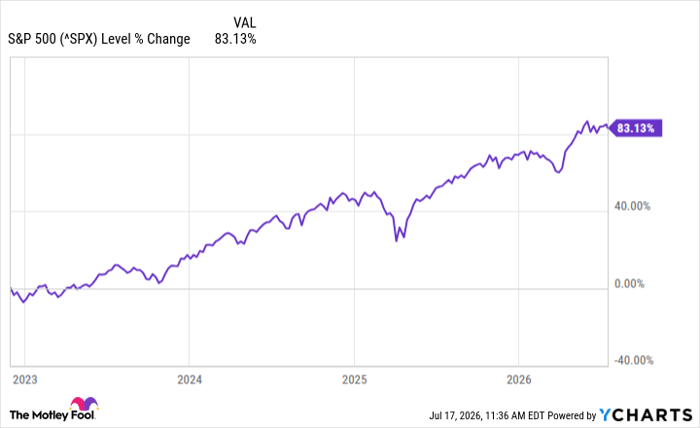
The stock market has long been one of the most reliable paths to create wealth. Since the artificial intelligence (AI) revolution ignited in late November 2022, the S&P 500 (SNPINDEX: ^GSPC) has gained a cumulative 83%, propelled by innovation and expanding corporate profits in technology and related sectors.
Missed Nvidia in 2009? This Rare Signal Is Flashing Again. In 2009, a "Double Down" signal flashed for a little-known chipmaker called Nvidia. For the first time in years, that same "Total Conviction" signal is flashing for a company 1/100th the size of Nvidia. Continue »
^SPX data by YCharts.
These advances reinforce the appeal of stocks for long-term investors who simply stay the course. At the same time, the market's elevated valuation and heavy concentration in a handful of dominant names have sparked growing speculation that a meaningful correction -- or even a bear market -- could lie ahead.
Understanding how the stock market moves
Stocks do not travel in a straight line upward or downward. Instead, they move through cycles of expansion and contraction that reflect the macroeconomic environment and shifts in investor psychology.
Declining stock prices often coincide with recessions, when the economy begins to show weakness with declining growth rates. Selling pressure can also emerge independently of economic downturns. When corporate profits fall short of optimistic forecasts that are already priced into stocks, investors may decide to lock in gains. This profit-taking can quickly snowball into broader selling.
Understanding these ebbs and flows as ordinary features of the stock market -- rather than anomalies -- allows investors to digest downturns with greater composure instead of panic.

Image source: Getty Images.
What lessons can be learned from prior downturns?
Since 2000, the S&P 500 has recorded four distinct bear markets:
- Dot-com bust: 49% decline
- 2008 financial crisis: 57% decline
- COVID-19 crash: 34% decline
- 2022 bear market: 25% decline
In the chart below, I've annotated recessions in the gray-shaded columns. History shows that the market ultimately recovered from each of these episodes and moved on to notch new all-time highs. Even earlier this year, the S&P 500 pulled back 7% as investors took profits after years of strong AI-driven gains, combined with questions about whether earnings growth would continue at the previously assumed pace we've witnessed over the last few years.
As always, the market absorbed the selling pressure, eventually stabilized, and resumed its upward trajectory.
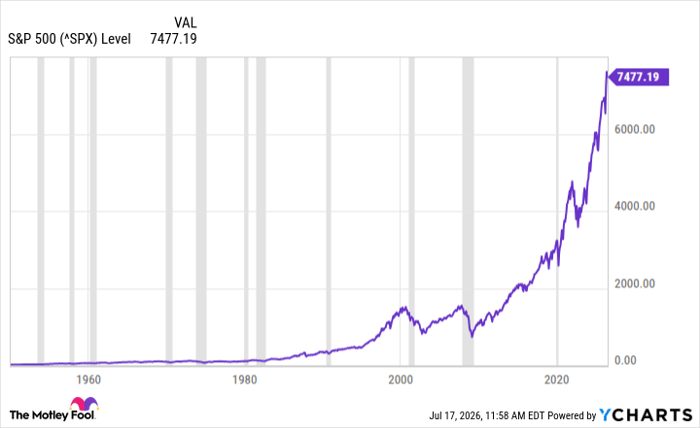
^SPX data by YCharts.
How can investors respond to uncertainty?
When the possibility of a bear market arises, perhaps the best action is to maintain a long-term mindset. This approach hinges on buying blue chip companies with durable business models, competitive advantages, and the ability to generate consistent cash flow through varying economic cycles.
Rather than monitoring daily price volatility or attempting to forecast short-term returns, the smartest investors measure success across decades. Wealth in the stock market is ultimately built through the compounding effect of buying and holding stocks, not through frequent day trading or reactive decisions.
By doubling down on quality positions during periods of stress, investors give themselves the best chance to participate fully in the market recoveries that have always followed every major decline.
Should you buy stock in S&P 500 Index right now?
Before you buy stock in S&P 500 Index, consider this:
The Motley Fool Stock Advisor analyst team just identified what they believe are the 10 best stocks for investors to buy now… and S&P 500 Index wasn’t one of them. The 10 stocks that made the cut could produce monster returns in the coming years.
Consider when Netflix made this list on December 17, 2004... if you invested $1,000 at the time of our recommendation, you’d have $371,842!* Or when Nvidia made this list on April 15, 2005... if you invested $1,000 at the time of our recommendation, you’d have $1,244,783!*
Now, it’s worth noting Stock Advisor’s total average return is 900% — a market-crushing outperformance compared to 207% for the S&P 500. Don't miss the latest top 10 list, available with Stock Advisor, and join an investing community built by individual investors for individual investors.
See the 10 stocks »
*Stock Advisor returns as of July 20, 2026.
Adam Spatacco has no position in any of the stocks mentioned. The Motley Fool has no position in any of the stocks mentioned. The Motley Fool has a disclosure policy.
Recommended Articles


