


AMD Shares Rise More Than 3%: First Rack-Scale AI System Helios Set for Delivery, Nvidia Faces First Strong Rival in Years
TradingKey - On July 20, Eastern Time, chip giant AMD ( AMD) is preparing to deliver its first rack-level AI system, Helios, to customers. According to CNBC, this represents the first real competitor in years to Nvidia's ( NVDA) Blackwell and Vera Rubin systems.
Meanwhile, Microsoft announced that it will deploy the Helios system in its data centers. AMD will begin shipping to customers, including Microsoft, later this year, with specific financial terms and computing capacity undisclosed.
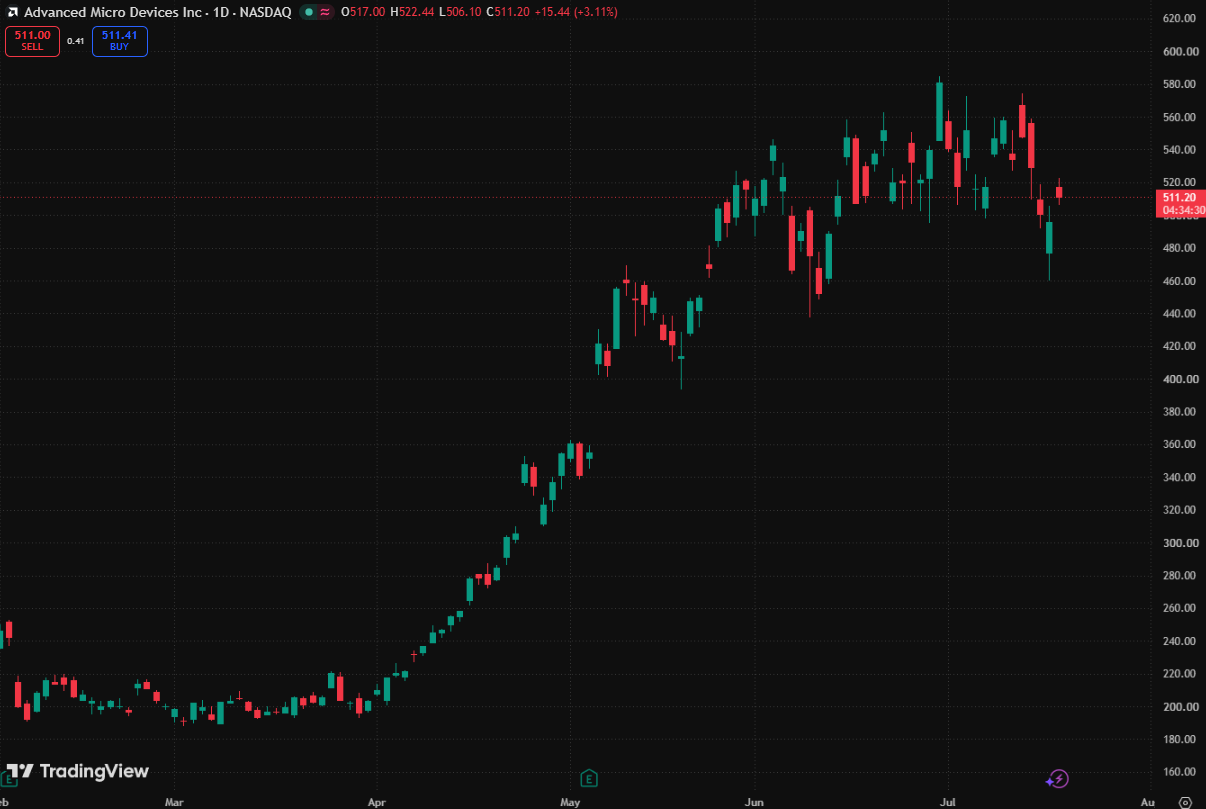
[Source: TradingView]
Spurred by the news, AMD's stock price rose today, up 3.11% to $511.20 as of press time.
Why Microsoft Chooses AMD Helios?
Microsoft is positioning the deployment of Helios for frontier model inference, AI customer service, and Azure AI service support. In addition, Microsoft will add two new computing instances based on AMD's latest 'Venice' CPU, which will be used for agentic AI and data pipelines, and semiconductor design, respectively.
This is a continuation of the long-standing partnership between the two companies—AMD chips have powered Microsoft's Surface PCs and Xbox gaming consoles for years. In 2023, Microsoft pioneered the adoption of AMD's MI300X GPU, serving as a frontrunner at the time to challenge Nvidia's AI chips. Meanwhile, Microsoft is also deploying its custom-designed Maia chips in its data centers.
Like all tech giants, Microsoft's appetite for computing power is virtually limitless. In June this year, Microsoft released seven self-developed models and continues to allocate more computing resources to R&D. However, Microsoft's AI commercialization results have been mixed so far—from 365 Copilot to GitHub Copilot, Microsoft is the worst-performing stock among the 'Magnificent Seven' this year.
What Is the Core Competitiveness of AMD Helios?
AMD's Helios system integrates four proprietary core technologies: GPUs, CPUs, networking, and software. Forrest Norrod, head of AMD's data center business, told CNBC: "We are very focused on delivering the best total cost of ownership (TCO) and achieving the lowest cost per token. Customers are telling us that we have done it."
Although the unit price of Helios is higher than Nvidia's Vera Rubin, AMD's competitive strategy is not a price war, but rather using the cost per unit of computing power (cost per token) as its core selling point.
According to data from Futurum Group, Nvidia currently controls over 95% of the data center GPU market, while AMD accounts for only about 4.5%. However, the launch of Helios could change this landscape.
Daniel Newman, CEO of Futurum Group, said: "I think it is entirely possible for AMD to do very well and capture a 20% to 25% share. By the way, that means hundreds of billions of dollars in revenue."
Recommended Articles


