


AMD Stock Near $510 Before Its Biggest AI Event — 12 Gigawatts on the Line
TradingKey - Advanced Micro Devices (NASDAQ: AMD) is poised for a critical week trading near $508, bouncing off the 200-period EMA of $480 following the recent sector-wide AI sell-off. This week is crucial not for technical levels, but for what AMD will reveal during its Advancing AI 2026 conference in San Francisco on July 22-23. It is anticipated the semiconductor firm will reveal details about its MI450 accelerator and Helios rack-scale system, the technologies that are expected to fulfill the 12-gigawatt demand agreed to with Meta and OpenAI. AMD is also scheduled to release its Q2 earnings on August 4.
The 12 Gigawatt Commitments — What Meta and OpenAI Actually Signed
Meta has agreed to deploy a total of 6GW of AMD GPUs across multiple generations, starting with an initial 1GW implementation using custom MI450 accelerators and sixth-generation EPYC Venice processors in the second half of 2026. Alongside that deal, Meta has been issued a performance-based warrant that enables it to buy up to 160 million AMD shares at a price of $0.01 apiece if AMD meets certain purchase and performance targets. OpenAI has agreed to purchase a total of 6GW of AMD accelerator capacity, split across different generations of product. Like Meta, it is expected to implement an initial 1GW of MI450 in the second half of 2026.
In total, Meta and OpenAI have made contractual commitments to purchase up to 12GW. One GW of AI compute typically translates to approximately 25,000 to 50,000 high-end GPUs, depending on the chip generation, power requirements, and cooling needs. Those agreements, naturally, won't generate immediate revenue in totality: Data-center buildouts, availability of power, product qualifications, and ramp plans will determine when orders become revenue. But the deals position AMD as an established No. 2 AI accelerator supplier for two of the top three AI research labs globally, a position not available in that sector a year ago.
Tuesday’s Advancing AI Event — What AMD Must Show
The Advancing AI 2026 conference, running July 22-23 at the Moscone Center in San Francisco, will be AMD's first major opportunity to move the needle on MI450 and Helios. MI450 is the specific GPU that is powering Meta's and OpenAI's H2 2026 deployments. Helios is a new rack-scale system that AMD is offering to combine MI450 GPUs with EPYC CPUs, Pensando networking, and an open-rack architecture. That's the product that will enable AMD to sell complete AI systems and not just individual AI chips to its customers. Customers that scale, like Meta and OpenAI, buy complete rack-scale systems, with networking, power, cooling and software already baked in.
The Advancing AI event needs to answer three questions: Are MI450 ramp and yields on track for H2 deployments? How does Helios perform in benchmarking against competing NVIDIA NVL rack systems? What is the latest ROCm update and is it actually possible for enterprise customers to run AI workloads without the same friction that's prevented broader software adoption, especially versus CUDA? AMD has been ramping, with Q1 2026 Data Center revenue of $5.8 billion growing 57% YoY. The question the event will answer is if the next step change for MI450 ramp is going to happen.
AMD Technical Setup — 200-EMA Held, $517 Is the First Hurdle
The 4H chart shows AMD rebounding off the 200-period EMA of $480.80 and recovering above the 38.2% Fibonacci retracement at $503.74. The RSI has been trending higher from oversold conditions. Immediate resistance is at $517.08, where the 50% Fibonacci resides.
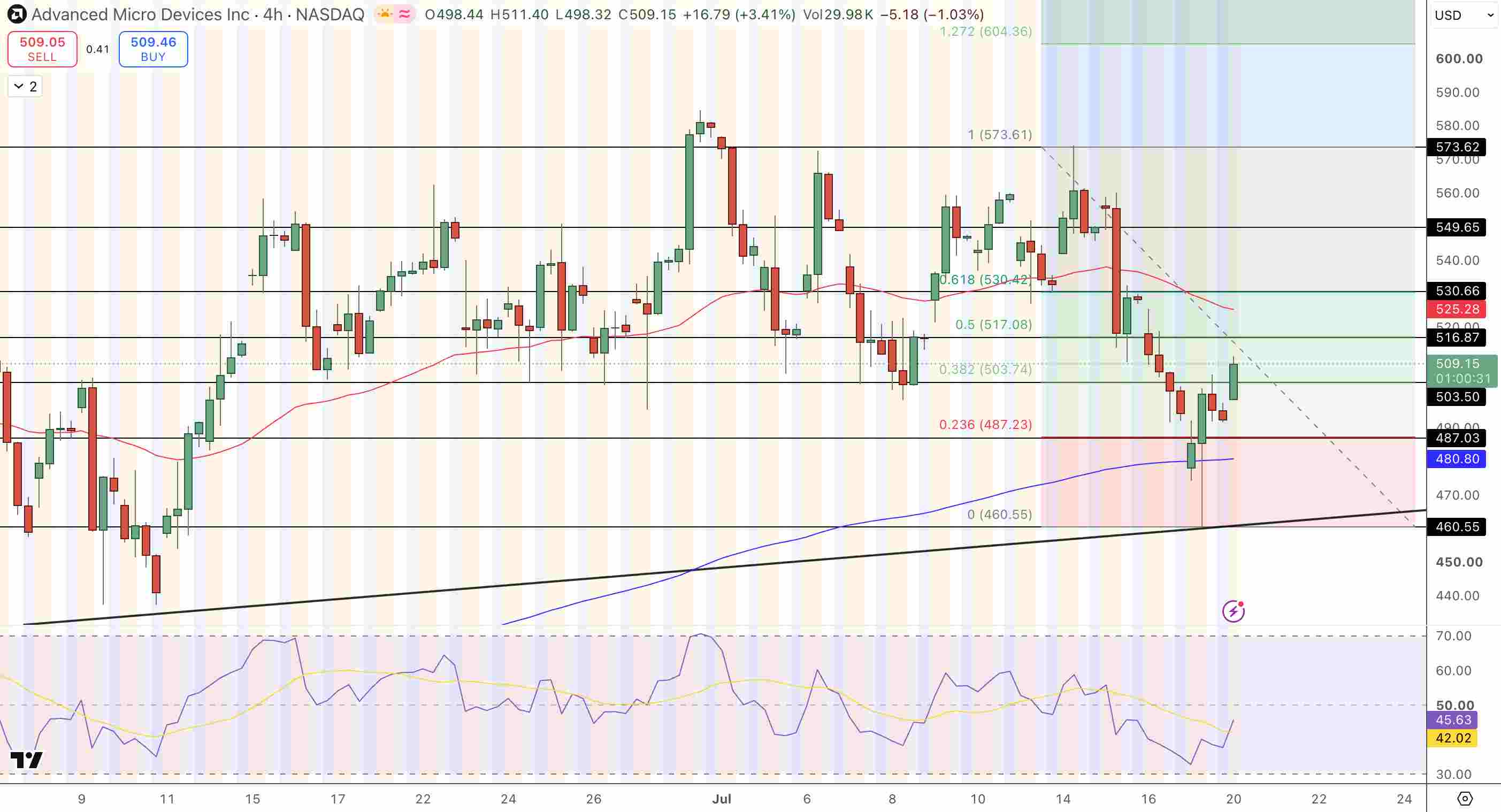
AMD Stock Price Chart - Source: Tradingview
The next level, where sellers may test is at $530.66 (61.8% Fib), and a close above that opens $549.65 and $573.62. Below $503.74, $487.03 would be the first line of support before $480.80, where the 200-EMA resides, and must continue to hold to validate the recovery.
- Event: Advancing AI 2026, July 22-23, SF. Expect MI450, Helios details
- Meta deal: Up to 6 GW AMD GPUs; 1GW MI450 starting H2 2026
- OpenAI deal: Up to 6 GW AMD accelerators, 1GW MI450 in H2 2026
- Earnings: Aug 4, after market. Consensus: $11.2B (+46% YoY), adj. EPS $1.67
- Resistance: $517.08 (50% Fib), then $530.66 (61.8% Fib); break clears $549.65
- Support: $503.74 (38.2% Fib), $487.03, 200-EMA at $480.80
What Are the Meta and OpenAI Agreements and What Do They Mean for AMD Revenue?
Meta has agreed to use at least 6 GW of AMD GPU power over several product generations, starting with a 1 GW installation of custom MI450 accelerators and EPYC Venice CPUs in H2 2026. OpenAI has agreed to use at least 6 GW of AMD accelerator capacity across product generations, also starting with a 1 GW MI450 deployment in H2 2026. Neither is revenue yet, but both provide some demand visibility. Actual revenue recognition depends on data center build-out, power delivery, and product qualification. Additionally, Meta’s deal includes a performance-based warrant for the company to acquire 160 million AMD shares at $0.01 per share if AMD reaches a series of purchase and performance milestones.
What Is Helios and How Does It Compare to NVIDIA’s Rack-Scale Systems?
Helios is AMD’s rack-scale AI infrastructure system built around the Instinct MI450 GPUs, EPYC server processors, Pensando networking, and an open rack architecture. Helios competes directly with NVIDIA’s NVL rack-scale systems. AMD’s differentiator, as it positions itself with Helios, is openness: it’s a standards-based networking and open rack architecture versus NVIDIA’s NVLink proprietary. In AMD’s view, that is a much better situation for end customers as it enables more flexibility and eliminates vendor lock-in. Whether Helios achieves performance per watt, and performance per rack in the aggregate, comparable to NVIDIA’s rack scale solutions is something that will be discussed on Tuesday at the Advancing AI event, and benchmark performance and examples of customer deployments are expected to be presented.
What Should Investors Watch at AMD’s Q2 Earnings on August 4?
AMD’s Q2 2026 results will be released August 4, after the market closes. Analysts on average are looking for the company to come in with $11.2 billion of revenues, which implies 46% year-over-year growth. They expect AMD to deliver an adjusted gross margin of about 56% and adjusted EPS of approximately $1.67. The number to look for is data center revenues. They clocked in at $5.8 billion in Q1 with a 57% jump from the comparable period in 2025. The focus is to see if MI350 GPU sales are ramping quickly enough to support the guidance range. A secondary focus is gross margins. Given the high cost of the MI450 system, specifically with respect to the required high-bandwidth memory and advanced packaging of the GPU chiplets and CPU processor, the company will have to deliver the goods in terms of margin while ramping AI accelerator sales.
Bottom Line
AMD has secured 12 GW of committed AI demand from Meta and OpenAI. On July 22 and 23, MI450 and Helios will be introduced as demonstrated products, not just announcements. The 200-EMA bounce at $480 established a favorable technical structure at $508. A confirmed close over $517.08 looks at $530.66; a close over $530.66 would set a target of $549.65. Any close under $503.74 needs to watch for $487.03. AMD will report Q2 earnings on August 4, focusing on data center revenues and gross margin. That report will serve as financial confirmation of the 12-gigawatt demand commitment narrative.
Recommended Articles


