


What Happens to Stocks After Joining the Nasdaq-100 (History Has a Clear Answer)
Key Points
Funds that track the Nasdaq-100 must buy shares of any new additions.
Investors have wondered if this movement actually translates into significant gains.
- 10 stocks we like better than Space Exploration Technologies ›
Joining the Nasdaq-100 represents a big milestone, as it includes the biggest non-financial companies on the Nasdaq. The idea is, once a company joins, it may see its share price advance as managers of funds tracking this index buy shares -- since their funds must mimic the index's performance, they have to make these additions.
The Nasdaq-100 rebalances annually to remove certain members and add new ones, and it also may add members at other points in the year. And this brings me to the reason why the Nasdaq-100 has drawn attention in recent times. The index adjusted its admission rules to allow companies in sooner after their market launches than ever before -- and that resulted in Space Exploration Technologies (NASDAQ: SPCX) joining the Nasdaq-100 earlier this month.
Where to invest $1,000 right now? Our analyst team just revealed what they believe are the 10 best stocks to buy right now, when you join Stock Advisor. See the stocks »
So now, with SpaceX newly in the index, investors may be wondering: What happens to stocks after joining the benchmark? History has a clear answer.

Image source: Getty Images.
An Elon Musk-led company
So, first, a note about SpaceX. The company, a giant in rocket launches, satellite-based connectivity, and artificial intelligence (AI), has drawn great attention from investors due to this dynamic mix of businesses. And some investors also like the idea of being involved in a business led by Elon Musk. Also at the helm of electric vehicle giant Tesla, he's known for his commitment to innovation.
SpaceX's IPO, the world's largest, was massively oversubscribed, and the stock rose right out of the gate, gaining 67% from the IPO price of $135 to a peak of $225 on June 16. And the company's trillion-dollar valuation helped it land a spot on the Nasdaq-100 on July 7, about 15 days after its launch as part of the index's new "fast track" rules. Prior to this, a company had to wait at least three months for inclusion.
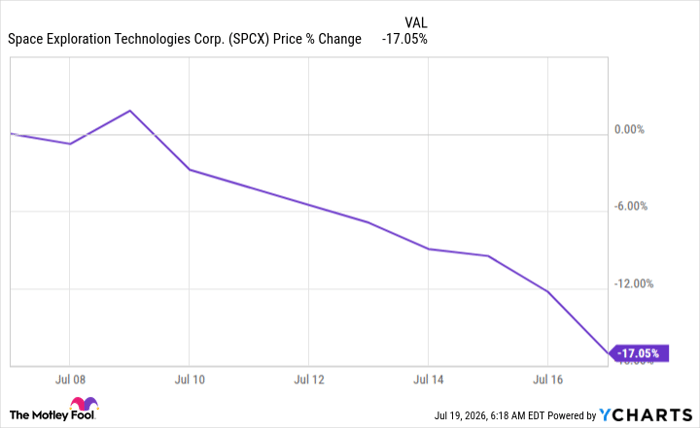
So far, the Nasdaq-100 addition hasn't brought SpaceX lasting gains. The stock has declined from its peak, and as of the July 17 market close, SpaceX traded at $123.99, significantly below its IPO price.
New additions to the Nasdaq-100
For some clues about what may happen next, let's turn to history. We'll consider some of the new additions to the index over the past three years and their performances in the two months following their entrance.
| Entry date | Stock | Two-month performance |
|---|---|---|
| Dec. 18, 2023 | DoorDash | up 12% |
| Dec. 18, 2023 | MongoDB | up 12% |
| Dec, 18, 2023 | Roper Technologies | up 0.5% |
| Dec. 23, 2024 | Palantir Technologies | up 25% |
| Dec. 23, 2024 | Strategy | down 9.7% |
| Dec. 23, 2024 | Axon Enterprise | down 17% |
| Dec. 22, 2025 | Alnylam Pharmaceuticals | down 17% |
| Dec. 22, 2025 | Insmed | down 6.1% |
| Dec. 22, 2025 | Seagate Technology | up 45% |
| Dec. 22, 2025 | Western Digital | up 61% |
|
Data source: Ycharts. |
As we can see, six out of 10 stocks advanced during this time period. But in the case of Seagate Technology and Western Digital, we can't attribute the movement to entrance in the index: Both companies are involved in the booming AI memory and storage businesses, and stocks in the industry have soared this year.
So history offers us a clear answer: While a stock may see a bit of upward momentum around the time of its addition to the index, it's generally limited in size and duration. In some cases, it's hardly even noticeable.
SpaceX has echoed this, advancing slightly right after the addition. But then the stock plummeted in the days to follow.
SPCX data by YCharts
Look to earnings
What does this mean for you as an investor? A stock's entry into a particular index isn't a reason to add that player to your portfolio. It's great that a company is acknowledged as a giant of the times, but this doesn't necessarily make it a fantastic investment. Instead, investors should look to the company's earnings track record, or if the company isn't yet profitable, consider its path to profitability: Does it have a clear roadmap and goals that are attainable? And it's important to consider your own investment style too.
For example, SpaceX isn't yet profitable, and some of its biggest goals rely on technology that hasn't yet been proven -- if the company reaches its goals, it may be a smashing success, but along the way, the stock carries a significant amount of risk. So, while SpaceX may be appropriate for a very aggressive investor, it's not the best choice for a cautious investor.
History offers us a clear message: Nasdaq-100 membership, while exciting, isn't the key to stock performance. All of this means it's a better idea to turn our attention to the company's -- whether it's SpaceX or another -- next earnings reports and progress toward goals.
Should you buy stock in Space Exploration Technologies right now?
Before you buy stock in Space Exploration Technologies, consider this:
The Motley Fool Stock Advisor analyst team just identified what they believe are the 10 best stocks for investors to buy now… and Space Exploration Technologies wasn’t one of them. The 10 stocks that made the cut could produce monster returns in the coming years.
Consider when Netflix made this list on December 17, 2004... if you invested $1,000 at the time of our recommendation, you’d have $371,842!* Or when Nvidia made this list on April 15, 2005... if you invested $1,000 at the time of our recommendation, you’d have $1,244,783!*
Now, it’s worth noting Stock Advisor’s total average return is 900% — a market-crushing outperformance compared to 207% for the S&P 500. Don't miss the latest top 10 list, available with Stock Advisor, and join an investing community built by individual investors for individual investors.
See the 10 stocks »
*Stock Advisor returns as of July 20, 2026.
Adria Cimino has no position in any of the stocks mentioned. The Motley Fool has positions in and recommends Alnylam Pharmaceuticals, Axon Enterprise, DoorDash, MongoDB, Palantir Technologies, and Western Digital. The Motley Fool recommends Roper Technologies. The Motley Fool has a disclosure policy.
Recommended Articles


