


Why Does Donald Trump Think Australia Has the Answer to Social Security's Woes?
Key Points
Australia's superannuation fund helps ensure workers have money in retirement.
Only employers are mandated to pay into the superannuation fund.
U.S. retirement experts warn that switching over to the Australian system would not be an easy fix.
- The $23,760 Social Security bonus most retirees completely overlook ›
President Donald Trump has said that his administration is examining an overhaul of the U.S. retirement savings system, and that Trump would like that overhaul to be modeled on Australia's approach. While the president's details remain fuzzy, he promises the new system -- known as superannuation funds -- would be better for American workers.
"They have a plan in Australia, which people really like. It’s really worked out very well, incredibly well, and very respected. And we’re going to be talking about that with Congress and see if we can implement it ..." Trump was quoted as saying July 6 during a Rose Garden lunch.
Missed Nvidia in 2009? This Rare Signal Is Flashing Again. In 2009, a "Double Down" signal flashed for a little-known chipmaker called Nvidia. For the first time in years, that same "Total Conviction" signal is flashing for a company 1/100th the size of Nvidia. Continue »
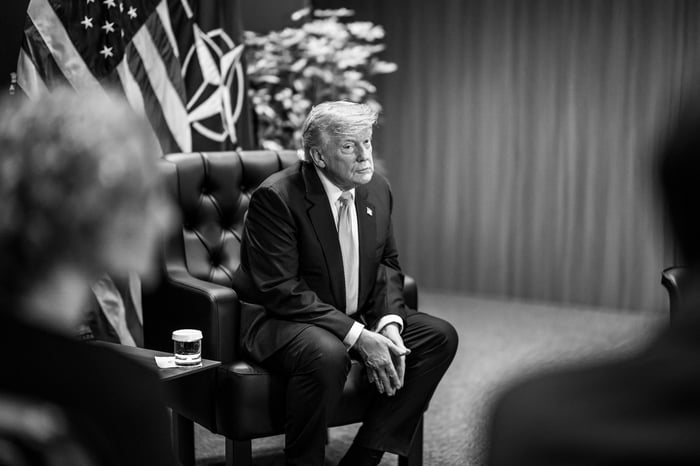
Image source: The White House.
How superannuation works
Superannuation -- also called "super" -- works by the employer putting an amount equal to a fixed percentage of an employee's wages into an investment fund solely in their name. Employers are required to make contributions on the employee's behalf. Unlike in the U.S., Australian workers don't see this money being taken out of their paycheck. As of 2026, the mandatory contribution is 12% of an employee's earnings up to $270,830 and must be paid at the same time as their normal salary. In the U.S., the tax rate for Social Security is 6.2% for the employer and 6.2% for the employee.
Like Social Security in the U.S., the worker can generally access the account only upon reaching retirement age or meeting specific conditions, and temporary residents who've paid into the system may be able to claim their super after they leave the country as a departing Australia superannuation payment (DASP).
Self-determination
Most employees can compare available super funds and choose the one they want their contributions paid into. If they don't choose their own, their employer pays into the person's existing "stapled super fund." A stapled super fund is an existing account that's linked (or "stapled") to an individual employee and follows them as they change jobs. The Australian Tax Office notes that "if you don't have a stapled super fund, your employer pays your super into a nominated super fund that they choose."
In addition to employer contributions, Australians can add to their super by making voluntary contributions. Although there are limits on the amount they can contribute annually without incurring additional tax, employee contributions can supersize their super fund.
Has the time for change arrived?
Among the 5 million people with a 401(k)-type plan administered by Vanguard, the median balance in 2025 was just $44,115, far short of the amount most Americans will need to retire. The issue becomes even more pressing when you consider that the Social Security trust fund is set to run dry in 2032. Unless Congress steps in to shore up the system, Social Security recipients can expect benefit cuts of 24%.
No easy fix
Retirement experts caution that adopting the Australian system wouldn't provide the U.S. with an easy fix. Even if the decision is made to replace the current Social Security system, the government still must determine how to handle the benefits already promised. And if the U.S. started superannuation next year, people's accounts wouldn't build up enough to pay for retirement for many years.
There's also a good chance that higher compulsory employer contributions would spark outrage among businesses, which might decide to pass the contributions they're forced to pay on to employees through lower compensation.
While we can't know what Donald Trump is thinking or if he will bring a super plan to lawmakers, it's possible that the president's interest in the Australian system is rooted in the fact that employers must make investments for nearly all workers, who get back their own (invested) money when they retire. In the U.S., the system relies on current workers paying for the benefits of those who have already retired.
The $23,760 Social Security bonus most retirees completely overlook
If you're like most Americans, you're a few years (or more) behind on your retirement savings. But a handful of little-known "Social Security secrets" could help ensure a boost in your retirement income.
One easy trick could pay you as much as $23,760 more... each year! Once you learn how to maximize your Social Security benefits, we think you could retire confidently with the peace of mind we're all after. Join Stock Advisor to learn more about these strategies.
View the "Social Security secrets" »
The Motley Fool has a disclosure policy.
Recommended Articles


