


AMD Stock Down 17% From Peak — Can July 22 Advancing AI Save It?
TradingKey -Advanced Micro Devices (NASDAQ: AMD) closed the week on Friday, July 17, with the stock trading just beneath $500 after slipping below its uptrend line and the critical $501.50 support level on the two-hour chart. That puts shares down roughly 17% from their high of $584.73 set on June 30. Meanwhile, both the 50-period and 200-period EMAs (at $526.68 and $520.65 respectively) remain over the stock to confirm short term bearish pressure.
RSI was somewhere in the range of 29 to 34, indicating deep selling. And the week ahead will host the key AMD catalyst for the year: July 22-23 Advancing AI 2026, when Zen 6 Venice EPYC ships on TSMC 2nm, and when the MI455X roadmap gets updated. A confirmed close over $501.50 next week will mark the start of the recovery. Support levels sit at $478 then $457.
Why AMD’s Trendline Break and 17% Decline from High Came With No AMD-Specific News
The drop from AMD’s trendline and its 17% drawdown from highs has nothing to do with a company-specific negative catalyst. The firm had no bad quarter, no customer pulled back, and no new product delays. Every one of the declines was part of a broader sector selloff. To start with, TSMC announced its second quarter results on July 16, raised the company’s capex budget by $5 billion from $52 to $56 billion, and raised again to a range of $60 to $64 billion, which sent the stock 5% or more down after hours on concerns that increased industry spending could pressure margins across the AI value chain.
From here, every company in the broader semiconductor space for AI sold off as a group. Micron, Nvidia, SK Hynix, AMD, ASML, Tokyo Electron and everyone else all sold down that day. AMD dropped 5.33% Friday alone, compounding declines from earlier in the week, also after Samsung announced its record Q2 results and profit taking occurred.
On a macro level, Bank of America’s Bubble Risk Indicator is now at its highest level since June 2000, which sparked comparisons back to the bubble peak of 2000. This is the overhang on the sector at the moment. Wedbush Securities analyst Dan Ives argues AI is still just in the third inning and that most enterprise AI is coming soon.
Meanwhile, Goldman Sachs pointed out that Nvidia’s forward P/E ratio is below its five-year average, indicating that the sector may not be overvalued even at current levels. And, AMD is still up somewhere in the range of 140% to 150% year-to-date. This is technically just a trendline break and the RSI reading of 29. It is technical, a manifestation of sentiment-driven selling, not fundamentals deteriorating.
Analysts Raised Price Targets as the Sell-off Unfolded; What They’re Seeing
The divergence in AMD’s share price and analyst actions this week is probably the best signal we can read today. As AMD fell through $501 and below the 200 period EMA, KeyBanc raised its AMD price target from $530 to $725. BofA raised its AMD price target to $620 due to what they described as exceptional demand for server chips and a beat-and-raise on the Aug. 4 report. BNP Paribas also raised the firm’s AMD price target to $600. TD Cowen raised the target to $675. And Stifel raised the firm’s AMD price target.
All of them made the same argument: AMD’s Zen 6 Venice EPYC server processor, which has a confirmed commercial launch on July 22, along with an MI455X GPU roadmap update announced at Advancing AI 2026, will drive stronger AMD earnings growth in 2H26, and into 2027. The second quarter has a EPS consensus of $1.61 and growth of 235% year over year. Second quarter revenue is forecast at $11.29 billion, up 47% year over year.
The average AMD price target after the multiple upgrades comes to around $541. However, the distribution shows the KeyBanc $725, the BofA $620, TD Cowen $675, and BNP $600 targets all well above the former consensus level. AMD currently has 28 Buy ratings and 8 Hold recommendations. Analysts are signaling that the TSMC capex-driven sell-off impacted AMD purely as a function of industry exposure, but not because AMD is experiencing any material shift in its revenue outlook.
Meta confirmed in its June partnership announcement that it will use AMD’s MI450-series GPUs and the Zen 6 EPYC in H2 2026, providing the kind of visibility needed for multi-gigawatt orders. That’s not going away because of TSMC raising its guidance.
The AMD Weekly Breakout Trade Setup Ahead of the July 22 Advancing AI Event: $478 Is the Hard Support
The upcoming July 22-23 Advancing AI 2026 event, which will be held in San Francisco, represents the catalyst the stock needs to turn the tide and break its current bearish trend. That’s where AMD plans to officially ship its new Zen 6 Venice server CPU, its fastest ever at 1.7x performance compared to the previous generation, along with an MI455X GPU roadmap refresh targeting H2 2026 deployment. A solid product announcement or new hyperscaler contract would likely lift AMD back over the $501.50 barrier. Second quarter 2026 earnings results will follow the meeting on Aug. 4.
What's Happening at AMD Advancing AI on July 22?
AMD is expected to announce its 6th-generation EPYC server CPUs (codename Zen 6 Venice) in advance, which will be the commercial release of AMD chips built on TSMC 2nm and 1.7x performance improvement over the prior generation, and likely an update of the MI455X GPU roadmap for the second half of 2026.
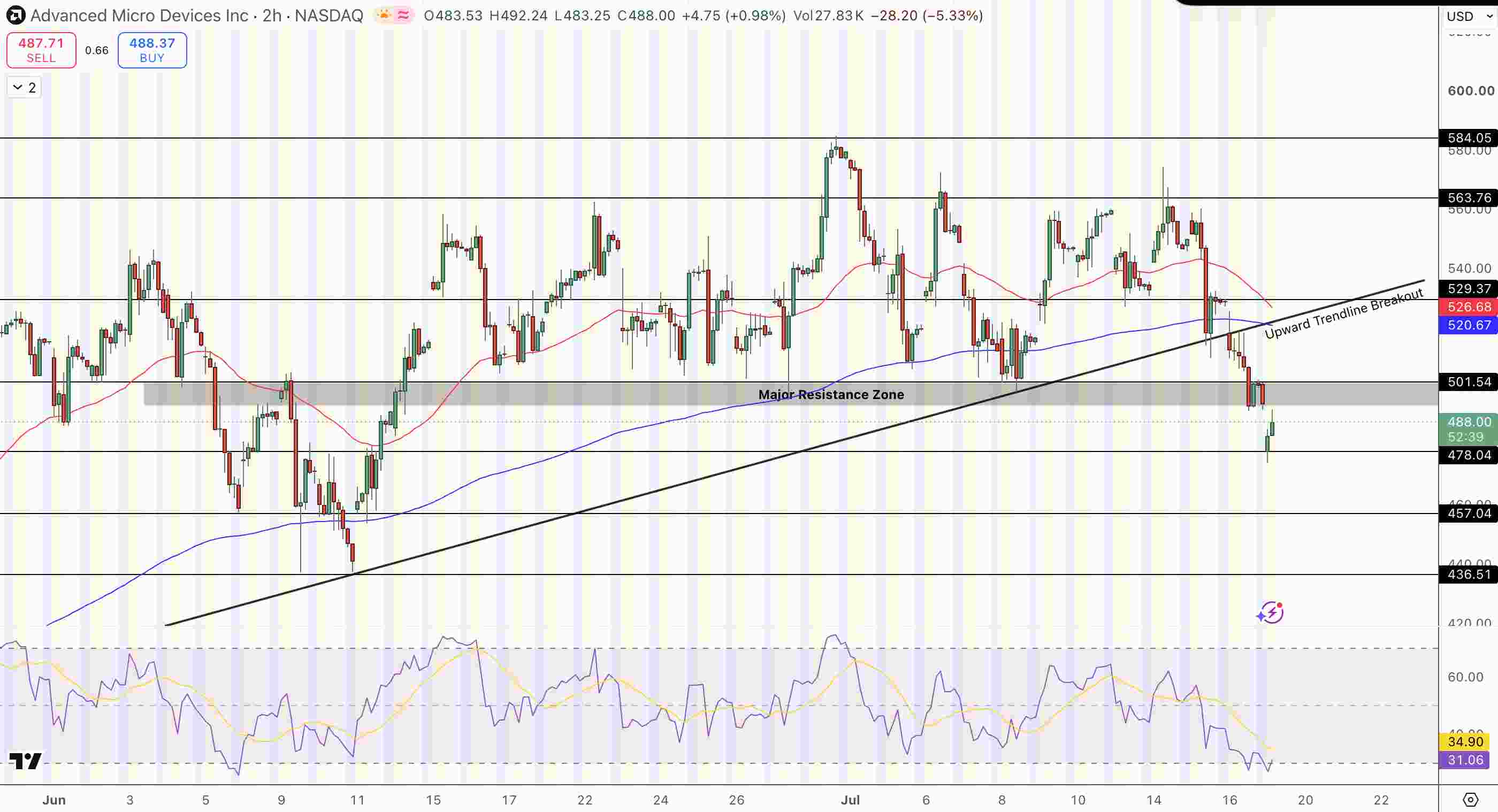
AMD Price Chart - Source: Tradingview
Meta said that it will buy AMD's 5th-generation MI450 series datacenter GPUs and 6th-generation EPYC CPUs starting from second-half 2026, so we have a real hyperscaler deployment for these launches to point to as we wait. The event, called Advancing AI on Wednesday, July 22 and 23, is the next key AMD-specific catalyst ahead of its Aug. 4 Q2 earnings report.
Why Are Analysts Raising Targets Into The Weakness?
The analyst firms raising their AMD price targets this week include KeyBanc, Bank of America, BNP Paribas, TD Cowen, and Stifel. The thesis for those higher targets is similar to the one we've outlined here: TSMC was sold due to concerns around advanced node demand and TSMC's own capex outlook. Analysts don't think AMD is any worse for wear after this selloff.
The consensus estimate of $1.61 for Q2 EPS (up 235% year-on-year) and $11.29B in revenue (up 47% year-on-year) still comes from the same server CPU and GPU business that led to this selloff. July 22 will see the Zen 6 Venice launch with the expected MI455X GPU roadmap update, providing the next near-term catalyst for continued revenue acceleration into second half 2026 and beyond into 2027. The next catalysts are independent of TSMC's capital spending outlook.
Bottom Line
AMD closes the week at $486.27, down 17% from its $584.73 high in June. AMD's trendline is down, with the relative strength index hovering near 29. The selloff isn't caused by any AMD-specific bad news. Price targets were raised at KeyBanc ($725), BofA ($620), TD Cowen ($675) and BNP ($600) ahead of the weakness. This week is centered on July 22-23 Advancing AI 2026 where we expect to see the commercial Zen 6 Venice on TSMC 2nm, with the expected MI455X GPU roadmap update.
AMD can start to turn higher if the next week closes higher than $501.50, targeting $520 EMA cluster. The next major support is at $478 with $457 being the next support if broken. Q2 earnings on August 4 have consensus EPS estimates of $1.61 (up 235% year-on-year) and revenue of $11.29B (up 47% year-on-year).
Recommended Articles


