


The Stock Market Is Rocky Right Now. History Says It's Still a Prime Buying Opportunity.
Key Points
After a record-breaking year, major market indexes have stagnated in recent weeks.
History shows that time in the market is more important than timing the market.
Even if a downturn is coming, investing now can be a smart move.
- 10 stocks we like better than S&P 500 Index ›
The S&P 500 (SNPINDEX: ^GSPC), Nasdaq Composite (NASDAQINDEX: ^IXIC), and Dow Jones Industrial Average (DJINDICES: ^DJI) have been making headlines recently for closing out their best quarter in years.
However, as tech volatility rattles the market, these indexes have stagnated -- up by only 1.6%, 0.9%, and 2.6%, respectively, over the last month, as of this writing.
Where to invest $1,000 right now? Our analyst team just revealed what they believe are the 10 best stocks to buy right now, when you join Stock Advisor. See the stocks »
Despite the market's rocky performance lately, history still has plenty of good news for investors. With the right strategy, buying now could be a lucrative decision.
Image source: Getty Images.
History says there's never a bad time to invest
It can be tempting to put off investing until the market stabilizes, especially if you're worried we're on the verge of a recession or crash. But if history proves anything, it's that time in the market is far more valuable than timing the market.
There's no way to know how stock prices will fare in the coming months or years, and even the experts sometimes get it wrong. In June 2023, for example, analysts at Deutsche Bank predicted a "near-100%" chance that a recession would begin in the next year. Since then, however, the S&P 500 has surged by more than 77%.
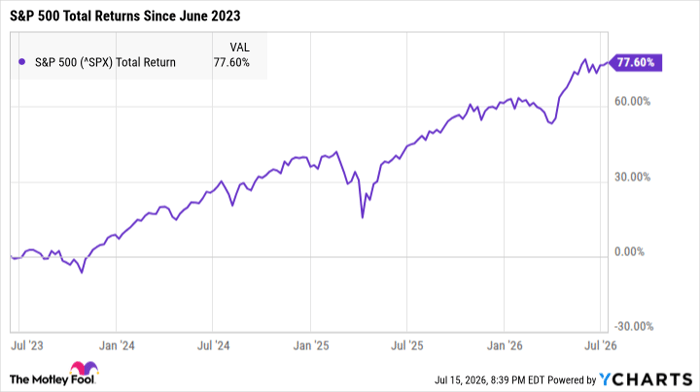
^SPX data by YCharts
If you'd decided to sit out of the market back in 2023 out of fear that a recession was looming, you'd have missed out on potentially lucrative gains.
But what if a recession really is coming?
We're bound to face a downturn at some point, but history still has good news: With a long-enough outlook, you're incredibly likely to earn positive total returns.
Say, for instance, you'd invested in an S&P 500 ETF or index fund in January 2000. The market was at its tipping point during the dot-com bubble, which would lead to one of the longest bear markets in S&P 500 history. It faced the Great Recession almost immediately after it recovered, and the index wouldn't reach a new all-time high until 2012.
Since January 2000, however, the S&P 500 has earned total returns of 735%. In other words, no matter how severe the short-term volatility may be, history says the market has outstanding long-term earning potential.
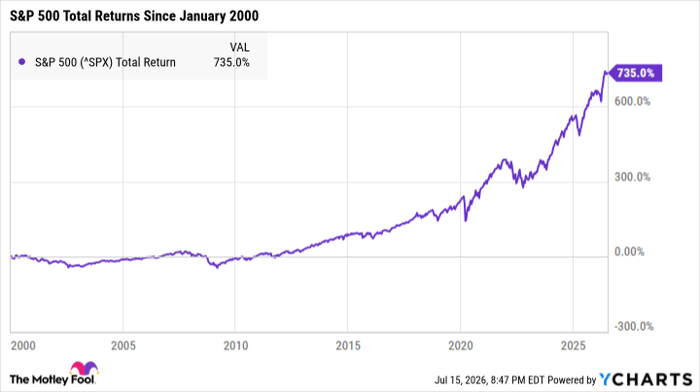
^SPX data by YCharts
The key is to invest in healthy stocks from companies with sturdy foundations. Recessions are major tests for companies, and only the strongest will survive prolonged economic instability.
Some stocks are incredibly overvalued right now, and those investments are typically hit the hardest during bear markets and recessions. Companies with unstable finances, a leadership team with a history of questionable decisions, or a lack of a competitive advantage, for example, may struggle to survive.
The best thing you can do right now is to double-check that you have a well-diversified portfolio of stocks with solid fundamentals and prepare to hold those stocks for at least a few years. With enough time, history shows that a strong portfolio can survive nearly anything.
Should you buy stock in S&P 500 Index right now?
Before you buy stock in S&P 500 Index, consider this:
The Motley Fool Stock Advisor analyst team just identified what they believe are the 10 best stocks for investors to buy now… and S&P 500 Index wasn’t one of them. The 10 stocks that made the cut could produce monster returns in the coming years.
Consider when Netflix made this list on December 17, 2004... if you invested $1,000 at the time of our recommendation, you’d have $400,964!* Or when Nvidia made this list on April 15, 2005... if you invested $1,000 at the time of our recommendation, you’d have $1,272,955!*
Now, it’s worth noting Stock Advisor’s total average return is 930% — a market-crushing outperformance compared to 210% for the S&P 500. Don't miss the latest top 10 list, available with Stock Advisor, and join an investing community built by individual investors for individual investors.
See the 10 stocks »
*Stock Advisor returns as of July 17, 2026.
Katie Brockman has no position in any of the stocks mentioned. The Motley Fool has no position in any of the stocks mentioned. The Motley Fool has a disclosure policy.
Recommended Articles


