

Inflation Can Quickly Erode Your Portfolio's Value: This Is the ETF Type I'm Counting On as a Hedge Against That Happening

Source The Motley Fool

Key Points

  • Treasury Inflation-Protected Securities are designed as a hedge against inflation.

  • TIPS, as they are known, offer interest payments that vary with inflation.

  • Inflation-proof investments help protect a well-rounded portfolio.

  • 10 stocks we like better than iShares Trust - iShares U.s. Treasury Bond ETF ›

I'd love to be one of those cool, calm investors. But the truth is, I'm a natural worrywart. While I have no interest in putting the brakes on my overall portfolio, I look for ways to minimize risks. Lately, inflation has been heavy on my mind, which makes me particularly grateful for Treasury Inflation-Protected Securities (TIPS) -- specifically those included in a high-quality exchange-traded fund (ETF).

Looking for inflation protection? Look no further

Like other ETFs, TIPS ETFs are investment funds that pool your money with that of other investors to purchase a diversified portfolio of TIPS. These ETFs trade on major stock exchanges, allowing you to buy and sell shares just as you would with regular stocks.

Missed Nvidia in 2009? This Rare Signal Is Flashing Again. In 2009, a "Double Down" signal flashed for a little-known chipmaker called Nvidia. For the first time in years, that same "Total Conviction" signal is flashing for a company 1/100th the size of Nvidia. Continue »

One advantage of TIPS ETFs is their ease of access and liquidity. Couple that with built-in inflation protection, and it's easy to see how TIPS ETFs fit neatly into the diversified portfolio of anyone who worries about inflation eating away at their investments.
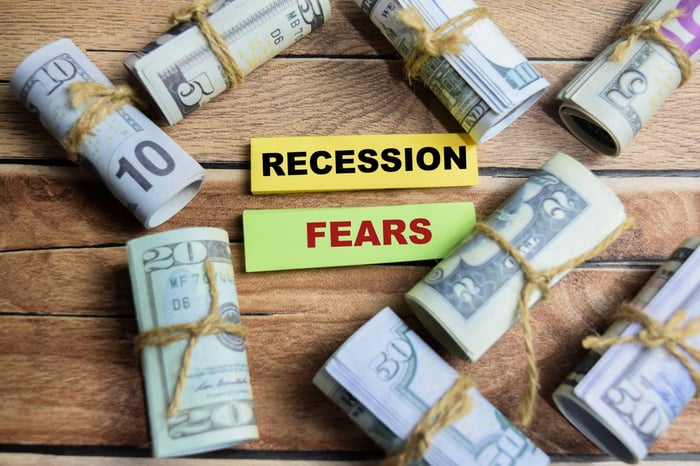
Cash wrapped in bundles with the words "Recession Fears" in the middle.

Image source: Getty Images.

How TIPS work

While traditional bonds pay a fixed interest rate, TIPS' interest payments are directly linked to inflation. As inflation rises, the principal value increases, leading to higher interest payments. On the other hand, if deflation occurs, the TIPS' principal value can decrease. However, it's guaranteed to never fall below its original value at maturity.

In other words, TIPS won't allow your investment to be eroded by inflation.

What makes TIPS so attractive

To date, it's been tough for me to identify much about TIPS ETFs that would dissuade me from adding one to my portfolio. Here's a highlight of what makes them so attractive for investors who want a measure of security in trying times.

  • Inflation hedging: If you're all about inflation-proof investments, you'll appreciate the way TIPS ETFs serve as a hedge against inflation. As grocery and gas prices rise due to inflation, so do the fund's interest payments and the value of the securities it holds.
  • Diversification: TIPS ETFs provide instant diversification across a host of issuers and maturities. This diversification reduces the risk inherent in investing in individual securities.
  • Liquidity: Unlike purchasing TIPS directly, TIPS ETFs can be traded throughout the day, providing greater ease of access when and if you need it.
  • Low expense ratio: Most TIPS ETFs carry relatively low management fees, especially as compared to mutual funds.

Performance matters

A fund must be more than a hedge against inflation. As with everything portfolio-related, there must be potential for growth. One TIPS ETF that I'm currently eyeing is the iShares U.S. Treasury Bond ETF (NYSEMKT: GOVT). With a 30-day SEC yield of 4.37% and a 12-month trailing yield of 3.61% (as of July 7), the fund has provided a stable income stream. Add to that its 0.05% expense ratio, and it's a low-cost way to invest in U.S. Treasury securities.

Nothing is perfect, and TIPS ETFs are no exception

As much as I like TIPS ETFs, there are two critical issues to keep in mind.

  1. In a deflationary environment or during periods of low inflation, TIPS ETFs may underperform.
  2. The interest income from TIPS is subject to federal income tax, which can affect overall returns.

A TIPS ETF can't prevent inflation, but it can protect a portion of my money.

Should you buy stock in iShares Trust - iShares U.s. Treasury Bond ETF right now?

Before you buy stock in iShares Trust - iShares U.s. Treasury Bond ETF, consider this:

The Motley Fool Stock Advisor analyst team just identified what they believe are the 10 best stocks for investors to buy now… and iShares Trust - iShares U.s. Treasury Bond ETF wasn’t one of them. The 10 stocks that made the cut could produce monster returns in the coming years.

Consider when Netflix made this list on December 17, 2004... if you invested $1,000 at the time of our recommendation, you’d have $395,679!* Or when Nvidia made this list on April 15, 2005... if you invested $1,000 at the time of our recommendation, you’d have $1,294,805!*

Now, it’s worth noting Stock Advisor’s total average return is 929% — a market-crushing outperformance compared to 211% for the S&P 500. Don't miss the latest top 10 list, available with Stock Advisor, and join an investing community built by individual investors for individual investors.

See the 10 stocks »

*Stock Advisor returns as of July 12, 2026.

The Motley Fool has a disclosure policy.

Disclaimer: For information purposes only. Past performance is not indicative of future results.
placeholder
Bitcoin briefly loses 2025 gains as crypto plunges over the weekend.Bitcoin experienced a sharp decline this weekend, briefly erasing its 2025 gains and dipping below its year-opening value of $93,507. The cryptocurrency fell to a low of $93,029 on Sunday, representing a 25% drop from its all-time high in October. Although it has rebounded slightly to around $94,209, the pressures on the market remain significant. The downturn occurred despite the reopening of the U.S. government on Thursday, which many had hoped would provide essential support for crypto markets. This year initially appeared promising for cryptocurrencies, particularly after the inauguration of President Donald Trump, who has established the most pro-crypto administration thus far. However, ongoing political tensions—including Trump's tariff strategies and the recent government shutdown, lasting a historic 43 days—have contributed to several rapid price pullbacks for Bitcoin throughout the year. Market dynamics are also being influenced by Bitcoin whales—investors holding large amounts of Bitcoin—who have been offloading portions of their assets, consequently stalling price rallies even as positive regulatory developments emerge. Despite these sell-offs, analysts from Glassnode argue that this behavior aligns with typical patterns seen among long-term investors during the concluding stages of bull markets, suggesting it is not indicative of a mass exodus. Notably, Bitcoin is not alone in its struggles, as Ethereum and Solana have also recorded declines of 7.95% and 28.3%, respectively, since the start of the year, while numerous altcoins have faced even steeper losses. Looking ahead, questions linger regarding the viability of the four-year cycle thesis, particularly given the increasing institutional support and regulatory frameworks now in place in the crypto landscape. Matt Hougan, chief investment officer at Bitwise, remains optimistic, suggesting a potential Bitcoin resurgence in 2026 driven by the “debasement trade” thesis and a broader trend toward increased adoption of stablecoins, tokenization, and decentralized finance. Hougan emphasized the soundness of the underlying fundamentals, pointing to a positive outlook for the sector in the longer term.
Author  Mitrade
Nov 17, 2025
Bitcoin experienced a sharp decline this weekend, briefly erasing its 2025 gains and dipping below its year-opening value of $93,507. The cryptocurrency fell to a low of $93,029 on Sunday, representing a 25% drop from its all-time high in October. Although it has rebounded slightly to around $94,209, the pressures on the market remain significant. The downturn occurred despite the reopening of the U.S. government on Thursday, which many had hoped would provide essential support for crypto markets. This year initially appeared promising for cryptocurrencies, particularly after the inauguration of President Donald Trump, who has established the most pro-crypto administration thus far. However, ongoing political tensions—including Trump's tariff strategies and the recent government shutdown, lasting a historic 43 days—have contributed to several rapid price pullbacks for Bitcoin throughout the year. Market dynamics are also being influenced by Bitcoin whales—investors holding large amounts of Bitcoin—who have been offloading portions of their assets, consequently stalling price rallies even as positive regulatory developments emerge. Despite these sell-offs, analysts from Glassnode argue that this behavior aligns with typical patterns seen among long-term investors during the concluding stages of bull markets, suggesting it is not indicative of a mass exodus. Notably, Bitcoin is not alone in its struggles, as Ethereum and Solana have also recorded declines of 7.95% and 28.3%, respectively, since the start of the year, while numerous altcoins have faced even steeper losses. Looking ahead, questions linger regarding the viability of the four-year cycle thesis, particularly given the increasing institutional support and regulatory frameworks now in place in the crypto landscape. Matt Hougan, chief investment officer at Bitwise, remains optimistic, suggesting a potential Bitcoin resurgence in 2026 driven by the “debasement trade” thesis and a broader trend toward increased adoption of stablecoins, tokenization, and decentralized finance. Hougan emphasized the soundness of the underlying fundamentals, pointing to a positive outlook for the sector in the longer term.
placeholder
Markets in 2026: Will gold, Bitcoin, and the U.S. dollar make history again? — These are how leading institutions thinkAfter a turbulent 2025, what lies ahead for commodities, forex, and cryptocurrency markets in 2026?
Author  Insights
Dec 25, 2025
After a turbulent 2025, what lies ahead for commodities, forex, and cryptocurrency markets in 2026?
placeholder
Gold rises to weekly high as US, Iran reach peace dealGold price (XAU/USD) rises to a weekly high during the Asian trading hours on Monday. The precious metal rebounds after the United States (US) and Iran had reached a deal to end their conflict, easing concerns about inflation and higher interest rates.
Author  FXStreet
Jun 15, Mon
Gold price (XAU/USD) rises to a weekly high during the Asian trading hours on Monday. The precious metal rebounds after the United States (US) and Iran had reached a deal to end their conflict, easing concerns about inflation and higher interest rates.
placeholder
WTI consolidates below $72.00 as traders monitor geopolitical developmentsWest Texas Intermediate (WTI) – the benchmark US Crude Oil price – steadies during the Asian session on Friday, stalling the previous day's downfall amid mixed messaging from the US and Iran.
Author  FXStreet
Jul 10, Fri
West Texas Intermediate (WTI) – the benchmark US Crude Oil price – steadies during the Asian session on Friday, stalling the previous day's downfall amid mixed messaging from the US and Iran.
placeholder
Gold recovers above $4,100 as traders assess US-Iran conflict Gold price (XAU/USD) rebounds to around $4,120 during the early Asian session on Friday. The precious metal edges higher as traders weigh a resumption of war in the Middle East.
Author  FXStreet
Jul 10, Fri
Gold price (XAU/USD) rebounds to around $4,120 during the early Asian session on Friday. The precious metal edges higher as traders weigh a resumption of war in the Middle East.
goTop
quote