

Nvidia Stock Just Did Something for the First Time in 7 Years. Here's What History Says Happens Next.

Source The Motley Fool

Key Points

  • Nvidia stock has generated only modest gains so far in 2026, marking a stop to its near-vertical rise.

  • The chipmaker's P/E ratio is contracting despite the company's growing earnings base.

  • History shows that Nvidia stock tends to break out after experiencing long periods of digestion.

  • 10 stocks we like better than Nvidia ›

The artificial intelligence (AI) revolution turned Nvidia (NASDAQ: NVDA) into a household name virtually overnight. Since the public launch of ChatGPT in late November 2022, Nvidia stock has risen by 1,100% -- making the company the most valuable business in the world.

However, 2026 has been an entirely different story. Shares of the semiconductor darling have gained a modest 5% so far this year. With the stock's parabolic rise coming to a halt, close observers may have noticed that Nvidia's price-to-earnings (P/E) ratio is now at its lowest level in seven years.

Where to invest $1,000 right now? Our analyst team just revealed what they believe are the 10 best stocks to buy right now, when you join Stock Advisor. See the stocks »

Let's dive into how this happened and what it means for an investment in Nvidia going forward.
Nvidia logo.

Image source: The Motley Fool.

Nvidia maintains leadership in the AI chip stack, but investors worry about competition

Nvidia's long roster of graphics processing units (GPUs) has helped the company maintain a central position in the hyperscaler AI chip stack. The company's chips serve as the primary engines for both training large language models (LLMs) and running inference deployments at scale.

Major cloud providers like Amazon Web Services (AWS), Microsoft Azure, and Google Cloud Platform (GCP) and frontier AI labs such as OpenAI and Anthropic are leveraging Nvidia's Blackwell GPU architecture and accompanying CUDA software ecosystem to build AI applications.

Skeptics highlight two main sources of risk when it comes to investing in Nvidia. On the macro side of the equation, some investors worry that AI hyperscalers could eventually moderate capex if returns on AI infrastructure investments prove slower to materialize. On the company-specific side, new accelerator architectures from Advanced Micro Devices and custom ASIC designs from Broadcom represent competitive threats that could erode Nvidia's market share in certain data center workloads.

Where is Nvidia stock headed?

I think the concerns detailed above are legitimate and explain much of the compression in Nvidia's P/E multiple. However, history offers a consistent pattern. The chart below illustrates that every prior period in which Nvidia's valuation profile compressed was followed by a powerful and sustained re-rating higher once earnings confirmed the durability of growth.
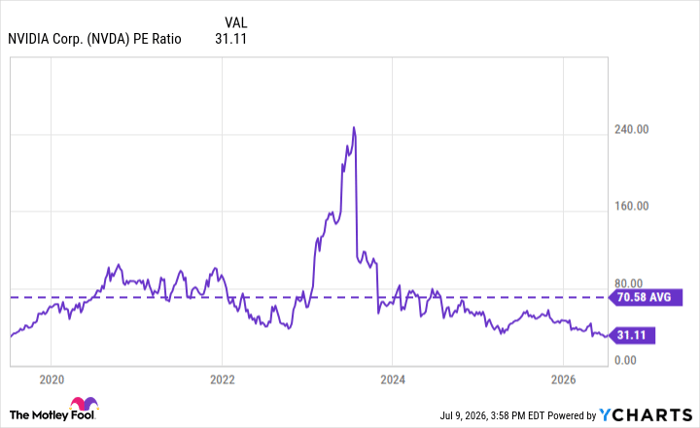
NVDA PE Ratio Chart

NVDA PE Ratio data by YCharts.

Why is this? The reason is simple: Markets ultimately follow earnings trajectories, not sentiment.

What investors are currently discounting is the fact that Nvidia is expanding beyond GPUs into adjacent layers of the AI stack. This includes investments and strategic collaborations with companies like Nokia, Marvell Technology, Coherent, and Lumentum. Through these relationships, Nvidia is becoming increasingly embedded across high-performance networking, CPU offerings optimized for AI systems, and optical interconnects needed to stitch enormous GPU clusters together.

These moves expand Nvidia's addressable market beyond general-purpose chips. As such, the company is in a position to create additional levers for revenue acceleration and compounded earnings. As Blackwell-driven revenue continues to materialize while diversification efforts scale, Nvidia's earnings base should widen -- setting the stage for meaningful valuation expansion.

All told, Nvidia's current P/E levels appear to embed a degree of normalization after years of extraordinary expansion. This is important to understand, because it helps silence the idea that there is a fundamental deterioration in Nvidia's underlying business.

Right now, investors are effectively pricing in the possibility that Nvidia's growth will moderate from its peak rates more than acknowledging how the company's absolute earnings power is positioned to expand. In turn, this creates a valuation setup that looks reasonable relative to historical trends, provided the company executes on its roadmap.

Should you buy stock in Nvidia right now?

Before you buy stock in Nvidia, consider this:

The Motley Fool Stock Advisor analyst team just identified what they believe are the 10 best stocks for investors to buy now… and Nvidia wasn’t one of them. The 10 stocks that made the cut could produce monster returns in the coming years.

Consider when Netflix made this list on December 17, 2004... if you invested $1,000 at the time of our recommendation, you’d have $395,679!* Or when Nvidia made this list on April 15, 2005... if you invested $1,000 at the time of our recommendation, you’d have $1,294,805!*

Now, it’s worth noting Stock Advisor’s total average return is 929% — a market-crushing outperformance compared to 211% for the S&P 500. Don't miss the latest top 10 list, available with Stock Advisor, and join an investing community built by individual investors for individual investors.

See the 10 stocks »

*Stock Advisor returns as of July 12, 2026.

Adam Spatacco has positions in Amazon, Microsoft, and Nvidia. The Motley Fool has positions in and recommends Advanced Micro Devices, Amazon, Broadcom, Coherent, Lumentum, Marvell Technology, Microsoft, and Nvidia. The Motley Fool has a disclosure policy.

Disclaimer: For information purposes only. Past performance is not indicative of future results.
placeholder
Bitcoin briefly loses 2025 gains as crypto plunges over the weekend.Bitcoin experienced a sharp decline this weekend, briefly erasing its 2025 gains and dipping below its year-opening value of $93,507. The cryptocurrency fell to a low of $93,029 on Sunday, representing a 25% drop from its all-time high in October. Although it has rebounded slightly to around $94,209, the pressures on the market remain significant. The downturn occurred despite the reopening of the U.S. government on Thursday, which many had hoped would provide essential support for crypto markets. This year initially appeared promising for cryptocurrencies, particularly after the inauguration of President Donald Trump, who has established the most pro-crypto administration thus far. However, ongoing political tensions—including Trump's tariff strategies and the recent government shutdown, lasting a historic 43 days—have contributed to several rapid price pullbacks for Bitcoin throughout the year. Market dynamics are also being influenced by Bitcoin whales—investors holding large amounts of Bitcoin—who have been offloading portions of their assets, consequently stalling price rallies even as positive regulatory developments emerge. Despite these sell-offs, analysts from Glassnode argue that this behavior aligns with typical patterns seen among long-term investors during the concluding stages of bull markets, suggesting it is not indicative of a mass exodus. Notably, Bitcoin is not alone in its struggles, as Ethereum and Solana have also recorded declines of 7.95% and 28.3%, respectively, since the start of the year, while numerous altcoins have faced even steeper losses. Looking ahead, questions linger regarding the viability of the four-year cycle thesis, particularly given the increasing institutional support and regulatory frameworks now in place in the crypto landscape. Matt Hougan, chief investment officer at Bitwise, remains optimistic, suggesting a potential Bitcoin resurgence in 2026 driven by the “debasement trade” thesis and a broader trend toward increased adoption of stablecoins, tokenization, and decentralized finance. Hougan emphasized the soundness of the underlying fundamentals, pointing to a positive outlook for the sector in the longer term.
Author  Mitrade
Nov 17, 2025
Bitcoin experienced a sharp decline this weekend, briefly erasing its 2025 gains and dipping below its year-opening value of $93,507. The cryptocurrency fell to a low of $93,029 on Sunday, representing a 25% drop from its all-time high in October. Although it has rebounded slightly to around $94,209, the pressures on the market remain significant. The downturn occurred despite the reopening of the U.S. government on Thursday, which many had hoped would provide essential support for crypto markets. This year initially appeared promising for cryptocurrencies, particularly after the inauguration of President Donald Trump, who has established the most pro-crypto administration thus far. However, ongoing political tensions—including Trump's tariff strategies and the recent government shutdown, lasting a historic 43 days—have contributed to several rapid price pullbacks for Bitcoin throughout the year. Market dynamics are also being influenced by Bitcoin whales—investors holding large amounts of Bitcoin—who have been offloading portions of their assets, consequently stalling price rallies even as positive regulatory developments emerge. Despite these sell-offs, analysts from Glassnode argue that this behavior aligns with typical patterns seen among long-term investors during the concluding stages of bull markets, suggesting it is not indicative of a mass exodus. Notably, Bitcoin is not alone in its struggles, as Ethereum and Solana have also recorded declines of 7.95% and 28.3%, respectively, since the start of the year, while numerous altcoins have faced even steeper losses. Looking ahead, questions linger regarding the viability of the four-year cycle thesis, particularly given the increasing institutional support and regulatory frameworks now in place in the crypto landscape. Matt Hougan, chief investment officer at Bitwise, remains optimistic, suggesting a potential Bitcoin resurgence in 2026 driven by the “debasement trade” thesis and a broader trend toward increased adoption of stablecoins, tokenization, and decentralized finance. Hougan emphasized the soundness of the underlying fundamentals, pointing to a positive outlook for the sector in the longer term.
placeholder
Markets in 2026: Will gold, Bitcoin, and the U.S. dollar make history again? — These are how leading institutions thinkAfter a turbulent 2025, what lies ahead for commodities, forex, and cryptocurrency markets in 2026?
Author  Insights
Dec 25, 2025
After a turbulent 2025, what lies ahead for commodities, forex, and cryptocurrency markets in 2026?
placeholder
Gold rises to weekly high as US, Iran reach peace dealGold price (XAU/USD) rises to a weekly high during the Asian trading hours on Monday. The precious metal rebounds after the United States (US) and Iran had reached a deal to end their conflict, easing concerns about inflation and higher interest rates.
Author  FXStreet
Jun 15, Mon
Gold price (XAU/USD) rises to a weekly high during the Asian trading hours on Monday. The precious metal rebounds after the United States (US) and Iran had reached a deal to end their conflict, easing concerns about inflation and higher interest rates.
placeholder
WTI consolidates below $72.00 as traders monitor geopolitical developmentsWest Texas Intermediate (WTI) – the benchmark US Crude Oil price – steadies during the Asian session on Friday, stalling the previous day's downfall amid mixed messaging from the US and Iran.
Author  FXStreet
Jul 10, Fri
West Texas Intermediate (WTI) – the benchmark US Crude Oil price – steadies during the Asian session on Friday, stalling the previous day's downfall amid mixed messaging from the US and Iran.
placeholder
Gold recovers above $4,100 as traders assess US-Iran conflict Gold price (XAU/USD) rebounds to around $4,120 during the early Asian session on Friday. The precious metal edges higher as traders weigh a resumption of war in the Middle East.
Author  FXStreet
Jul 10, Fri
Gold price (XAU/USD) rebounds to around $4,120 during the early Asian session on Friday. The precious metal edges higher as traders weigh a resumption of war in the Middle East.
goTop
quote