

Meta Stock Price Forecast: Heavy Upside Pressure on Stock Price, Can It Still Rise in the Second Half of 2026?

Source Tradingkey

TradingKey - As of July 9, Eastern Time, Meta ( META )'s latest stock price was $631.48, up 4.7% intraday, touching an intraday high of $633.27. Meta's stock price reclaimed the $600 mark, but technicals still suggest the possibility of a continued pullback.

Meta Advertising Business Strong, AI Capital Expenditure Becomes Biggest Disagreement

From a fundamental perspective, the company's first-quarter revenue reached $56.311 billion, up 33% year-over-year; net income was $26.773 billion, up 61% year-over-year; and diluted EPS was $10.44, compared with $6.43 in the same period last year. Advertising remains Meta's core cash cow, with first-quarter ad revenue reaching $55.024 billion, up 33% year-over-year. Ad impressions grew 19% year-over-year, and the average price per ad increased 12% year-over-year, indicating that Meta is not only continuing to expand its traffic, but is also improving its ad pricing power.

More importantly, Meta's second-quarter guidance remains strong. The company expects total second-quarter revenue to be between $58 billion and $61 billion, indicating that advertising demand and improvements in AI recommendation efficiency are still expected to continue supporting revenue growth.

Strong financial results and guidance have prompted institutions to collectively turn bullish on Meta. Wells Fargo recently raised Meta's price target to $767, primarily because advertising growth remains robust. Morgan Stanley maintained its $775 price target and considers Meta a key allocation choice among mega-cap tech stocks, believing that market concerns over the return on investment of AI spending have already been reflected in the stock price. Although Goldman Sachs slightly lowered its price target from $840 to $830 after the earnings release, it maintained its Buy rating, indicating that its core outlook has not turned pessimistic. Analyst data compiled by MarketBeat shows that Meta's average 12-month price target is approximately $840.64, representing substantial upside potential from the current share price, with the highest price target reaching $1,015.

However, the market's biggest debate over Meta currently lies in its heavy AI spending, which is pressuring short-term free cash flow. The company expects capital expenditures to reach $125 billion to $145 billion in 2026, higher than previously estimated, primarily for data centers, servers, and AI model training and inference infrastructure. For bulls, Meta's massive AI investment can enhance ad recommendation efficiency, content distribution efficiency, and user retention, ultimately translating into higher advertising revenue. For bears, such spending is difficult to justify in terms of return on investment in the short term.

Meanwhile, recent reports that Meta might sell or lease its surplus computing power have attracted market attention. If Meta can monetize part of its AI infrastructure through cloud computing or enterprise service revenue, it would help ease market concerns over capital expenditures. However, this also raises new questions: Is Meta truly strengthening its AI platform capabilities, or is it forced to seek monetization routes because its front-loaded investment in computing power was too large? Therefore, in upcoming earnings reports, investors will need to focus on whether AI spending is actually improving advertising efficiency and whether management provides a clearer commercialization path for its computing power.

Meta Stock Price Trend Analysis: Key Resistance Level at $650, Support at $520
meta-22c0e156f96a489c9cfb0f80a094b8eb

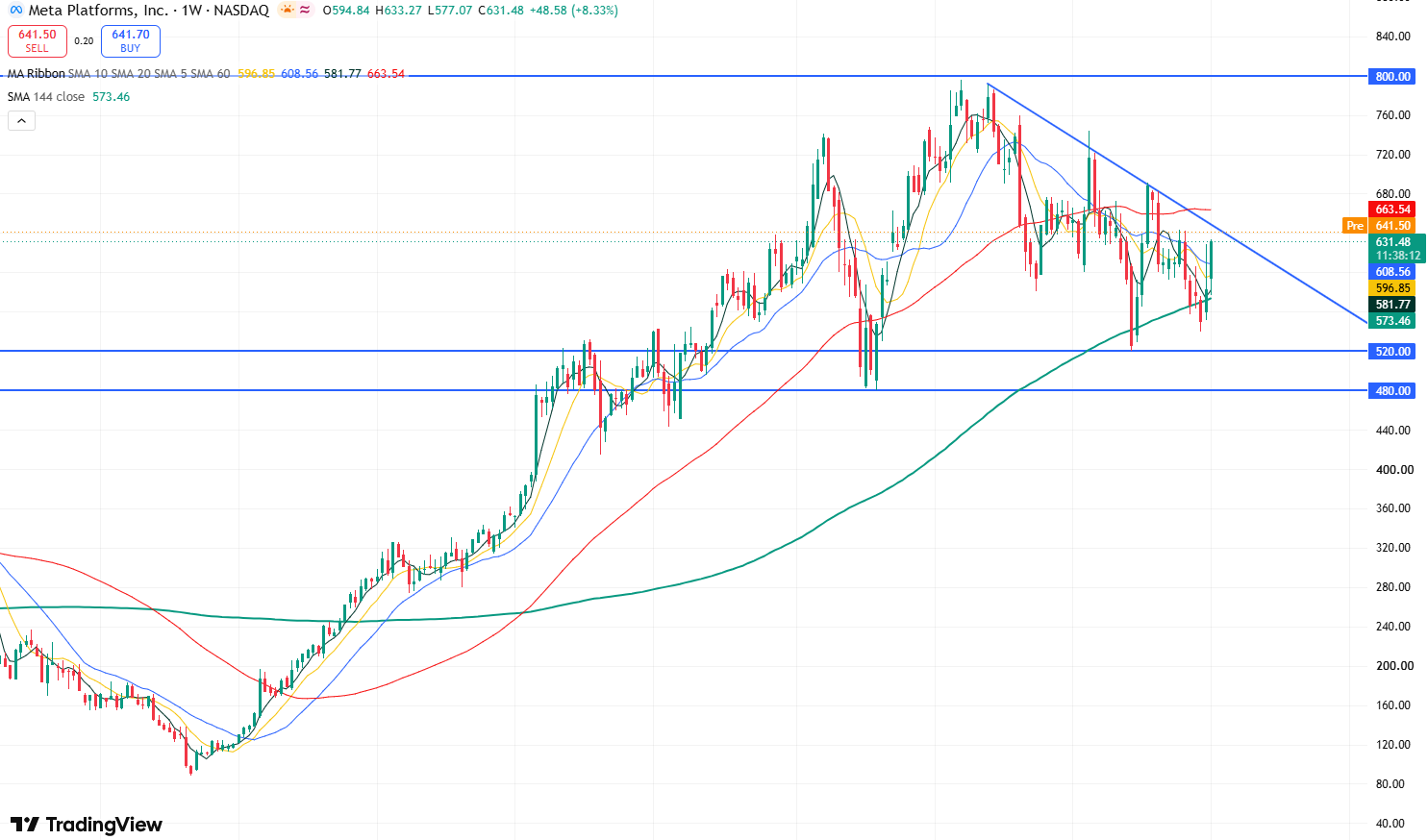
Meta weekly stock chart, Source: TradingView

Looking at Meta's weekly stock chart, the stock price exhibited a strong bullish trend from October 2022 to September 2025. However, since the beginning of this year, the stock has entered a wide-ranging consolidation and correction phase. Meanwhile, as the candlestick highs and lows continue to move lower, connecting the candlestick highs forms a clear downward trendline, indicating that the short-term trend of the stock price is biased to the downside.

From the perspective of the moving average system, as the stock price has fallen below the SMA144 moving average twice consecutively, the market's bearish momentum has been further strengthened, suggesting the stock price may continue to correct downward.

Currently, attention should be paid to the key resistance level overhead near the downward trendline, which is around $650. If the stock price can effectively break out and stabilize above the downward trendline, it will open up upside room toward the important resistance level of $800. Conversely, if the stock price remains under pressure below $650, it may continue to correct downward, with the primary support level below situated near $520. If the stock price breaks below this level, it may further correct toward the key support level of $480, and if it fails to hold $480, the stock price could undergo a deeper correction toward the $430 support level.

Disclaimer: For information purposes only. Past performance is not indicative of future results.
placeholder
Bitcoin CME gaps at $35,000, $27,000 and $21,000, which one gets filled first?Prioritize filling the $27,000 gap and even try higher.
Author  FXStreet
Aug 22, 2023
Prioritize filling the $27,000 gap and even try higher.
placeholder
Coinbase launches futures on new index tied to Apple, Microsoft, Nvidia, Tesla, and BlackRockCoinbase is launching a new futures contract that will track the price of both U.S. tech stocks and crypto ETFs in a single product.
Author  Cryptopolitan
Sep 03, 2025
Coinbase is launching a new futures contract that will track the price of both U.S. tech stocks and crypto ETFs in a single product.
placeholder
Bitcoin briefly loses 2025 gains as crypto plunges over the weekend.Bitcoin experienced a sharp decline this weekend, briefly erasing its 2025 gains and dipping below its year-opening value of $93,507. The cryptocurrency fell to a low of $93,029 on Sunday, representing a 25% drop from its all-time high in October. Although it has rebounded slightly to around $94,209, the pressures on the market remain significant. The downturn occurred despite the reopening of the U.S. government on Thursday, which many had hoped would provide essential support for crypto markets. This year initially appeared promising for cryptocurrencies, particularly after the inauguration of President Donald Trump, who has established the most pro-crypto administration thus far. However, ongoing political tensions—including Trump's tariff strategies and the recent government shutdown, lasting a historic 43 days—have contributed to several rapid price pullbacks for Bitcoin throughout the year. Market dynamics are also being influenced by Bitcoin whales—investors holding large amounts of Bitcoin—who have been offloading portions of their assets, consequently stalling price rallies even as positive regulatory developments emerge. Despite these sell-offs, analysts from Glassnode argue that this behavior aligns with typical patterns seen among long-term investors during the concluding stages of bull markets, suggesting it is not indicative of a mass exodus. Notably, Bitcoin is not alone in its struggles, as Ethereum and Solana have also recorded declines of 7.95% and 28.3%, respectively, since the start of the year, while numerous altcoins have faced even steeper losses. Looking ahead, questions linger regarding the viability of the four-year cycle thesis, particularly given the increasing institutional support and regulatory frameworks now in place in the crypto landscape. Matt Hougan, chief investment officer at Bitwise, remains optimistic, suggesting a potential Bitcoin resurgence in 2026 driven by the “debasement trade” thesis and a broader trend toward increased adoption of stablecoins, tokenization, and decentralized finance. Hougan emphasized the soundness of the underlying fundamentals, pointing to a positive outlook for the sector in the longer term.
Author  Mitrade
Nov 17, 2025
Bitcoin experienced a sharp decline this weekend, briefly erasing its 2025 gains and dipping below its year-opening value of $93,507. The cryptocurrency fell to a low of $93,029 on Sunday, representing a 25% drop from its all-time high in October. Although it has rebounded slightly to around $94,209, the pressures on the market remain significant. The downturn occurred despite the reopening of the U.S. government on Thursday, which many had hoped would provide essential support for crypto markets. This year initially appeared promising for cryptocurrencies, particularly after the inauguration of President Donald Trump, who has established the most pro-crypto administration thus far. However, ongoing political tensions—including Trump's tariff strategies and the recent government shutdown, lasting a historic 43 days—have contributed to several rapid price pullbacks for Bitcoin throughout the year. Market dynamics are also being influenced by Bitcoin whales—investors holding large amounts of Bitcoin—who have been offloading portions of their assets, consequently stalling price rallies even as positive regulatory developments emerge. Despite these sell-offs, analysts from Glassnode argue that this behavior aligns with typical patterns seen among long-term investors during the concluding stages of bull markets, suggesting it is not indicative of a mass exodus. Notably, Bitcoin is not alone in its struggles, as Ethereum and Solana have also recorded declines of 7.95% and 28.3%, respectively, since the start of the year, while numerous altcoins have faced even steeper losses. Looking ahead, questions linger regarding the viability of the four-year cycle thesis, particularly given the increasing institutional support and regulatory frameworks now in place in the crypto landscape. Matt Hougan, chief investment officer at Bitwise, remains optimistic, suggesting a potential Bitcoin resurgence in 2026 driven by the “debasement trade” thesis and a broader trend toward increased adoption of stablecoins, tokenization, and decentralized finance. Hougan emphasized the soundness of the underlying fundamentals, pointing to a positive outlook for the sector in the longer term.
placeholder
Gold rises to weekly high as US, Iran reach peace dealGold price (XAU/USD) rises to a weekly high during the Asian trading hours on Monday. The precious metal rebounds after the United States (US) and Iran had reached a deal to end their conflict, easing concerns about inflation and higher interest rates.
Author  FXStreet
Jun 15, Mon
Gold price (XAU/USD) rises to a weekly high during the Asian trading hours on Monday. The precious metal rebounds after the United States (US) and Iran had reached a deal to end their conflict, easing concerns about inflation and higher interest rates.
placeholder
Gold recovers above $4,100 as traders assess US-Iran conflict Gold price (XAU/USD) rebounds to around $4,120 during the early Asian session on Friday. The precious metal edges higher as traders weigh a resumption of war in the Middle East.
Author  FXStreet
Jul 10, Fri
Gold price (XAU/USD) rebounds to around $4,120 during the early Asian session on Friday. The precious metal edges higher as traders weigh a resumption of war in the Middle East.
goTop
quote