

Jensen Huang's Blue-Collar Millionaire Prediction Lifted Quanta Services' Backlog to $48 Billion

Source The Motley Fool

Key Points

  • Quanta Services offers a unique way to invest in AI infrastructure by building the power grid and electrical systems that data centers depend on.

  • Management projects the total addressable market through 2030 is $2.4 trillion.

  • 10 stocks we like better than Quanta Services ›

For a while now, Nvidia (NASDAQ: NVDA) CEO Jensen Huang has been making a point that runs counter to the usual AI hype. The bottleneck in building out artificial intelligence, he argues, isn't just chips, it's the electricians, pipefitters, and grid crews needed to raise the data centers, fabs, and power lines those chips depend on. He's gone so far as to suggest skilled tradespeople could become a new class of high earners. That thesis has a very real corporate beneficiary, and its backlog just told the story.

Why Quanta Services sits at the center of the build-out

Quanta Services (NYSE: PWR) is a specialty contractor that strings transmission lines, builds substations, and wires interconnections that enable a hyperscaler to power a new campus. When Quanta reported earlier this year, its total backlog, essentially the work already signed and waiting to be done, reached a record of $48.5 billion. Management frames the longer-term opportunity as a $2.4 trillion addressable market through 2030, driven by aging grids, new power generation, and the enormous electricity loads that AI facilities represent.

Where to invest $1,000 right now? Our analyst team just revealed what they believe are the 10 best stocks to buy right now, when you join Stock Advisor. See the stocks »

The moat most investors overlook: Quanta trains its own workforce

Here's the angle I find more interesting than the backlog figure itself. If labor is the true constraint on the AI build-out, then the company that controls its own labor supply holds a quiet advantage. Quanta does exactly that. It owns Northwest Lineman College, which trains thousands of pre-apprentices, apprentices, and journey-level line workers every year, and it runs its own advanced training centers to develop crews across its service lines.
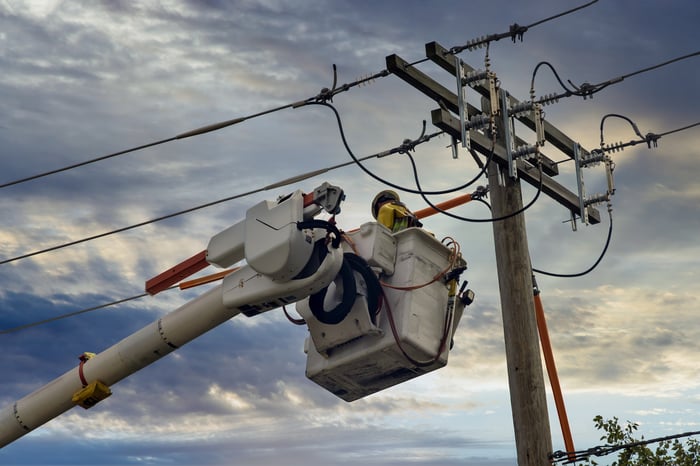
A line-worker sits in a basket attending to wires.

Image source: Getty Images.

That matters because you cannot conjure a journeyman lineworker overnight; the training takes years. While competitors bid against each other for the same scarce workers, Quanta is busy manufacturing them, then deploying them on its own projects. In a market where nearly every contractor tells investors the limit is people rather than demand, owning the pipeline of skilled hands is a genuine, durable edge.

None of this makes Quanta a sure thing. The same labor shortage that helps it can also cap how fast it grows, since even Quanta can only train and retain so many workers at once. Large infrastructure projects can slip or be delayed, backlog is a signal of future work rather than guaranteed profit, and heavy reliance on utility and data-center customers ties Quanta's fortunes to their spending plans. The stock has also climbed sharply, which leaves less room for error if results ever disappoint.

The takeaway for investors

Quanta Services is one of the clearest ways to invest in the physical side of the AI story -- the concrete, copper, and cooling behind Huang's vision -- without betting on which chipmaker wins. The record backlog confirms that demand is real, and the company's control over its skilled workforce is the kind of advantage that's hard for rivals to quickly replicate. For investors who believe the trades are about to have their moment, this is a name worth studying, provided you're comfortable buying after a strong run.

Should you buy stock in Quanta Services right now?

Before you buy stock in Quanta Services, consider this:

The Motley Fool Stock Advisor analyst team just identified what they believe are the 10 best stocks for investors to buy now… and Quanta Services wasn’t one of them. The 10 stocks that made the cut could produce monster returns in the coming years.

Consider when Netflix made this list on December 17, 2004... if you invested $1,000 at the time of our recommendation, you’d have $395,679!* Or when Nvidia made this list on April 15, 2005... if you invested $1,000 at the time of our recommendation, you’d have $1,294,805!*

Now, it’s worth noting Stock Advisor’s total average return is 929% — a market-crushing outperformance compared to 211% for the S&P 500. Don't miss the latest top 10 list, available with Stock Advisor, and join an investing community built by individual investors for individual investors.

See the 10 stocks »

*Stock Advisor returns as of July 12, 2026.

Micah Zimmerman has no position in any of the stocks mentioned. The Motley Fool has positions in and recommends Nvidia and Quanta Services. The Motley Fool has a disclosure policy.

Disclaimer: For information purposes only. Past performance is not indicative of future results.
placeholder
Bitcoin CME gaps at $35,000, $27,000 and $21,000, which one gets filled first?Prioritize filling the $27,000 gap and even try higher.
Author  FXStreet
Aug 22, 2023
Prioritize filling the $27,000 gap and even try higher.
placeholder
Coinbase launches futures on new index tied to Apple, Microsoft, Nvidia, Tesla, and BlackRockCoinbase is launching a new futures contract that will track the price of both U.S. tech stocks and crypto ETFs in a single product.
Author  Cryptopolitan
Sep 03, 2025
Coinbase is launching a new futures contract that will track the price of both U.S. tech stocks and crypto ETFs in a single product.
placeholder
Bitcoin briefly loses 2025 gains as crypto plunges over the weekend.Bitcoin experienced a sharp decline this weekend, briefly erasing its 2025 gains and dipping below its year-opening value of $93,507. The cryptocurrency fell to a low of $93,029 on Sunday, representing a 25% drop from its all-time high in October. Although it has rebounded slightly to around $94,209, the pressures on the market remain significant. The downturn occurred despite the reopening of the U.S. government on Thursday, which many had hoped would provide essential support for crypto markets. This year initially appeared promising for cryptocurrencies, particularly after the inauguration of President Donald Trump, who has established the most pro-crypto administration thus far. However, ongoing political tensions—including Trump's tariff strategies and the recent government shutdown, lasting a historic 43 days—have contributed to several rapid price pullbacks for Bitcoin throughout the year. Market dynamics are also being influenced by Bitcoin whales—investors holding large amounts of Bitcoin—who have been offloading portions of their assets, consequently stalling price rallies even as positive regulatory developments emerge. Despite these sell-offs, analysts from Glassnode argue that this behavior aligns with typical patterns seen among long-term investors during the concluding stages of bull markets, suggesting it is not indicative of a mass exodus. Notably, Bitcoin is not alone in its struggles, as Ethereum and Solana have also recorded declines of 7.95% and 28.3%, respectively, since the start of the year, while numerous altcoins have faced even steeper losses. Looking ahead, questions linger regarding the viability of the four-year cycle thesis, particularly given the increasing institutional support and regulatory frameworks now in place in the crypto landscape. Matt Hougan, chief investment officer at Bitwise, remains optimistic, suggesting a potential Bitcoin resurgence in 2026 driven by the “debasement trade” thesis and a broader trend toward increased adoption of stablecoins, tokenization, and decentralized finance. Hougan emphasized the soundness of the underlying fundamentals, pointing to a positive outlook for the sector in the longer term.
Author  Mitrade
Nov 17, 2025
Bitcoin experienced a sharp decline this weekend, briefly erasing its 2025 gains and dipping below its year-opening value of $93,507. The cryptocurrency fell to a low of $93,029 on Sunday, representing a 25% drop from its all-time high in October. Although it has rebounded slightly to around $94,209, the pressures on the market remain significant. The downturn occurred despite the reopening of the U.S. government on Thursday, which many had hoped would provide essential support for crypto markets. This year initially appeared promising for cryptocurrencies, particularly after the inauguration of President Donald Trump, who has established the most pro-crypto administration thus far. However, ongoing political tensions—including Trump's tariff strategies and the recent government shutdown, lasting a historic 43 days—have contributed to several rapid price pullbacks for Bitcoin throughout the year. Market dynamics are also being influenced by Bitcoin whales—investors holding large amounts of Bitcoin—who have been offloading portions of their assets, consequently stalling price rallies even as positive regulatory developments emerge. Despite these sell-offs, analysts from Glassnode argue that this behavior aligns with typical patterns seen among long-term investors during the concluding stages of bull markets, suggesting it is not indicative of a mass exodus. Notably, Bitcoin is not alone in its struggles, as Ethereum and Solana have also recorded declines of 7.95% and 28.3%, respectively, since the start of the year, while numerous altcoins have faced even steeper losses. Looking ahead, questions linger regarding the viability of the four-year cycle thesis, particularly given the increasing institutional support and regulatory frameworks now in place in the crypto landscape. Matt Hougan, chief investment officer at Bitwise, remains optimistic, suggesting a potential Bitcoin resurgence in 2026 driven by the “debasement trade” thesis and a broader trend toward increased adoption of stablecoins, tokenization, and decentralized finance. Hougan emphasized the soundness of the underlying fundamentals, pointing to a positive outlook for the sector in the longer term.
placeholder
Gold rises to weekly high as US, Iran reach peace dealGold price (XAU/USD) rises to a weekly high during the Asian trading hours on Monday. The precious metal rebounds after the United States (US) and Iran had reached a deal to end their conflict, easing concerns about inflation and higher interest rates.
Author  FXStreet
Jun 15, Mon
Gold price (XAU/USD) rises to a weekly high during the Asian trading hours on Monday. The precious metal rebounds after the United States (US) and Iran had reached a deal to end their conflict, easing concerns about inflation and higher interest rates.
placeholder
Gold recovers above $4,100 as traders assess US-Iran conflict Gold price (XAU/USD) rebounds to around $4,120 during the early Asian session on Friday. The precious metal edges higher as traders weigh a resumption of war in the Middle East.
Author  FXStreet
Jul 10, Fri
Gold price (XAU/USD) rebounds to around $4,120 during the early Asian session on Friday. The precious metal edges higher as traders weigh a resumption of war in the Middle East.
goTop
quote