

Warren Buffett Swears By This 1 Low-Cost Investment. History Proves He's Been Right Every Time.

Source The Motley Fool

Key Points

  • Now more than ever, it's crucial to invest in quality long-term stocks and funds.

  • The S&P 500 ETF is a powerhouse investment endorsed by Warren Buffett.

  • However, there are two key drawbacks to consider before you buy.

  • 10 stocks we like better than S&P 500 Index ›

The S&P 500 (SNPINDEX: ^GSPC) is up by more than 10% over the last three months alone, as of this writing -- its most successful quarter in years. But it's also a historically expensive time to invest, and some metrics are sounding the alarm over the market's valuation.

For example, the Buffett indicator -- named for Warren Buffett after he used the metric to predict the dot-com bubble burst -- now sits at a record high of 236%. In a 2001 interview with Fortune Magazine, Buffett himself noted that when this metric nears 200%, investors are "playing with fire."

Where to invest $1,000 right now? Our analyst team just revealed what they believe are the 10 best stocks to buy right now, when you join Stock Advisor. See the stocks »

Now, this doesn't necessarily mean that a bear market or recession is around the corner. But it's more important than ever to ensure you're investing in strong long-term stocks and funds. There's one investment Buffett has strongly recommended for decades, and history proves he's been right every single time.
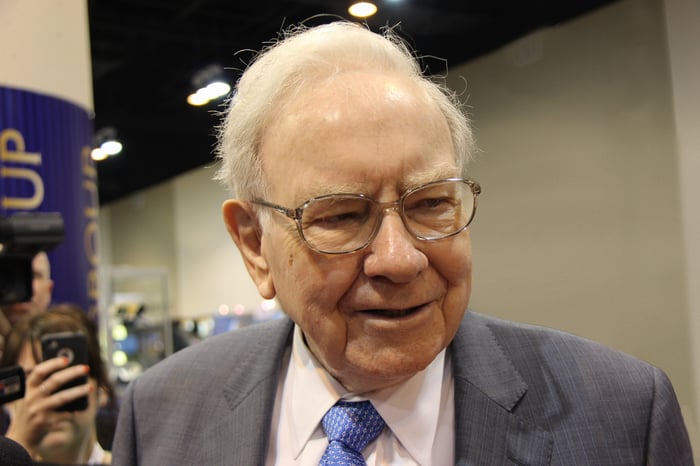
Close-up shot of Warren Buffett at an event.

Image source: The Motley Fool.

A failsafe long-term investment

For decades, Warren Buffett has recommended the S&P 500 ETF. During Berkshire Hathaway's 2020 meeting, he even went so far as to call it "the best thing" for most investors.

In 2008, he also made a $1 million bet that this type of investment could outperform a group of actively managed funds. After 10 years, his S&P 500 fund had earned total returns of nearly 126%, while the five actively managed funds averaged a total return of around 36%.
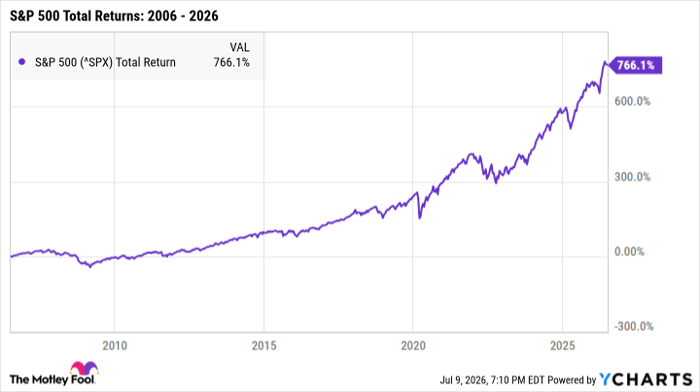
^SPX Chart

^SPX data by YCharts.

History backs up Buffett's approval of the S&P 500 ETF, too. Analysts at Crestmont Research studied the S&P 500's long-term performance and found that since the index's inception, it's ended every 20-year period with positive total returns regardless of how volatile the market was during that period.

In other words, by holding an S&P 500 ETF for at least 20 years, it's historically been harder to lose money with this investment than it is to make money.

Two risks to consider before buying

One potential downside to the S&P 500 ETF is that it's becoming increasingly dominated by tech stocks, making it more vulnerable to volatility.

For example, the "Magnificent Seven" -- which includes Apple, Amazon, Alphabet, Meta Platforms, Microsoft, Nvidia, and Tesla -- make up around one-third of the S&P 500's total value, making the S&P 500 ETF more easily swayed by megacap tech companies. If those stocks are thriving, it can lift the S&P 500 to new heights. But if they falter, they can drag the entire index down with them.

With a long enough timeline, this may not be an issue for many investors, as most leading companies can recover from downturns and achieve long-term growth. But it can result in more short-term volatility than some investors expect, so it's an important factor to consider.
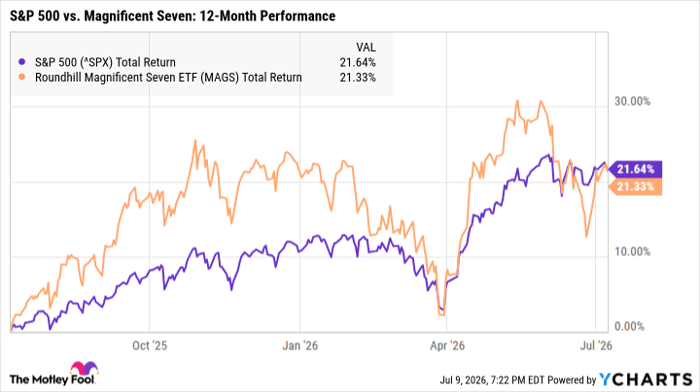
^SPX Chart

^SPX data by YCharts.

The other potential downside is that because the S&P 500 ETF tracks a major market index, it's impossible for it to beat the market. Over time, even a seemingly minor difference in performance can add up.

Let's say you're investing $200 per month in an S&P 500 ETF earning a 10% average annual return -- which is in line with the S&P 500's historic average. Let's also say that you could invest $200 per month in a growth ETF earning a marginally higher 11% average annual return. Over decades, here's approximately how much you could earn in total with each investment:

Number of Years Total Portfolio Value: 10% Avg. Annual Return Total Portfolio Value: 11% Avg. Annual Return
20 $137,000 $154,000
25 $236,000 $275,000
30 $395,000 $478,000
35 $650,000 $820,000
40 $1,062,000 $1,396,000

Data source: Author's calculations via investor.gov.

No investment is perfect, and the S&P 500 ETF won't be the ideal fit for everyone, especially investors nervous about the tech industry's volatility or looking to maximize their earnings in the stock market.

However, there's good reason why Warren Buffett highly recommends the S&P 500 ETF. It shines with its consistency over decades, and even while earning average returns, it's still possible to accumulate hundreds of thousands of dollars with this investment.

Should you buy stock in S&P 500 Index right now?

Before you buy stock in S&P 500 Index, consider this:

The Motley Fool Stock Advisor analyst team just identified what they believe are the 10 best stocks for investors to buy now… and S&P 500 Index wasn’t one of them. The 10 stocks that made the cut could produce monster returns in the coming years.

Consider when Netflix made this list on December 17, 2004... if you invested $1,000 at the time of our recommendation, you’d have $395,679!* Or when Nvidia made this list on April 15, 2005... if you invested $1,000 at the time of our recommendation, you’d have $1,294,805!*

Now, it’s worth noting Stock Advisor’s total average return is 929% — a market-crushing outperformance compared to 211% for the S&P 500. Don't miss the latest top 10 list, available with Stock Advisor, and join an investing community built by individual investors for individual investors.

See the 10 stocks »

*Stock Advisor returns as of July 11, 2026.

Katie Brockman has no position in any of the stocks mentioned. The Motley Fool has positions in and recommends Alphabet, Amazon, Apple, Berkshire Hathaway, Meta Platforms, Microsoft, Nvidia, and Tesla. The Motley Fool has a disclosure policy.

Disclaimer: For information purposes only. Past performance is not indicative of future results.
placeholder
Bitcoin CME gaps at $35,000, $27,000 and $21,000, which one gets filled first?Prioritize filling the $27,000 gap and even try higher.
Author  FXStreet
Aug 22, 2023
Prioritize filling the $27,000 gap and even try higher.
placeholder
Coinbase launches futures on new index tied to Apple, Microsoft, Nvidia, Tesla, and BlackRockCoinbase is launching a new futures contract that will track the price of both U.S. tech stocks and crypto ETFs in a single product.
Author  Cryptopolitan
Sep 03, 2025
Coinbase is launching a new futures contract that will track the price of both U.S. tech stocks and crypto ETFs in a single product.
placeholder
Bitcoin briefly loses 2025 gains as crypto plunges over the weekend.Bitcoin experienced a sharp decline this weekend, briefly erasing its 2025 gains and dipping below its year-opening value of $93,507. The cryptocurrency fell to a low of $93,029 on Sunday, representing a 25% drop from its all-time high in October. Although it has rebounded slightly to around $94,209, the pressures on the market remain significant. The downturn occurred despite the reopening of the U.S. government on Thursday, which many had hoped would provide essential support for crypto markets. This year initially appeared promising for cryptocurrencies, particularly after the inauguration of President Donald Trump, who has established the most pro-crypto administration thus far. However, ongoing political tensions—including Trump's tariff strategies and the recent government shutdown, lasting a historic 43 days—have contributed to several rapid price pullbacks for Bitcoin throughout the year. Market dynamics are also being influenced by Bitcoin whales—investors holding large amounts of Bitcoin—who have been offloading portions of their assets, consequently stalling price rallies even as positive regulatory developments emerge. Despite these sell-offs, analysts from Glassnode argue that this behavior aligns with typical patterns seen among long-term investors during the concluding stages of bull markets, suggesting it is not indicative of a mass exodus. Notably, Bitcoin is not alone in its struggles, as Ethereum and Solana have also recorded declines of 7.95% and 28.3%, respectively, since the start of the year, while numerous altcoins have faced even steeper losses. Looking ahead, questions linger regarding the viability of the four-year cycle thesis, particularly given the increasing institutional support and regulatory frameworks now in place in the crypto landscape. Matt Hougan, chief investment officer at Bitwise, remains optimistic, suggesting a potential Bitcoin resurgence in 2026 driven by the “debasement trade” thesis and a broader trend toward increased adoption of stablecoins, tokenization, and decentralized finance. Hougan emphasized the soundness of the underlying fundamentals, pointing to a positive outlook for the sector in the longer term.
Author  Mitrade
Nov 17, 2025
Bitcoin experienced a sharp decline this weekend, briefly erasing its 2025 gains and dipping below its year-opening value of $93,507. The cryptocurrency fell to a low of $93,029 on Sunday, representing a 25% drop from its all-time high in October. Although it has rebounded slightly to around $94,209, the pressures on the market remain significant. The downturn occurred despite the reopening of the U.S. government on Thursday, which many had hoped would provide essential support for crypto markets. This year initially appeared promising for cryptocurrencies, particularly after the inauguration of President Donald Trump, who has established the most pro-crypto administration thus far. However, ongoing political tensions—including Trump's tariff strategies and the recent government shutdown, lasting a historic 43 days—have contributed to several rapid price pullbacks for Bitcoin throughout the year. Market dynamics are also being influenced by Bitcoin whales—investors holding large amounts of Bitcoin—who have been offloading portions of their assets, consequently stalling price rallies even as positive regulatory developments emerge. Despite these sell-offs, analysts from Glassnode argue that this behavior aligns with typical patterns seen among long-term investors during the concluding stages of bull markets, suggesting it is not indicative of a mass exodus. Notably, Bitcoin is not alone in its struggles, as Ethereum and Solana have also recorded declines of 7.95% and 28.3%, respectively, since the start of the year, while numerous altcoins have faced even steeper losses. Looking ahead, questions linger regarding the viability of the four-year cycle thesis, particularly given the increasing institutional support and regulatory frameworks now in place in the crypto landscape. Matt Hougan, chief investment officer at Bitwise, remains optimistic, suggesting a potential Bitcoin resurgence in 2026 driven by the “debasement trade” thesis and a broader trend toward increased adoption of stablecoins, tokenization, and decentralized finance. Hougan emphasized the soundness of the underlying fundamentals, pointing to a positive outlook for the sector in the longer term.
placeholder
Gold rises to weekly high as US, Iran reach peace dealGold price (XAU/USD) rises to a weekly high during the Asian trading hours on Monday. The precious metal rebounds after the United States (US) and Iran had reached a deal to end their conflict, easing concerns about inflation and higher interest rates.
Author  FXStreet
Jun 15, Mon
Gold price (XAU/USD) rises to a weekly high during the Asian trading hours on Monday. The precious metal rebounds after the United States (US) and Iran had reached a deal to end their conflict, easing concerns about inflation and higher interest rates.
placeholder
Gold recovers above $4,100 as traders assess US-Iran conflict Gold price (XAU/USD) rebounds to around $4,120 during the early Asian session on Friday. The precious metal edges higher as traders weigh a resumption of war in the Middle East.
Author  FXStreet
Jul 10, Fri
Gold price (XAU/USD) rebounds to around $4,120 during the early Asian session on Friday. The precious metal edges higher as traders weigh a resumption of war in the Middle East.
goTop
quote