

The Vanguard ETF Warren Buffett Endorsed in 2014 Would Have Turned $5,000 Into $20,465 Today

Source The Motley Fool

Key Points

  • Patience has paid off for investors who don't feel compelled to take constant action every time the market ebbs and flows.

  • Too much timing-minded trading activity, in fact, can be detrimental to a portfolio's performance.

  • Temperament and humility are far more important to an investor than information or experience.

  • 10 stocks we like better than Vanguard S&P 500 ETF ›

You may know him as Berkshire Hathaway's (NYSE: BRKA) (NYSE: BRKB) long-tenured, brilliant stock picker, as evidenced by Berkshire's market-beating returns.

Warren Buffett isn't necessarily a big fan of picking individual stocks, though, discouraging most ordinary investors not to whenever they have the option. His advice? Buy index funds meant to mirror the performance of the S&P 500 (SNPINDEX: ^GSPC); he prefers the Vanguard S&P 500 ETF (NYSEMKT: VOO).

Missed Nvidia in 2009? This Rare Signal Is Flashing Again. In 2009, a "Double Down" signal flashed for a little-known chipmaker called Nvidia. For the first time in years, that same "Total Conviction" signal is flashing for a company 1/100th the size of Nvidia. Continue »

The thing is, his simple solution has proven to be brilliant since he first made his feelings on the matter clear.
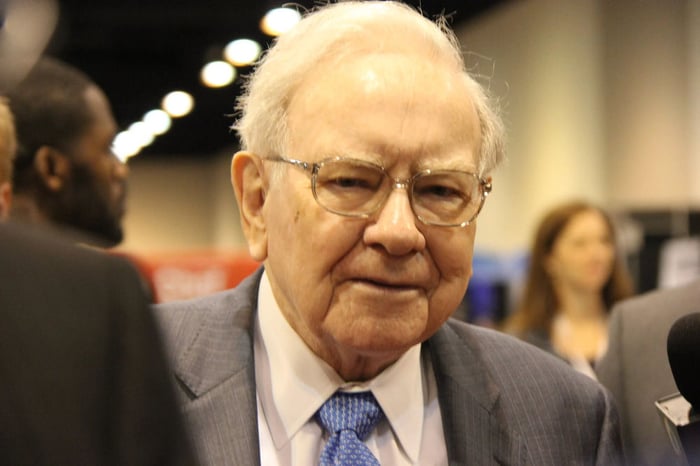
Warren Buffett is walking down a hallway.

Image source: Getty Images.

Simpler is better

Buffett's always leaned in this general direction. He put his commitment to the premise in writing back on March 1, 2014, however, penning in Berkshire's 2013 shareholder letter:

My advice to [my estate's] trustee could not be more simple: Put 10% of the cash in short-term government bonds and 90% in a very low-cost S&P 500 index fund. (I suggest Vanguard's.) I believe the trust's long-term results from this policy will be superior to those attained by most investors -- whether pension funds, institutions or individuals -- who employ high-fee managers.

And he was right. Over the past 10 years, data from Standard & Poor's suggests that over 85% of large-cap mutual funds available to U.S. investors have underperformed the S&P 500. For the last 15 years, nearly 90% of these funds have lagged the benchmark index. The numbers don't get any better with other timeframes either. Beating the market is just hard to do, which is why even most professionals don't do it.

Perhaps more important to investors, you would have done very well by simply taking Buffett's advice, regardless of how the fund fared against others. A $5,000 investment made in the Vanguard S&P 500 ETF on the first trading day after Buffett's letter was released would be worth a whopping $20,465 today. And that's without factoring in dividends. Adding reinvested dividends to the mix pumps this number up to $25,270.

You could have certainly done worse. And most people did.

Avoiding ego traps is the strategy

Sure, it's boring. Picking individual stocks, conversely, is exciting, specifically because it gives you a chance of beating the market.

If you want to play the statistical odds, though -- minimizing your risk while realistically maximizing your reward -- something else Warren Buffett explains in the very same shareholder letter hits home. That is, "the unsophisticated investor who is realistic about his shortcomings is likely to obtain better long-term results than the knowledgeable professional who is blind to even a single weakness." That's what Standard & Poor's surprising fund performance numbers are actually showing us.

The trick? You just need to be strong enough to admit to yourself that you may be unable to navigate the market's ebbs and flows as easily as it seems it should be. In Buffett's own words, the average investor is far too likely to "enter the market at a time of extreme exuberance and then become disillusioned when paper losses occur," ultimately leading to decisions that make matters worse rather than better. Holding a long-term stake in Vanguard's simple index fund sidesteps this risk altogether.

Of course, the SPDR S&P 500 ETF Trust (NYSEMKT: SPY) is a perfectly fine alternative to Vanguard's S&P 500 ETF.

Should you buy stock in Vanguard S&P 500 ETF right now?

Before you buy stock in Vanguard S&P 500 ETF, consider this:

The Motley Fool Stock Advisor analyst team just identified what they believe are the 10 best stocks for investors to buy now… and Vanguard S&P 500 ETF wasn’t one of them. The 10 stocks that made the cut could produce monster returns in the coming years.

Consider when Netflix made this list on December 17, 2004... if you invested $1,000 at the time of our recommendation, you’d have $395,679!* Or when Nvidia made this list on April 15, 2005... if you invested $1,000 at the time of our recommendation, you’d have $1,294,805!*

Now, it’s worth noting Stock Advisor’s total average return is 929% — a market-crushing outperformance compared to 211% for the S&P 500. Don't miss the latest top 10 list, available with Stock Advisor, and join an investing community built by individual investors for individual investors.

See the 10 stocks »

*Stock Advisor returns as of July 11, 2026.

James Brumley has no position in any of the stocks mentioned. The Motley Fool has positions in and recommends Berkshire Hathaway and Vanguard S&P 500 ETF. The Motley Fool has a disclosure policy.

Disclaimer: For information purposes only. Past performance is not indicative of future results.
placeholder
Bitcoin CME gaps at $35,000, $27,000 and $21,000, which one gets filled first?Prioritize filling the $27,000 gap and even try higher.
Author  FXStreet
Aug 22, 2023
Prioritize filling the $27,000 gap and even try higher.
placeholder
Coinbase launches futures on new index tied to Apple, Microsoft, Nvidia, Tesla, and BlackRockCoinbase is launching a new futures contract that will track the price of both U.S. tech stocks and crypto ETFs in a single product.
Author  Cryptopolitan
Sep 03, 2025
Coinbase is launching a new futures contract that will track the price of both U.S. tech stocks and crypto ETFs in a single product.
placeholder
Bitcoin briefly loses 2025 gains as crypto plunges over the weekend.Bitcoin experienced a sharp decline this weekend, briefly erasing its 2025 gains and dipping below its year-opening value of $93,507. The cryptocurrency fell to a low of $93,029 on Sunday, representing a 25% drop from its all-time high in October. Although it has rebounded slightly to around $94,209, the pressures on the market remain significant. The downturn occurred despite the reopening of the U.S. government on Thursday, which many had hoped would provide essential support for crypto markets. This year initially appeared promising for cryptocurrencies, particularly after the inauguration of President Donald Trump, who has established the most pro-crypto administration thus far. However, ongoing political tensions—including Trump's tariff strategies and the recent government shutdown, lasting a historic 43 days—have contributed to several rapid price pullbacks for Bitcoin throughout the year. Market dynamics are also being influenced by Bitcoin whales—investors holding large amounts of Bitcoin—who have been offloading portions of their assets, consequently stalling price rallies even as positive regulatory developments emerge. Despite these sell-offs, analysts from Glassnode argue that this behavior aligns with typical patterns seen among long-term investors during the concluding stages of bull markets, suggesting it is not indicative of a mass exodus. Notably, Bitcoin is not alone in its struggles, as Ethereum and Solana have also recorded declines of 7.95% and 28.3%, respectively, since the start of the year, while numerous altcoins have faced even steeper losses. Looking ahead, questions linger regarding the viability of the four-year cycle thesis, particularly given the increasing institutional support and regulatory frameworks now in place in the crypto landscape. Matt Hougan, chief investment officer at Bitwise, remains optimistic, suggesting a potential Bitcoin resurgence in 2026 driven by the “debasement trade” thesis and a broader trend toward increased adoption of stablecoins, tokenization, and decentralized finance. Hougan emphasized the soundness of the underlying fundamentals, pointing to a positive outlook for the sector in the longer term.
Author  Mitrade
Nov 17, 2025
Bitcoin experienced a sharp decline this weekend, briefly erasing its 2025 gains and dipping below its year-opening value of $93,507. The cryptocurrency fell to a low of $93,029 on Sunday, representing a 25% drop from its all-time high in October. Although it has rebounded slightly to around $94,209, the pressures on the market remain significant. The downturn occurred despite the reopening of the U.S. government on Thursday, which many had hoped would provide essential support for crypto markets. This year initially appeared promising for cryptocurrencies, particularly after the inauguration of President Donald Trump, who has established the most pro-crypto administration thus far. However, ongoing political tensions—including Trump's tariff strategies and the recent government shutdown, lasting a historic 43 days—have contributed to several rapid price pullbacks for Bitcoin throughout the year. Market dynamics are also being influenced by Bitcoin whales—investors holding large amounts of Bitcoin—who have been offloading portions of their assets, consequently stalling price rallies even as positive regulatory developments emerge. Despite these sell-offs, analysts from Glassnode argue that this behavior aligns with typical patterns seen among long-term investors during the concluding stages of bull markets, suggesting it is not indicative of a mass exodus. Notably, Bitcoin is not alone in its struggles, as Ethereum and Solana have also recorded declines of 7.95% and 28.3%, respectively, since the start of the year, while numerous altcoins have faced even steeper losses. Looking ahead, questions linger regarding the viability of the four-year cycle thesis, particularly given the increasing institutional support and regulatory frameworks now in place in the crypto landscape. Matt Hougan, chief investment officer at Bitwise, remains optimistic, suggesting a potential Bitcoin resurgence in 2026 driven by the “debasement trade” thesis and a broader trend toward increased adoption of stablecoins, tokenization, and decentralized finance. Hougan emphasized the soundness of the underlying fundamentals, pointing to a positive outlook for the sector in the longer term.
placeholder
Gold rises to weekly high as US, Iran reach peace dealGold price (XAU/USD) rises to a weekly high during the Asian trading hours on Monday. The precious metal rebounds after the United States (US) and Iran had reached a deal to end their conflict, easing concerns about inflation and higher interest rates.
Author  FXStreet
Jun 15, Mon
Gold price (XAU/USD) rises to a weekly high during the Asian trading hours on Monday. The precious metal rebounds after the United States (US) and Iran had reached a deal to end their conflict, easing concerns about inflation and higher interest rates.
placeholder
Gold recovers above $4,100 as traders assess US-Iran conflict Gold price (XAU/USD) rebounds to around $4,120 during the early Asian session on Friday. The precious metal edges higher as traders weigh a resumption of war in the Middle East.
Author  FXStreet
Jul 10, Fri
Gold price (XAU/USD) rebounds to around $4,120 during the early Asian session on Friday. The precious metal edges higher as traders weigh a resumption of war in the Middle East.
goTop
quote