


SpaceX IPO: The Last Time a Company This Big Went Public, Here's What Happened to Investors 1 Year Later
Key Points
Back in 2020, Snowflake completed the largest software IPO in history.
Snowflake stock remained elevated for about a year after going public, but has since traded sideways.
SpaceX stock initially surged on its Nasdaq debut, and remains elevated above the IPO price despite recent selling pressure.
- 10 stocks we like better than Space Exploration Technologies ›
The recent initial public offering (IPO) of Space Exploration Technologies (NASDAQ: SPCX), better known as SpaceX, captured global attention that very few public debuts have matched.
While SpaceX stock was priced at $135, shares actually opened on the Nasdaq at around $150. By the end of the first day of trading, the stock was priced at $161. Momentum carried over into the next trading day with a roughly 20% gain. SpaceX stock climbed even further from there to a peak of about $226 before eventually pulling back. Recently, shares trade around $162 -- still modestly above the opening day price.
Where to invest $1,000 right now? Our analyst team just revealed what they believe are the 10 best stocks to buy right now, when you join Stock Advisor. See the stocks »
The rapid ascent followed by a sharp reversal underscores the extreme volatility that often accompanies highly anticipated IPOs. In my view, this pattern echoes the explosive yet ultimately uneven trajectory of Snowflake's (NYSE: SNOW) 2020 IPO. Smart investors are raising questions about whether SpaceX's early gains will prove sustainable or whether those who chased momentum will face a prolonged period of disappointment.

Image source: Getty Images.
Remembering the Snowflake IPO
Snowflake went public in September 2020. The company's offering stood out as a landmark event in the technology sector because, at the time, it was the largest software IPO in history.
While Snowflake priced its shares at $120, the stock opened at $245 and closed the first day of trading at $254 -- more than doubling in value. The surge reflected a newfound appetite for high-growth cloud software companies beyond the usual suspects among big tech.
One month later, Snowflake had eased from its opening-day pop but remained robustly elevated, trading in the $240 range. By December 2020, the company still boasted a premium market cap as shares held steady at lofty levels even as Wall Street began to question its valuation expansion. By the one-year anniversary of the Snowflake IPO, the stock had climbed further, trading near $300 amid rising enthusiasm for the emerging data warehousing opportunity.
Snowflake's initial surge stemmed from several factors. First, the low-interest-rate environment at the time worked in favor of growth stocks. In addition, growing narratives around digital transformation and big data fueled outsize participation in Snowflake's IPO -- including from prominent investors such as Berkshire Hathaway. Naturally, these points inspired classic FOMO-driven trading -- especially among retail buyers piling into the hype.
When did Snowflake stock peak?
Snowflake stock reached its all-time high of $402 in November 2021, a little more than one year after going public. As the chart below shows, investors who bought near this apex have watched Snowflake's price decline substantially. With shares recently trading around $260, those who bought at the top are down about 35%. Moreover, buyers who entered Snowflake on its first day of trading have fared only marginally better.
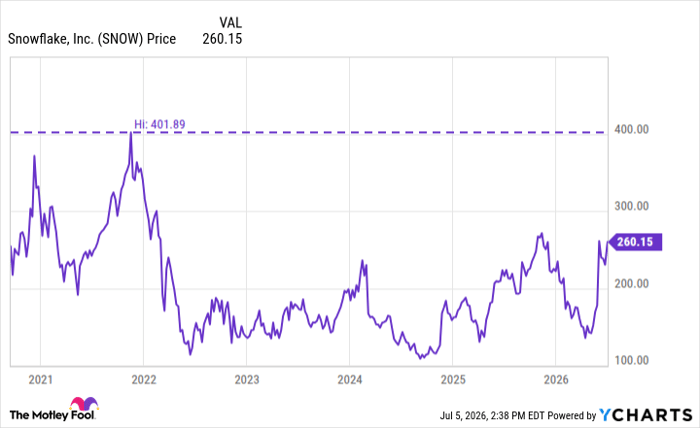
SNOW data by YCharts
After nearly six years, Snowflake stock essentially delivered flat returns. This outcome falls far short of the generational multibagger Snowflake was marketed as. This type of humbling investing experience underscores how initial hype often inflates prices beyond levels congruent with underlying business fundamentals. In turn, this can lead to extended periods of underperformance and sideways trading.
What can investors expect from the SpaceX IPO?
In many ways, SpaceX's IPO generated levels of excitement and media coverage comparable to those of Snowflake's debut. As the largest IPO ever, SpaceX's listing tapped into a powerful narrative featuring space exploration, reusable rocketry, Starlink internet, and Elon Musk's vision for next-generation artificial intelligence (AI) infrastructure.
Just as Snowflake benefited from its perception as a game-changing data analytics platform and support from celebrity investors, SpaceX's price action suggests it has drawn intense interest from momentum traders, growth-oriented funds, and retail participants captivated by the company's technological achievements and management's vision.
Smart investors realize that history offers a cautionary parallel here. Snowflake's dramatic first-day pop and subsequent elevated trading paved the way for an unsustainable peak, followed by years of disappointing performance for early buyers. SpaceX's post-IPO path -- sharp initial gains, a quick peak, and an early reversal -- suggests the stock could very well experience similar consolidation or further volatility over the next year (or longer).
While SpaceX's business fundamentals and market position differ markedly from Snowflake's, the pattern of hype-driven pops followed by extended periods of digestion remains a recurring theme in blockbuster IPOs. Ultimately, investors who chased SpaceX's early momentum may find themselves vulnerable if enthusiasm cools and the stock reverts to a more reasonable valuation.
Should you buy stock in Space Exploration Technologies right now?
Before you buy stock in Space Exploration Technologies, consider this:
The Motley Fool Stock Advisor analyst team just identified what they believe are the 10 best stocks for investors to buy now… and Space Exploration Technologies wasn’t one of them. The 10 stocks that made the cut could produce monster returns in the coming years.
Consider when Netflix made this list on December 17, 2004... if you invested $1,000 at the time of our recommendation, you’d have $409,970!* Or when Nvidia made this list on April 15, 2005... if you invested $1,000 at the time of our recommendation, you’d have $1,200,223!*
Now, it’s worth noting Stock Advisor’s total average return is 916% — a market-crushing outperformance compared to 210% for the S&P 500. Don't miss the latest top 10 list, available with Stock Advisor, and join an investing community built by individual investors for individual investors.
See the 10 stocks »
*Stock Advisor returns as of July 8, 2026.
Adam Spatacco has no position in any of the stocks mentioned. The Motley Fool has positions in and recommends Berkshire Hathaway and Snowflake. The Motley Fool has a disclosure policy.
Recommended Articles


