


3 of the Top 5 Performers in the S&P 500 in the First Half Offer 1 Particular Thing for AI Customers. (Hint: It Isn't the GPU, and Nvidia Isn't Among Them.)
Key Points
Nvidia was the star of the show in the earliest phases of the AI boom.
While Nvidia remains a key player, other companies have also emerged as current and future AI winners.
- 10 stocks we like better than Western Digital ›
Over the past three years, a particular type of company and product emerged as the key player in the artificial intelligence (AI) revolution: designers of logic chips to power AI tasks. And the most popular logic chip turned out to be the graphics processing unit (GPU). Nvidia (NASDAQ: NVDA), as the world's leading designer of such chips, scored a tremendous earnings and stock performance win.
Nvidia's revenue and profit have climbed in the double- and triple-digits in recent years, reaching record levels. For example, last year, revenue soared to more than $215 billion. This is as companies involved in AI rushed to Nvidia for these powerful GPUs to run their workloads. In many cases, these tech giants needed the GPU to train models on enormous amounts of information so that they eventually could go on to solve real-world problems.
Missed Nvidia in 2009? This Rare Signal Is Flashing Again. In 2009, a "Double Down" signal flashed for a little-known chipmaker called Nvidia. For the first time in years, that same "Total Conviction" signal is flashing for a company 1/100th the size of Nvidia. Continue »
The AI story is progressing, however, and though these needs continue, new needs are emerging, too. And investors are recognizing this as they choose stocks to buy. We could see this in first-half performance. Three of the top five performers in the S&P 500 offer one particular thing for AI customers. Hint: It isn't the GPU to fuel tasks like training -- and Nvidia wasn't among these first-half winners.

Image source: Getty Images.
The need for logic chips
As mentioned, logic chips wrote the first chapters of the AI growth story. Companies such as Nvidia and Advanced Micro Devices saw revenue rise as customers rushed to gain access to GPUs. Stock performance followed, with Nvidia and AMD each climbing more than 350% over the past three years.
But, in recent months, investors have looked with optimism toward companies selling another critical tool for AI -- and one that could stand out as the technology is used in the real world. I'm talking about memory and storage. Three of the top five performers in the S&P 500 in the first half specialize in this area. They are Sandisk Corp. (NASDAQ: SNDK), Micron Technology (NASDAQ: MU), and Western Digital (NASDAQ: WDC), which posted the first, second, and fifth largest gains, respectively, in the S&P 500 in the first six months of the year.
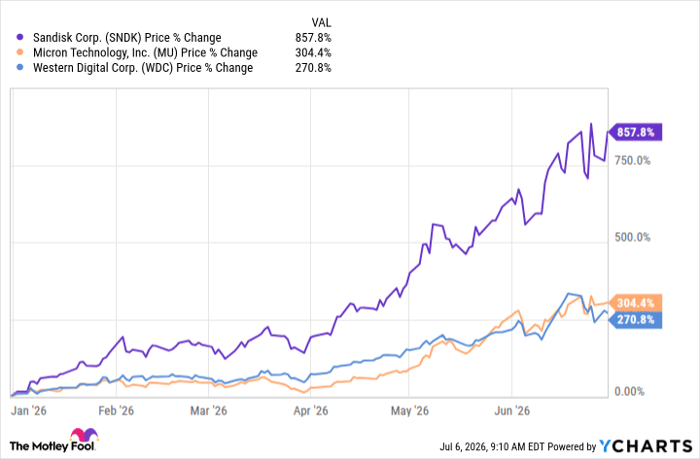
SNDK data by YCharts
Each of these players is involved in serving the memory and storage needs of AI, and this has generated spectacular growth in recent times. Sandisk, a specialist in NAND flash memory, saw data center revenue soar more than 640% year-over-year in the latest quarter to $1.4 billion. Micron, a provider of a broad range of memory solutions, said its data center revenue jumped more than 650% to $11 billion. Western Digital, serving hard drive storage systems to data centers, reported a 45% increase in total revenue to more than $3 billion.
Memory and storage
Memory and storage growth may be just beginning, and that's because, as AI is actually applied to real situations, it will need greater memory and storage capacity.
Western Digital chief Irving Tan explains it well: "This year, inference is expected to account for roughly two-thirds of all AI compute," he said during the latest earnings call. "This larger focus on inference increases the amount of data generated, which in turn increases the need for data storage."
Inference involves the AI's "thinking" process as it prepares to solve a problem. This, along with agentic AI operations, in which AI takes the steps needed to address a particular assignment, should result in ongoing high demand for the offerings of Sandisk, Micron, Western Digital, and others in the space.
Does this mean investors should stick to memory companies and forget about the makers of logic chips? Not necessarily. It's important to remember that designers of GPUs and other chips to power AI processes and sellers of memory and storage products will each play an important role in the upcoming phases of AI. So, while certain players that skyrocketed in recent months or years may not jump overnight, they still have what it takes to advance over the long term. This makes those with reasonable valuations great investments to buy and hold.
Should you buy stock in Western Digital right now?
Before you buy stock in Western Digital, consider this:
The Motley Fool Stock Advisor analyst team just identified what they believe are the 10 best stocks for investors to buy now… and Western Digital wasn’t one of them. The 10 stocks that made the cut could produce monster returns in the coming years.
Consider when Netflix made this list on December 17, 2004... if you invested $1,000 at the time of our recommendation, you’d have $409,970!* Or when Nvidia made this list on April 15, 2005... if you invested $1,000 at the time of our recommendation, you’d have $1,200,223!*
Now, it’s worth noting Stock Advisor’s total average return is 916% — a market-crushing outperformance compared to 210% for the S&P 500. Don't miss the latest top 10 list, available with Stock Advisor, and join an investing community built by individual investors for individual investors.
See the 10 stocks »
*Stock Advisor returns as of July 8, 2026.
Adria Cimino has no position in any of the stocks mentioned. The Motley Fool has positions in and recommends Advanced Micro Devices, Micron Technology, Nvidia, and Western Digital. The Motley Fool has a disclosure policy.
Recommended Articles


