


Bank of America Stock Just Hit a Record High. Here's What It Means Ahead of Earnings
Key Points
Bank of America has underperformed the sector so far this year.
Investors may still like banking as a theme, rotating into some of the weaker-performing names.
Banks will be under pressure to deliver strong results in the second quarter.
- 10 stocks we like better than Bank of America ›
Bank of America (NYSE:BAC), the second-largest bank in the U.S. by assets, hit a new all-time high today, with the stock topping $60 per share.
Many large bank stocks have had a good year thus far, particularly the investment banks, which have benefited from some massive artificial intelligence initial public offerings.
Missed Nvidia in 2009? This Rare Signal Is Flashing Again. In 2009, a "Double Down" signal flashed for a little-known chipmaker called Nvidia. For the first time in years, that same "Total Conviction" signal is flashing for a company 1/100th the size of Nvidia. Continue »
However, some of the money-center banks, such as Bank of America, have not performed as well. The stock is up about 7.5%, trailing the broader market S&P 500 Index and the Nasdaq Bank Index.
Here’s what it means ahead of second-quarter earnings.

Image source: Getty Images.
Overcoming challenges
Bank of America is viewed as a high-quality banking franchise, with the number one consumer bank, and strong franchises in investment banking, trading, wealth management, and commercial lending.
The Iran war, which has led to higher inflation and higher bond yields, may have derailed some of its momentum because investors are now worried about persistent inflation and whether the Federal Reserve will need to raise interest rates to ensure price stability.
Higher rates can put pressure on the credit profiles of consumers and businesses and stymie lending and investment banking activity.
Bank of America has also long grappled with balance sheet issues that stem from the pandemic, when the bank loaded up on low-yielding, long-duration bonds.
The bank has nearly $915 billion in bonds still yielding 2.77%, which is depressing earnings somewhat.
Furthermore, the bank locked in nearly $515 billion of bonds into its held-to-maturity folder that are still carrying an unrealized $81 billion loss.
While Bank of America will be able to hold these bonds to maturity and avoid taking these paper losses, it’s still a drag on earnings. Higher rates would likely exacerbate the paper losses as well.
The good news is that Bank of America is just coming off one of its strongest quarters in a while in the first quarter of 2026, having delivered a 16% return on tangible common equity (ROTCE).
Net interest income, the spread revenue banks make on their lending and bond portfolios after paying funding costs, has been building in recent quarters.
Investment banking should be strong as well, given that Bank of America served as one of the five main bookrunners on the massive Space Exploration Technologies (NASDAQ:SPCX) IPO.
How investors should think about earnings
Bank of America will report its second-quarter earnings next week on July 14.
Wall Street analysts’ consensus estimates suggest the bank will report revenue of $30.58 billion and earnings per share of $1.14. That implies slight growth from the first quarter, but certainly nothing heroic.
This is not a huge surprise because large banks are mature companies at this point.
Investors will need to see the company beat estimates for the stock to rise, and credit quality, investment banking fees, and net interest income trends will also be top of mind for the market.
With Bank of America trading at a price-to-tangible-book ratio over 2x and near 10-year highs, earnings misses or minor concerns could lead to selling pressure, given the elevated valuation.
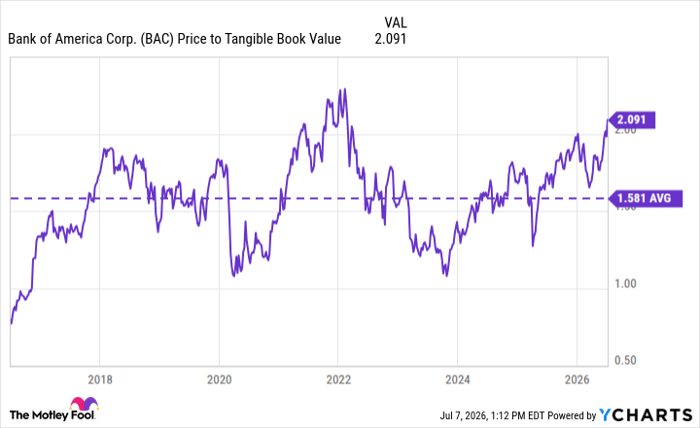
BAC Price to Tangible Book Value data by YCharts
That said, I still think Bank of America is a decent long-term investment.
Continued improvements in ROTCE can lead to a higher valuation over time, and eventually the bond portfolio will run off, boosting the company’s earnings power.
Should you buy stock in Bank of America right now?
Before you buy stock in Bank of America, consider this:
The Motley Fool Stock Advisor analyst team just identified what they believe are the 10 best stocks for investors to buy now… and Bank of America wasn’t one of them. The 10 stocks that made the cut could produce monster returns in the coming years.
Consider when Netflix made this list on December 17, 2004... if you invested $1,000 at the time of our recommendation, you’d have $409,970!* Or when Nvidia made this list on April 15, 2005... if you invested $1,000 at the time of our recommendation, you’d have $1,200,223!*
Now, it’s worth noting Stock Advisor’s total average return is 916% — a market-crushing outperformance compared to 210% for the S&P 500. Don't miss the latest top 10 list, available with Stock Advisor, and join an investing community built by individual investors for individual investors.
See the 10 stocks »
*Stock Advisor returns as of July 7, 2026.
Bank of America is an advertising partner of Motley Fool Money. Bram Berkowitz has no position in any of the stocks mentioned. The Motley Fool has no position in any of the stocks mentioned. The Motley Fool has a disclosure policy.
Recommended Articles


