


3 Quantum Computing Stocks to Watch in the Second Half of 2026
Key Points
Some research suggests quantum computing could generate trillions in economic value in the coming decades.
The field is currently being explored by a number of AI developers -- from big tech to smaller newcomers.
However, the technology is still not expected to scale commercially for several years.
- 10 stocks we like better than Nvidia ›
Over the past year, quantum computing stocks have emerged as a compelling complement to mainstream opportunities in the artificial intelligence (AI) ecosystem. While classical AI systems have demonstrated impressive capabilities in pattern recognition and generative tasks, many high-value problems remain computationally strained.
Quantum machines leverage properties known as superposition and entanglement to better explore solutions in more sophisticated applications. This opens the door to hybrid quantum-classical environments that could usher in waves of better data, tighter constraints, and new algorithms for AI.
Missed Nvidia in 2009? This Rare Signal Is Flashing Again. In 2009, a "Double Down" signal flashed for a little-known chipmaker called Nvidia. For the first time in years, that same "Total Conviction" signal is flashing for a company 1/100th the size of Nvidia. Continue »
According to an analysis by management consulting firm McKinsey & Company, quantum AI could generate between $1.3 trillion and $2.7 trillion in economic value by 2035. McKinsey sees quantum computing playing a critical role across energy and materials, pharmaceuticals, financial services, and travel and logistics, as well as advanced electronics and defense systems.
In my view, three companies stand out in the quantum AI arena for distinct reasons: Nvidia (NASDAQ: NVDA), IonQ (NYSE: IONQ), and Quantinuum (NASDAQ: QNT). Let's dig into how each of these companies is involved with quantum computing and assess their respective investment profiles.

Image source: Getty Images.
Nvidia: The ecosystem enabler of tomorrow
Nvidia dominates classical AI thanks to its one-two punch, featuring a deep roster of graphics processing unit (GPU) architectures and software system CUDA. The company's primary quantum efforts revolve around cuQuantum, a toolkit that accelerates the simulation of quantum circuits on Nvidia hardware. This design allows researchers to prototype next-generation algorithms without requiring capital-intensive physical quantum processors.
While quantum computing is a negligible contributor to Nvidia's overall business today, the company's approach is to quietly become the broader foundation for hybrid classical-quantum systems in the long run. As quantum hardware matures, demand for high-performance classical compute -- Nvidia's expertise -- should rise sharply as these components help handle critical variables such as error correction and processing.
In essence, Nvidia is uniquely positioned to become the backbone that drives quantum progress and further demand for its core data center products, rather than needing to build an entirely separate business line.
IonQ: A pure play provider across the quantum stack
IonQ provides direct exposure to quantum computing, one of the few pure-play opportunities, alongside peers such as Rigetti Computing and D-Wave Quantum. The company's trapped-ion systems are accessible through major cloud platforms such as Amazon Braket, Microsoft Azure, and Alphabet's Google Cloud.
Over the past couple of years, IonQ has pursued an aggressive acquisition strategy to build a vertically integrated quantum platform. The rationale behind these deals is to strengthen its capabilities across ion-trap scaling, quantum networking, secure communications, sensing, security, and manufacturing.
While this approach is compelling, IonQ's valuation profile reflects extraordinarily high expectations amid revenue growth, though the company remains fairly early-stage and unprofitable.
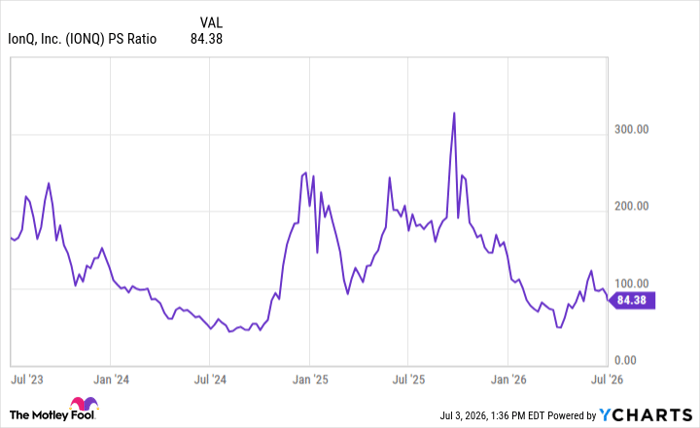
IONQ PS Ratio data by YCharts
Quantinuum: A new quantum computing IPO stock
Quantinuum just went public last month. The company was formed through the merger of Honeywell Quantum Solutions and Cambridge Quantum.
Quantinuum's products and application tools are best suited for chemistry, cybersecurity, and machine learning. Given its reach among critical use cases, it's not surprising that Quantinuum is backed by notable strategic investors, including JPMorgan Chase, Amgen, Mitsui, and Nvidia. This institutional support contrasts with that of smaller pure-play peers like IonQ, Rigetti, D-Wave, and Quantum Computing Inc.
While it's still early innings for quantum computing, I think Quantinuum's diversified backing offers a more stable investment profile among other names in the space as commercialization advances. With that said, I'd expect Quantinuum's stock to be relatively volatile over the next several months as investors digest the company's earnings reports and business updates following its IPO.
Should you buy stock in Nvidia right now?
Before you buy stock in Nvidia, consider this:
The Motley Fool Stock Advisor analyst team just identified what they believe are the 10 best stocks for investors to buy now… and Nvidia wasn’t one of them. The 10 stocks that made the cut could produce monster returns in the coming years.
Consider when Netflix made this list on December 17, 2004... if you invested $1,000 at the time of our recommendation, you’d have $418,761!* Or when Nvidia made this list on April 15, 2005... if you invested $1,000 at the time of our recommendation, you’d have $1,195,804!*
Now, it’s worth noting Stock Advisor’s total average return is 918% — a market-crushing outperformance compared to 208% for the S&P 500. Don't miss the latest top 10 list, available with Stock Advisor, and join an investing community built by individual investors for individual investors.
See the 10 stocks »
*Stock Advisor returns as of July 7, 2026.
JPMorgan Chase is an advertising partner of Motley Fool Money. Adam Spatacco has positions in Alphabet, Amazon, Microsoft, and Nvidia. The Motley Fool has positions in and recommends Alphabet, Amazon, Amgen, Honeywell Technologies, IonQ, JPMorgan Chase, Microsoft, and Nvidia. The Motley Fool has a disclosure policy.
Recommended Articles


