

Nvidia Shares Under Pressure Pre-Market on Reports DeepSeek Is Developing Its Own AI Inference Chips

Source Tradingkey

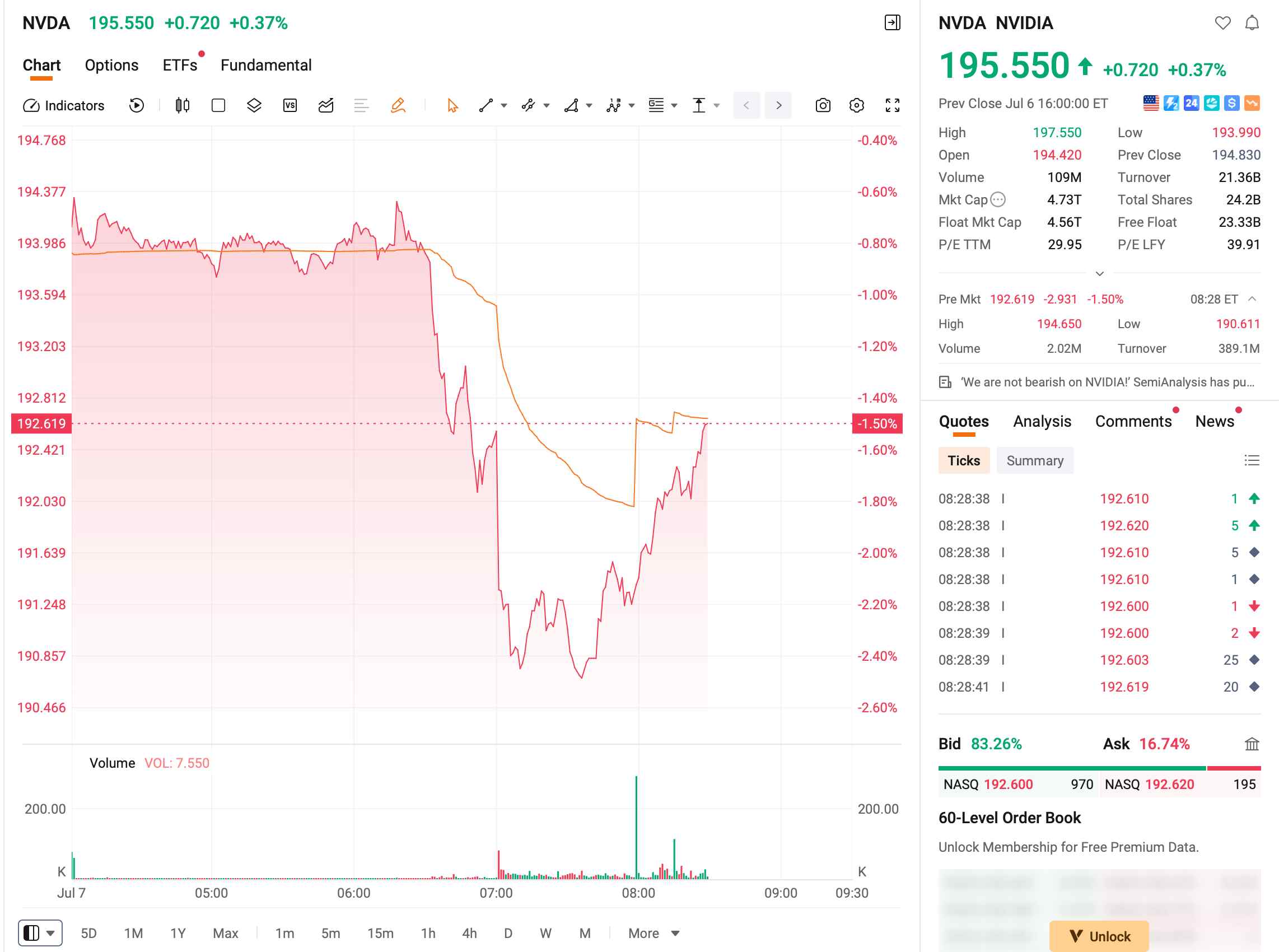
TradingKey - On July 7, Eastern Time, media reports indicated that Chinese AI startup DeepSeek is independently developing its own AI inference chips, a move that could reduce its reliance on Nvidia ( NVDA) and Huawei chips. Following the news, Nvidia shares fell as much as 2% in pre-market trading. As of press time, Nvidia's pre-market stock price was trading at approximately $192.62, down 1.5%.
NVDA-707-efcceae34d3d4d38870010acb51acce4

[Source: Futu]

The chip is designed specifically for the inference stage—the process where trained models generate responses for users—rather than for training new models. This positioning targets the fastest-growing sector of AI computing demand. As AI applications become more widespread, industry computing power is shifting from model training to model operation, and dedicated inference chips typically offer lower costs and lower power consumption than general-purpose GPUs.

DeepSeek's chip R&D efforts began about a year ago, and the company has already entered into discussions with chip design, foundry, and memory companies. In recent months, DeepSeek has stepped up its recruitment of chip design engineers, though the hiring is being conducted privately without public job postings.

If DeepSeek successfully enters the chip design space, it would mark a significant shift in the company's strategy. DeepSeek became globally renowned more than a year ago for releasing two highly efficient AI models. The base model for its R1 inference model was trained on Nvidia's H800, a chip banned from export to China by the U.S. government in late 2023. Since then, DeepSeek has gradually shifted its workloads to Huawei Ascend chips, with its V4 model released in April this year already adapted to Huawei processors.

First Round of Financing Finalized: RMB 51 Billion Raised, Post-Investment Valuation Reaches RMB 400 Billion

According to media reports, DeepSeek completed its Series A funding round on June 16, raising approximately RMB 51 billion (about $7.5 billion), with a post-money valuation approaching RMB 400 billion (about $59 billion). This marks the largest single-round financing record in China's AI industry to date.

Founder Liang Wenfeng personally contributed approximately RMB 20 billion (about $2.9 billion), making him the largest single investor in this round. Other investors include: Tencent contributing approximately RMB 10 billion (about $1.5 billion); the CATL ecosystem contributing approximately RMB 5 billion (about $730 million); NetEase, JD.com, Monolith Management, and IDG Capital contributing approximately RMB 3 billion (about $440 million) each; Loyal Valley Capital and Showstream contributing approximately RMB 1.5 billion (about $220 million) each; and the National Artificial Intelligence Industry Investment Fund contributing approximately RMB 980 million (about $144 million).

This funding round employed an extremely rare transaction structure. Except for the National Artificial Intelligence Industry Investment Fund, the funds from all external investors must be injected into a limited partnership managed by Liang Wenfeng, rather than directly into the DeepSeek entity. External investors do not hold voting rights in the company, have no board seats, and can only share in the financial returns based on their contribution ratios, while being subject to a five-year lock-up period. The National Artificial Intelligence Industry Investment Fund is the sole exception, taking a direct equity stake and holding voting rights.

From Light-Asset to Heavy-Asset: Doubling Recruitment and Building Self-Owned Data Centers

This funding is rapidly translating into action. On June 25, DeepSeek posted large-scale recruitment information on social media platforms, covering 33 positions across seven major categories, including algorithms, R&D, operations and maintenance, products, data engineers, and functional departments. These positions belong to different directions than the aforementioned chip design roles. DeepSeek stated in the recruitment post that it is "working hard to at least double the size of all departments."

At the same time, DeepSeek is also laying out its own computing power infrastructure. Since the beginning of this year, the company has posted its first batch of data center positions in Ulanqab, Inner Mongolia, covering operations and maintenance, delivery, and design planning directions, marking the company's transition from a light-asset model R&D approach to a heavy-asset model of self-built computing clusters.

DeepSeek's self-developed chips align with the trend of global AI developers. Last month, OpenAI released its first custom inference chip, Jalapeno, developed in cooperation with Broadcom ( AVGO )—and Anthropic is also considering building its own AI chips.

However, chip design is far from easy. Developing a competitive AI chip typically requires years and substantial capital. The manufacturing process also faces obstacles; U.S. regulations prohibit Chinese design firms from using the most advanced overseas foundries, and other export controls restrict China's access to high-bandwidth memory chips, which are key components for AI inference chips.

Disclaimer: For information purposes only. Past performance is not indicative of future results.
placeholder
Bitcoin CME gaps at $35,000, $27,000 and $21,000, which one gets filled first?Prioritize filling the $27,000 gap and even try higher.
Author  FXStreet
Aug 22, 2023
Prioritize filling the $27,000 gap and even try higher.
placeholder
Pinduoduo Earnings Incoming: Morgan Stanley Sees Long-Term Profit Potential​Insights – On November 21, Chinese e-commerce giant Pinduoduo (PDD) will release its Q3 2024 earnings.
Author  Mitrade
Nov 20, 2024
​Insights – On November 21, Chinese e-commerce giant Pinduoduo (PDD) will release its Q3 2024 earnings.
placeholder
Elon Musk’s xAI and Neuralink Launch New Funding Rounds​Billionaire Elon Musk recently raised funds for his two high-profile tech companies, xAI and Neuralink.
Author  Insights
Jun 03, 2025
​Billionaire Elon Musk recently raised funds for his two high-profile tech companies, xAI and Neuralink.
placeholder
Bitcoin briefly loses 2025 gains as crypto plunges over the weekend.Bitcoin experienced a sharp decline this weekend, briefly erasing its 2025 gains and dipping below its year-opening value of $93,507. The cryptocurrency fell to a low of $93,029 on Sunday, representing a 25% drop from its all-time high in October. Although it has rebounded slightly to around $94,209, the pressures on the market remain significant. The downturn occurred despite the reopening of the U.S. government on Thursday, which many had hoped would provide essential support for crypto markets. This year initially appeared promising for cryptocurrencies, particularly after the inauguration of President Donald Trump, who has established the most pro-crypto administration thus far. However, ongoing political tensions—including Trump's tariff strategies and the recent government shutdown, lasting a historic 43 days—have contributed to several rapid price pullbacks for Bitcoin throughout the year. Market dynamics are also being influenced by Bitcoin whales—investors holding large amounts of Bitcoin—who have been offloading portions of their assets, consequently stalling price rallies even as positive regulatory developments emerge. Despite these sell-offs, analysts from Glassnode argue that this behavior aligns with typical patterns seen among long-term investors during the concluding stages of bull markets, suggesting it is not indicative of a mass exodus. Notably, Bitcoin is not alone in its struggles, as Ethereum and Solana have also recorded declines of 7.95% and 28.3%, respectively, since the start of the year, while numerous altcoins have faced even steeper losses. Looking ahead, questions linger regarding the viability of the four-year cycle thesis, particularly given the increasing institutional support and regulatory frameworks now in place in the crypto landscape. Matt Hougan, chief investment officer at Bitwise, remains optimistic, suggesting a potential Bitcoin resurgence in 2026 driven by the “debasement trade” thesis and a broader trend toward increased adoption of stablecoins, tokenization, and decentralized finance. Hougan emphasized the soundness of the underlying fundamentals, pointing to a positive outlook for the sector in the longer term.
Author  Mitrade
Nov 17, 2025
Bitcoin experienced a sharp decline this weekend, briefly erasing its 2025 gains and dipping below its year-opening value of $93,507. The cryptocurrency fell to a low of $93,029 on Sunday, representing a 25% drop from its all-time high in October. Although it has rebounded slightly to around $94,209, the pressures on the market remain significant. The downturn occurred despite the reopening of the U.S. government on Thursday, which many had hoped would provide essential support for crypto markets. This year initially appeared promising for cryptocurrencies, particularly after the inauguration of President Donald Trump, who has established the most pro-crypto administration thus far. However, ongoing political tensions—including Trump's tariff strategies and the recent government shutdown, lasting a historic 43 days—have contributed to several rapid price pullbacks for Bitcoin throughout the year. Market dynamics are also being influenced by Bitcoin whales—investors holding large amounts of Bitcoin—who have been offloading portions of their assets, consequently stalling price rallies even as positive regulatory developments emerge. Despite these sell-offs, analysts from Glassnode argue that this behavior aligns with typical patterns seen among long-term investors during the concluding stages of bull markets, suggesting it is not indicative of a mass exodus. Notably, Bitcoin is not alone in its struggles, as Ethereum and Solana have also recorded declines of 7.95% and 28.3%, respectively, since the start of the year, while numerous altcoins have faced even steeper losses. Looking ahead, questions linger regarding the viability of the four-year cycle thesis, particularly given the increasing institutional support and regulatory frameworks now in place in the crypto landscape. Matt Hougan, chief investment officer at Bitwise, remains optimistic, suggesting a potential Bitcoin resurgence in 2026 driven by the “debasement trade” thesis and a broader trend toward increased adoption of stablecoins, tokenization, and decentralized finance. Hougan emphasized the soundness of the underlying fundamentals, pointing to a positive outlook for the sector in the longer term.
placeholder
Gold Price Forecast: XAU/USD struggles to extend recovery above 20-day EMAGold price (XAU/USD) is down 0.8% to near $4,140 during the European trading session on Monday. The precious metal faces selling pressure as the three-day rally hits a pause after failing to extend above $4,202.
Author  FXStreet
Yesterday 10: 23
Gold price (XAU/USD) is down 0.8% to near $4,140 during the European trading session on Monday. The precious metal faces selling pressure as the three-day rally hits a pause after failing to extend above $4,202.
goTop
quote