


NVIDIA (NVDA) Stock Price Forecast July 2026: Goldman Says 21.7x Is ‘Compelling’ After Kyber Delay Denied
TradingKey - At $198.34, NVIDIA (NASDAQ: NVDA) is still grappling to get past $198-203, a resistance level within a descending channel pattern on the 2H timeframe. The relative strength index (RSI) of 46.58 is neutral, while the repeated fail at resistance shows that sellers are dominant.
July 7 brought two positive factors for NVDA. The shares gained over 1% after it refuted claims its Kyber NVL144, a high-end AI system, would be delayed until 2028. At the same time, one Goldman Sachs analyst said NVIDIA’s forward price-to-earnings (P/E) of 21.7 times looks attractive, because it’s close to the average S&P 500 price-to-earnings ratio, and it’s well below the five-year average of 72x. Meanwhile, Jim Cramer says the chip stocks have bounced back after last week's sell-off, while Dan Ives sees the sector as still the leaders.
Kyber Update and Why Valuation Is Back in Focus
Kyber NVL144 is NVIDIA's next rack-scale AI platform following Vera Rubin, designed to link multiple GPUs into one unit to serve as a cluster for AI training and inference. The news reports that the Kyber rack had been delayed to 2028, creating concerns over NVIDIA's product roadmap, however the firm promptly denied them and reaffirmed the schedule for Kyber remains on track. Shares of NVIDIA rose over 1% following the company update and the short-term concerns around product updates were removed.
Attention now turns back to valuation. Goldman Sachs analyst said that the forward P/E of NVIDIA is 21.7 times, which looks attractive because it is near the average S&P 500 P/E, as it is way below the company's P/E average of 72x over five years. NVIDIA's current valuations appear reasonable given the big cloud providers like Microsoft, Alphabet, Meta, and Amazon are gearing up more investments in their AI infra, with hyperscaler AI capex projected to rise from $650 billion in 2026 to $1 trillion in 2027. According to Goldman, this is one of the reasons why the current valuations may not be fully accounting for the potential revenue growth.
5% YTD in a Semiconductor ETF Up 59%; Why NVDA Is Its Own Chip Group’s Worst Performer
Despite its dominance as the primary AI chip supplier, NVDA is only up by 5% this year so far, a performance overshadowed by the 59% gain on the SOXX semiconductor exchange traded fund, 100%+ for AMD, and memory stocks like Micron which has been rallying on increased memory demand. Entering 2026, it was one of the most held stocks on the market; however the stock has contracted in valuation with the continued strength in earnings and in demand for AI. Short interest remains elevated at about $16.7 billion, which is the highest of the major chip companies. The positioning is not as aggressive as it is in certain pockets of the asian chip market, so there's not the threat of a significant short squeeze.
The next drivers will be earnings from Microsoft and Alphabet on July 29, followed by Amazon in early August, with NVDA's second quarter 2027 fiscal year earnings report on August 26. That will tell us where the sector stands on AI spending, and if NVDA has room left to grow on the current valuation.
NVDA Technical Setup — Resistance at $198–$203, RSI 46.58, Short Target $184.70
The stock has been trading within a descending channel (drawn from the $236.54 high) on the 2H time frame under a resistance area that ranges $198-$203. RSI is sitting at 46.58, and the signal is neutral.
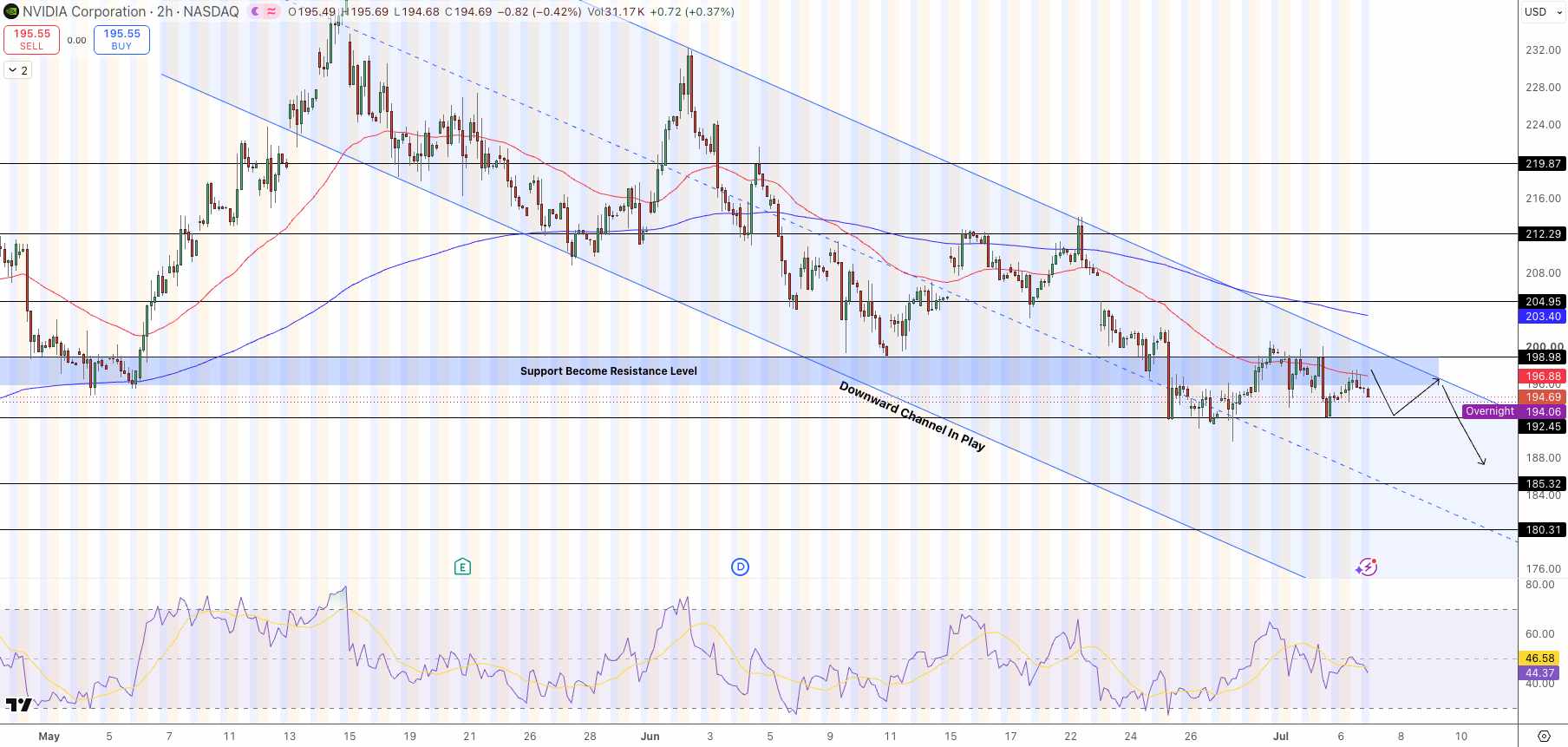
NVIDIA (NVDA) Stock Price Chart - Source: Tradingview
Short Entry: below $198.30; Short Target: $184.70; Stop Loss: a day close above $203.40. If we have a close above $203.40, the trade thesis starts to weaken. If we see an active breakout above $212, NVDA may be on its way out of the channel.
Key catalysts:
- Forward P/E is 21.7x; well below the five-year P/E of 72x (via Finviz)
- Kyber NVL144: NVIDIA says development still on track (via CNBC)
- Next earnings: August 26, 2026, the second quarter 2027 fiscal year
Why Did NVIDIA Deny the Kyber NVL144 Delay Report?
July 7 news reports suggested that NVIDIA's upcoming Kyber NVL144 AI platform would be pushed back to 2028. However, the firm denied it, saying it was on schedule. The denial boosted the stock price by over 1%, reducing the market's concern about the impact on NVIDIA's AI roadmap. The AI roadmap remains critical to NVIDIA's projected growth.
Why Does Goldman Sachs See Value in NVIDIA?
Goldman sees NVIDIA as an undervalued stock given its current pullback. It's trading at a multiple of 21.7x forward earnings. This is close to its S&P 500 average and far below its 5-year average of 72x. Goldman also argues that these earnings multipliers don't factor in the anticipated growth from the continued ramp-up in AI investment from the major cloud providers and the predicted industry AI capex from $650 billion in 2026 to $1 trillion in 2027.
Why Is NVIDIA Trailing Other AI Chip Stocks?
Year-to-date, the semiconductor industry and AI chips have done well. NVIDIA is up 5% so far this year. AMD, meanwhile, is up more than 100%, while the SOXX ETF (Semiconductors) is up 59%. Why is NVIDIA underperforming the semiconductor ETF and AMD this year? One factor is NVIDIA's entry price in 2026. This stock has been one of the market's priciest and most crowded names, making it harder to boost its multiple. AMD and Micron, meanwhile, started the year at less elevated levels and saw stronger re-rating from the surge in AI demand.
Bottom Line
NVDA at $198.34 is rejecting the $198 to $203 resistance level in the descending channel. Two catalysts have helped the stock today, denial that Kyber chip production would be delayed, is 1% higher, as is Goldman’s call that the valuation is “compelling” because it trades for only 21.7 times forward earnings. But neither has been enough to punch through this technicals setup.
Short below $198.30 has $184.70 as the target, stop $203.40.
Long from Goldman is the 21.7 times forward P/E and a price that assumes average growth among all AI companies when the hyperscalers themselves are calling for $1 trillion in 2027 capital expenditures, and that doesn’t appear to be a bad call. The bears have the channel of course, six consecutive lower highs, 5% year to date in a sector that’s been up 59% this year, and if price continues to roll over the resistance we’ll see a test of $184.70 support.
Recommended Articles


