


Move Over SpaceX: These 2 Space Stocks Are Nipping at Its Heels
Key Points
SpaceX does everything from orbital launches to mobile broadband to artificial intelligence to owning X (formerly known as Twitter).
Its satellite-to-surface broadband arm, however, faces new and motivated competition.
Meanwhile, a rival rocket company now offers a complete lineup of specialized launch and satellite communications services.
- These 10 stocks could mint the next wave of millionaires ›
There's no denying it. Since its mid-June IPO, Space Exploration Technologies (NASDAQ: SPCX) has been the market's most-discussed stock. And understandably so. Not only was it the biggest-ever public offering of one of the world's most valuable companies (as measured by market cap) companies, but the company has the potential to change the world. Cost-effective space launches, artificial intelligence (AI) data centers, and satellite-based broadband connectivity are all in its wheelhouse.
It's not the only name in any of these businesses, though. While it's the biggest on most fronts, a couple of other companies are nipping at SpaceX's heels, making their stocks interesting investment prospects. Here's a closer look at both.
Where to invest $1,000 right now? Our analyst team just revealed what they believe are the 10 best stocks to buy right now, when you join Stock Advisor. See the stocks »
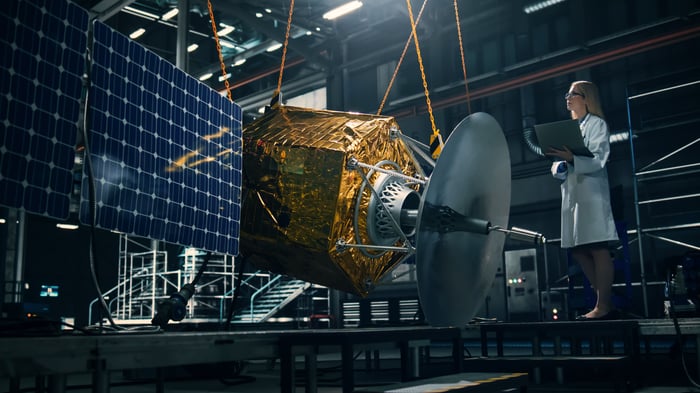
Image source: Getty Images.
1. Rocket Lab
You know it best as a space launch service provider, putting satellites of all sorts and sizes into low Earth orbit. It's also got rockets capable of ferrying cargo and personnel to the moon, if and when people begin making regular trips there.
SpaceX, however, isn't alone in this business. A company called Rocket Lab (NASDAQ: RKLB) has also developed a reusable rocket -- called Electron -- that can lift smaller satellites into orbit. To date, this launch vehicle has been utilized 91 times, successfully deploying over 262 satellites.
It's not a perfect apples-to-apples comparison. With a maximum payload capacity of 660 pounds, the Electron design is meant for relatively small equipment. SpaceX can certainly match that, but its Falcon rockets can lift a little over 50,000 pounds into low Earth orbit or send over 18,000 pounds' worth of supplies, cargo, and personnel to the moon.
Rocket Lab is closing the gap. While not quite yet ready for commercialization, Rocket Lab's reusable Neutron rocket can put payloads of nearly 30,000 pounds into orbit or be used for lunar delivery trips. Neutron is expected to begin flights by the end of this year.
The world will need all of these options, and there may be plenty of business to go around for both. Precedence Research predicts the worldwide launch market will more than double in size by 2035, reaching $70 billion per year, likely led by the medium-lift segment of the industry.
Rocket Lab may still be the better industry bet among the two investment options. Not only is it a "pure play" on launch services, but its smaller size and wider array of offerings also make it a complete solutions provider. In addition to launches, the company makes satellite components and can even help construct a satellite for a customer. Moreover, the impending $8 billion acquisition of satellite-based communications specialist Iridium Communications (NASDAQ: IRDM) means it will be able to monetize its existing launch capabilities and satellite know-how in a whole new way.
2. AST SpaceMobile
While rockets may be SpaceX's highest-profile business, it's not its biggest. Its Starlink arm, which provides satellite-based broadband internet service, is slightly bigger. As of the latest count, over 10,000 satellites are serving over 12 million residential and mobile customers worldwide, generating nearly $4.2 billion in revenue last year.
For perspective on where things may be going, however, at one point, founder and CEO Elon Musk has suggested that more than 40,000 Starlink satellites could be put into orbit, although the number's since been dialed back to a slightly less jaw-dropping 25,000.
Like its orbital launch arm, Starlink isn't the only name in this business. While much smaller right now, a company called AST SpaceMobile (NASDAQ: ASTS) could prove a serious competitive threat to Starlink's hold on the satellite-to-surface broadband business.
It doesn't necessarily look that way at first blush. Starlink has a significant head start. Indeed, AST SpaceMobile currently has fewer than a dozen functioning satellites in orbit.
But AST has one thing that SpaceX's Starlink doesn't. That's developmental partnerships with wireless carriers Verizon Communications and AT&T. Starlink is working with T-Mobile to serve its customers when they're out of reach of T-Mobile's terrestrial broadband network. With two partners instead of just one -- both of whom want to disrupt their more advanced common rival -- AST SpaceMobile could grow surprisingly quickly. To this end, analysts expect AST's stop line to grow by 140% this year before accelerating to 340% next year, dramatically reducing its losses en route to a swing to profitability by 2028.
Also like Rocket Lab, AST SpaceMobile is a true "pure play" on the satellite-delivered broadband connectivity business that Precedence believes will grow at an average pace of 13.5% through 2035, when it will be worth over $40 billion per year.
Just bear in mind this is a holding that will require patience and a stomach for volatility.
Don’t miss this second chance at a potentially lucrative opportunity
Ever feel like you missed the boat in buying the most successful stocks? Then you’ll want to hear this.
On rare occasions, our expert team of analysts issues a “Double Down” stock recommendation for companies that they think are about to pop. If you’re worried you’ve already missed your chance to invest, now is the best time to buy before it’s too late. And the numbers speak for themselves:
- Nvidia: if you invested $1,000 when we doubled down in 2009, you’d have $505,952!*
- Apple: if you invested $1,000 when we doubled down in 2008, you’d have $58,823!*
- Netflix: if you invested $1,000 when we doubled down in 2004, you’d have $418,761!*
Right now, we’re issuing “Double Down” alerts for three incredible companies, available when you join Stock Advisor, and there may not be another chance like this anytime soon.
See the 3 stocks »
*Stock Advisor returns as of July 7, 2026.
James Brumley has positions in AT&T. The Motley Fool has positions in and recommends AST SpaceMobile and Rocket Lab. The Motley Fool recommends T-Mobile US and Verizon Communications. The Motley Fool has a disclosure policy.
Recommended Articles


