


Meta Plans 10 Trillion Won Order as Anthropic Talks Simultaneously, Is Samsung's Foundry Business Reaching a Turning Point?
TradingKey - During the Asian trading session on July 3, South Korean stocks surged, with Samsung Electronics' share price jumping over 8%. On the news front, two rumors regarding AI chip foundry services gained traction simultaneously: Meta ( META) is reportedly considering commissioning Samsung to produce custom AI chips worth over 10 trillion Korean won; Anthropic is also reportedly in talks with Samsung over a foundry partnership for its self-developed chips.
For Samsung's foundry division, this might be the turnaround opportunity it has been waiting for over the past four years.
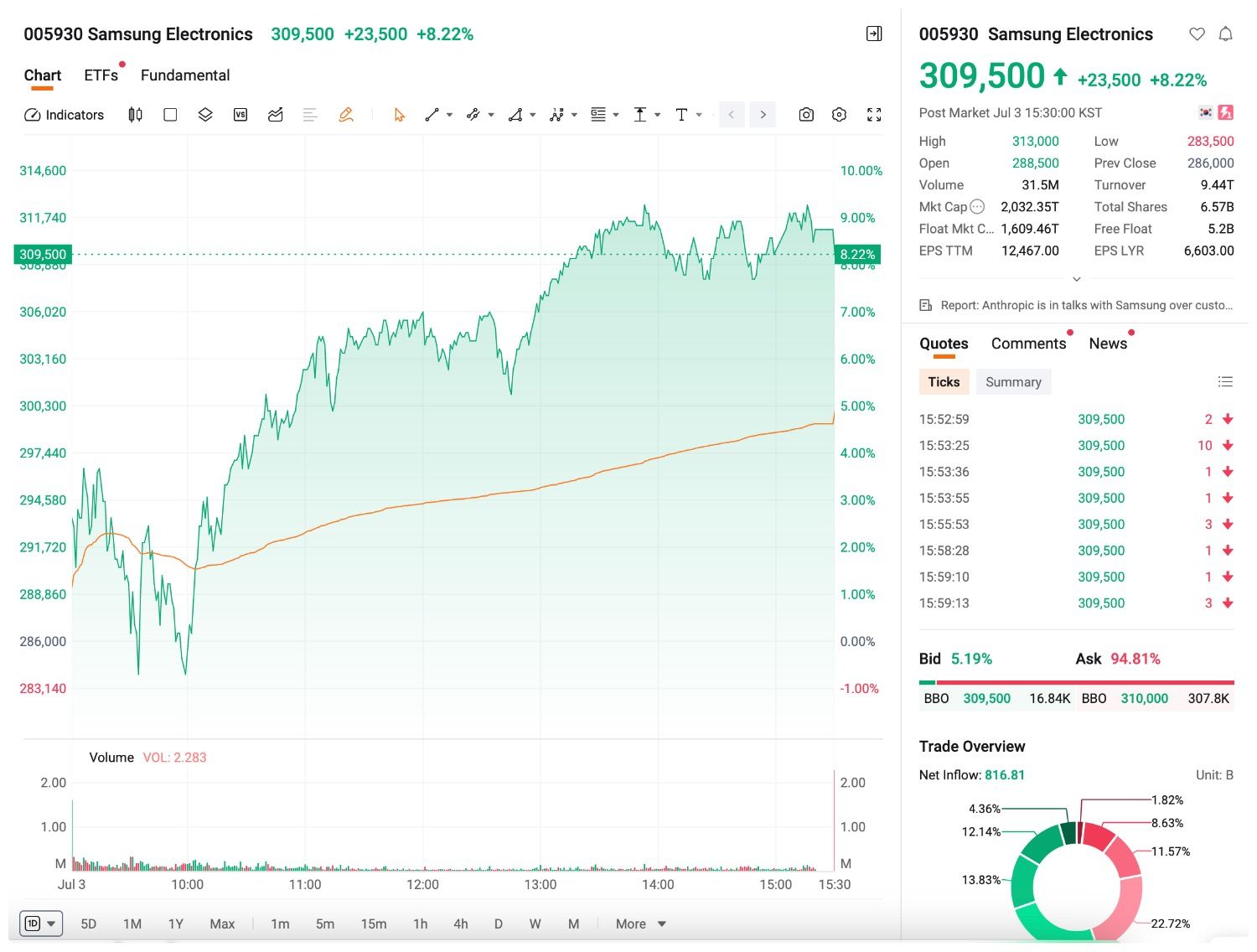
Source: Futu
2nm Yield Ramps Up to Mid-50% Range, Marking an Inflection Point for Samsung's Foundry Division
Over the past few years, Samsung's foundry business has been under continuous pressure. In the first quarter of this year, TSMC ( TSM) held a market share of up to 73%, while Samsung accounted for only 7%; its foundry division has suffered continuous losses since 2022, with single-quarter losses once hovering between 1 trillion and 2 trillion Korean won.
The turning point came in 2026. Samsung shifted its strategic focus to the 2nm process, moving away from its obsession with the marketing gimmick of "world firsts" to concentrate resources on improving yield rates. According to Korean media reports, Samsung's 2nm yield rate was only about 20% in the second half of 2025, but is said to have surpassed 60% by the first quarter of this year; when accounting for back-end process losses, the actual proportion of profitable chips is about 40%. Raising the yield rate from 20% to the mid-50% range within half a year is a rare advancement in the field of advanced nodes.
In contrast, TSMC's 2nm (N2) process has officially entered mass production, with wafer defect density meeting targets two quarters ahead of schedule. Five 2nm fabs are being launched simultaneously this year, and the compound annual growth rate of capacity from 2026 to 2028 is expected to reach 70%. Monthly capacity at the initial stage of mass production is about 35,000 wafers, and is expected to rise to 140,000 wafers by the end of the year.
The gap remains, but the trend is changing: Tesla ( TSLA) has signed a 2.28 trillion Korean won long-term supply agreement with Samsung to produce AI5 and AI6 autonomous driving chips using the 2nm process; in March this year, Nvidia ( NVDA) CEO Jensen Huang publicly confirmed at the GTC conference that the Grok 3 AI inference chips will be outsourced to Samsung's foundry; in June, market sources indicated that Samsung's foundry division is expected to turn a profit as early as the third quarter.
Meta Plans to Place 10 Trillion Won Order, with 2nm Process as the Key
According to reports on July 3, Meta is considering commissioning Samsung to produce custom AI chips valued at over 10 trillion won (approximately $7.5 billion), with plans to mass-produce hundreds of thousands of sets of its self-developed AI accelerator, "MTIA," using a 2-nanometer process. If the order is finalized, Samsung Foundry's medium-to-long-term order backlog is expected to approach 50 trillion won.
A volume of this scale represents a mega-order in the foundry sector. Meta has been positioning itself in the self-developed chip track for a long time, with continuous iterations of its MTIA accelerator. For Samsung, securing a client of this caliber not only means substantial revenue but also serves as an important brand endorsement.
From the capacity perspective, Samsung's foundry division has recently adjusted its supply strategy. According to a report by South Korean media outlet ChosunBiz on July 3, its 4nm process capacity is virtually sold out, and some 8nm production lines are also operating near full capacity. The demand structure is rapidly shifting from smartphone APs to AI accelerators, ASICs, and HPC chips. This shift indirectly confirms that the heat in the AI chip foundry market is spreading across all process nodes.
Anthropic in Talks with Samsung for 2nm Foundry Services, Adding Another Player to the Self-Developed Chip Wave
According to a report by The Information, Anthropic has initiated early-stage preparations for its in-house AI chips and has entered talks with Samsung Electronics regarding potential manufacturing cooperation, considering Samsung's 2nm process node and advanced packaging technologies. Currently, the project remains in the planning phase, and the chip's functional positioning, computing power specifications, and deployment plans have not yet been finalized.
The logic behind developing in-house chips is straightforward: Anthropic's annualized revenue has surged from approximately $9 billion at the end of 2025 to over $30 billion, leading to exponential growth in computing power demand, while long-term reliance on Nvidia GPUs implies high costs and supply constraints. Even minor efficiency gains can translate into massive savings when scaled across large clusters.
In fact, prior to preparing for its own chip development, Anthropic had already made frequent moves, poaching Clive Chan, an early member of OpenAI's custom chip team, last month, and posting job openings for chip engineers; in April, it signed a multi-gigawatt TPU capacity agreement with Google ( GOOGL) and Broadcom ( AVGO ); in May, it completed a $65 billion funding round, reaching a post-money valuation of $965 billion, while signing an agreement with Amazon ( AMZN) for up to 5 gigawatts of capacity.
The rationale for choosing Samsung is that TSMC's 2nm capacity has been fully booked by AI orders, with schedules already pushed out to 2028-2029; meanwhile, Samsung's Taylor plant in the U.S. is expected to achieve mass production of 2nm chips by the second half of 2026, with a monthly capacity target of 50,000 wafers, offering relatively abundant capacity. Furthermore, Samsung can provide an integrated solution encompassing HBM memory and advanced packaging, which can significantly reduce supply chain integration costs for Anthropic as it builds chips from scratch.
In addition, in May of this year, Samsung, along with SK Hynix and Micron ( MU ), participated in Anthropic's $65 billion funding round and were designated as "strategic infrastructure partners".
TSMC's capacity booked through 2028, opening a window of opportunity for Samsung's 2nm process
If the aforementioned orders are finalized, the mid-to-long-term order backlog of Samsung's foundry business is expected to approach 50 trillion won. Meanwhile, Samsung's Taylor, Texas campus covers 4.85 million square meters—exceeding the combined area of its Pyeongtaek and Hwaseong plants—and can accommodate 10 fabs (including advanced packaging facilities) to provide clients with one-stop services.
To be sure, uncertainties remain: Anthropic's chip project is still in its early stages, and whether it will ultimately materialize is yet to be seen. Although Samsung's foundry business is showing signs of improvement, its yield rates still lag behind those of TSMC. Nonetheless, against the backdrop of TSMC's capacity being fully booked and customers lining up, Samsung's spare 2nm capacity is precisely its core bargaining chip in winning orders. Whether Samsung can seize this window of opportunity will directly determine the trajectory of its foundry business for years to come.
Recommended Articles


