


Samsung Electronics' Dual-Front Offensive: Squeezing Substrate Prices, Raising DRAM Prices, Memory Giant Profits From Both Ends
TradingKey - During the Asian trading session on July 3, the South Korean stock market staged a massive rebound after falling nearly 10% over the previous two trading days. By the close, the South Korean KOSPI index surged 5.76% to 8,088.33 points; Samsung Electronics closed up 8.22%, and SK Hynix closed up 10.88%. Behind the rebound were two pieces of industry news: chip price increases and substrate price cuts. Between raising one and suppressing the other, the memory giants fully demonstrated their pricing power across the upstream and downstream of the supply chain.
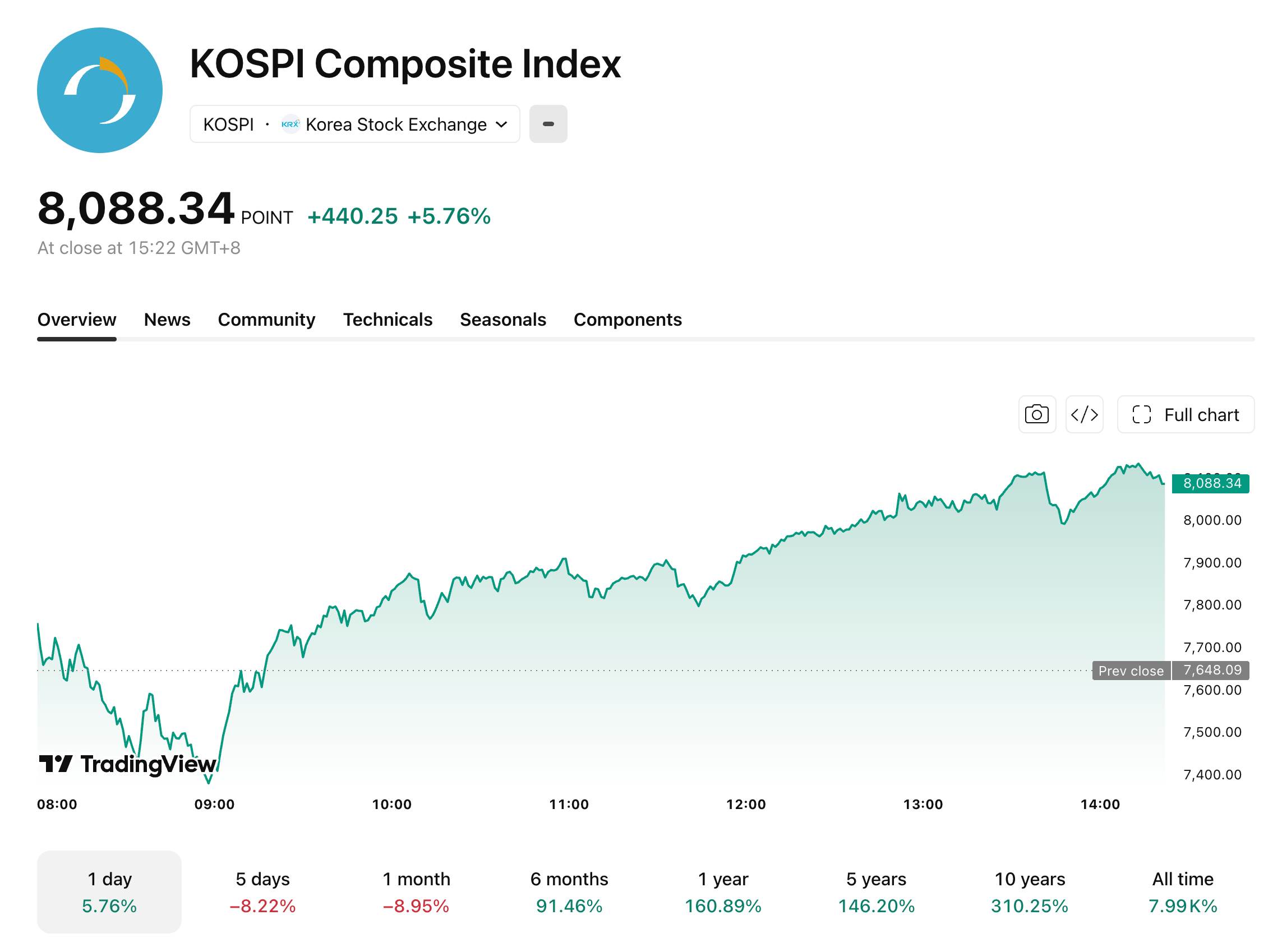
[Source: TradingView]
Samsung and SK Hynix are reportedly taking the lead in demanding price cuts from substrate manufacturers.
According to the Korea Printed Circuit Board & Semiconductor Packaging Association, Samsung and SK Hynix are demanding that substrate suppliers lower their quotes in the latest round of price negotiations, aiming to roll back the price increases of approximately 3% to 4% implemented in the first quarter of this year.
The two giants argue that at the beginning of the year, substrate manufacturers raised prices as raw materials like gold and copper surged, which the two companies accepted. However, as raw material price fluctuations have now stabilized and the factors driving the price hikes have disappeared, quotes for the second half of the year should return to previous levels.
Samsung Electronics plans to raise DRAM prices by up to 20% in the third quarter.
Almost simultaneously, media reports indicated that Samsung Electronics is in negotiations with customers, planning to raise the average price of conventional DRAM in the third quarter by up to 20% quarter-on-quarter. The price hike for server and mobile low-power DRAM is set even higher, at more than 20%.
Samsung's pace of price hikes this year is highly visible. According to media reports, its DRAM ASP surged by approximately 90% quarter-on-quarter in the first quarter, rose another 50% to 60% in the second quarter, and is targeted for an additional 20% increase in the third quarter.
Viewed together, Samsung's position is highly delicate: driving down prices for upstream suppliers while raising them for downstream customers. It is abundantly clear which way the profit margins are shifting.
Where does the support for DRAM price hikes come from?
The supply shortage of memory chips is by no means empty talk. With continuous investment in AI infrastructure, demand for server DRAM, HBM, and LPDDR is climbing rapidly, while the expansion cycle takes as long as 18 to 24 months, making the short-term supply gap difficult to fill. A recent research report from BOCOM International has pushed back its projection for the memory supply deficit to last until at least the fourth quarter of 2027.
Some semiconductor industry insiders revealed that Samsung maintained a tough stance in the third-quarter price negotiations, but whether customers will fully accept it remains to be seen.
The existence of long-term supply agreements is also putting a floor under prices. Micron ( MU) disclosed late last month that it has signed 16 long-term supply agreements with customers, which not only lock in purchase volumes but also set price floors to guarantee high profit margins. This long-term contract model is spreading across the industry, meaning that even if the momentum of subsequent price increases slows down, the room for price declines is quite limited.
Today's surge in Korean stocks indicates that the market still buys into the pricing power of memory giants. However, whether the strategy of 'squeezing the upstream to raise the downstream' can continue ultimately depends on the actual bearing capacity of downstream customers.
Memory costs for PC and smartphone manufacturers have climbed significantly, driving up terminal retail prices. Apple was the first to raise MacBook and iPad prices, attributing the move to rising prices of upstream memory chips, but Micron does not agree.
Micron CEO Sanjay Mehrotra pointed out that during the 2023 memory downturn, some customers pushed prices down to one-third of their original levels, leaving Micron unable to invest in new capacity, which is the root cause of the current shortage. Micron's Chief Business Officer Sumit Sadana also publicly hinted that aggressive price-squeezing strategies by certain customers turned the industry's gross margins negative, causing a massive amount of investment to be halted in 2023.
When price hikes on consumer terminal devices reach the limit of consumer tolerance, whether a demand backlash will occur is perhaps the biggest variable in this supercycle.
Recommended Articles


