


US Stocks Close: Three Major Indices Mixed, Dow Hits Another Record High; Meta's Plan to Sell Computing Power Still Dampens Market Sentiment, Memory Stocks Plummet Across the Board, SanDisk Drops Over 23% in Two Days
TradingKey - On July 2, Eastern Time, U.S. stock markets will be closed tomorrow for Independence Day. Today's weaker-than-expected non-farm payrolls data dampened bets on Fed rate hikes, but Meta's plan to sell computing power weighed on market sentiment. The three major U.S. stock indexes continued to diverge, with the Dow Jones Industrial Average hitting another record high, while memory and optical communication stocks led the declines.
By the close, the Dow Jones Industrial Average rose 1.14% to 52,900.07; the Nasdaq Composite Index fell 0.80% to 25,832.67; and the S&P 500 Index rose in late trading to finish nearly flat at 7,483.24.
Tech stock performance
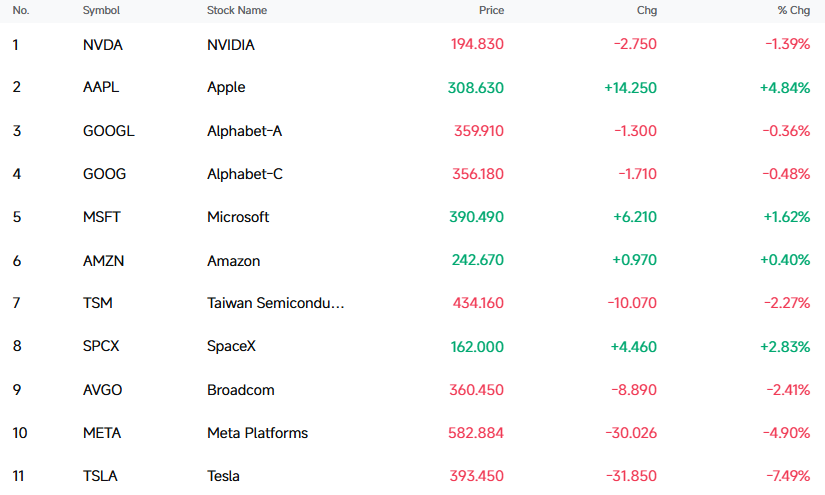
Tesla (TSLA) fell 7.49% to close at $393.45.
Tesla announced second-quarter deliveries that far exceeded market expectations. Q2 deliveries reached 480,100 vehicles, up 25% year-on-year, primarily boosted by a significant recovery in European demand and its low-priced model strategy. However, the market is focusing more on the development of its new business segments, such as artificial intelligence and robotics. Tesla is scheduled to release its full quarterly financial results after the market close on July 22, when the market will be able to further examine its profitability and the latest progress across its business lines.
Among mega-cap tech stocks, Apple (AAPL) rose 4.84%, SpaceX (SPCX) rose 2.83%, Microsoft (MSFT) rose 1.62%, and Amazon (AMZN) rose 0.40%. On the downside, Tesla (TSLA) fell 7.49%, Meta Platforms (META) fell 4.90%, Broadcom (AVGO) fell 2.41%, TSMC (TSM) fell 2.27%, Nvidia (NVDA) fell 1.39%, and Alphabet (GOOGL) fell 0.36%.
[Source: FutuBull]
The Philadelphia Semiconductor Index continued its decline, falling 5.44% to close at 12,626.22 points, bringing its two-day drop to over 11%, with all 30 of its components ending lower.
Optical communications stocks led the losses, with Corning (GLW) down 10.86%, Marvell Technology (MRVL) down 9.84%, Amphenol (APH) down 4.51%, and Broadcom (AVGO) down 2.41%.
Memory stocks plummeted across the board, with SanDisk (SNDK) down 14.13%, Seagate Technology (STX) down 10.38%, Western Digital (WDC) down 9.92%, and Micron Technology (MU) down 5.49%.
Most popular China concept stocks declined, with Chagee (CHA) down 8.02%, Pony.ai (PONY) down 6.31%, Hesai (HSAI) down 5.70%, and GDS Holdings (GDS) down 5.66%.
Corporate News
OpenAI Reportedly Proposes Offering 5% Equity Stake to Trump Administration
According to media reports, OpenAI is in talks with the U.S. government to sell a 5% stake, as the artificial intelligence startup, valued at $852 billion, seeks to clear political hurdles by securing financial support from the Trump administration. According to two people familiar with the matter, OpenAI CEO Sam Altman believes that allowing the public to hold shares in the company is the best way to share the benefits of AI, and he proposed a stake of this size in early conversations with the government.
Microsoft Invests $2.5 Billion to Establish New AI Implementation Unit, Doubling Down on On-Site Engineer Deployment
The competition for AI commercialization is extending from model capabilities to downstream implementation services, with Microsoft significantly ramping up its enterprise service efforts. The company announced the creation of an independent business entity, Microsoft Frontier Co., investing $2.5 billion and integrating a 6,000-member team to provide end-to-end AI implementation services to enterprises via an on-site engineer model, making it the latest tech giant to enter the segment following AWS, OpenAI, and Anthropic.
EU's Highest Court Upholds €4.1 Billion Antitrust Fine Against Google
The EU's highest court issued its final ruling, completely dismissing Google's appeal and upholding the €4.1 billion antitrust fine over anticompetitive behavior related to the Android operating system, leaving Google with no further legal recourse. The case began in 2018 with a record fine issued by the European Commission, centering on allegations that Google used Android's market dominance to squeeze out competitors by forcing device manufacturers to pre-install its own apps. In 2022, a lower EU court had slightly reduced the fine from €4.34 billion, and this final ruling now solidifies the legal force of the penalty.
Amazon Completes Initial Satellite Network Deployment, to Launch Broadband Service This Year to Rival SpaceX's Starlink
Amazon's satellite internet business has achieved a critical milestone. With the successful orbit of its latest batch of satellites, the company's low-Earth orbit (LEO) constellation has surpassed 390 satellites, meeting the minimum threshold to launch initial broadband services later this year. This officially marks Amazon's entry into the global LEO internet market to challenge the monopoly of SpaceX's Starlink.
Anthropic Partners with Samsung to Develop Custom Computing Hardware
According to media reports, Anthropic is moving forward with a manufacturing partnership with Samsung Electronics for custom AI chips to build proprietary computing hardware. The project is currently in the early feasibility stage, and the chips' functional positioning, performance specifications, and server integration solutions have not yet been finalized.
Sector & Macro News
BofA: Investors Need to Break Free from the Herd Mentality of Solely Betting on Megacap Tech
BofA Securities notes that the market's growth logic is shifting. Previously, the massive capital expenditures of megacap tech giants served as the market's core stabilizer, whereas the highlights of earnings growth are now gradually broadening to pro-cyclical sectors. S&P 500 companies with higher macroeconomic correlation are posting standout earnings, and cyclical sectors such as industrials, energy, and materials will directly benefit from U.S. economic growth. These areas represent a more attractive risk-reward allocation over the next few years, meaning investors need to move beyond the inertia of solely betting on megacap tech stocks.
Fed's Daly Expects Inflation to Start Slowing
San Francisco Fed President Mary Daly stated that the current slightly restrictive monetary policy stance will guide inflation gradually back down. However, disrupted by multiple factors, uncertainty surrounding the economic outlook has amplified significantly, and the Fed will keep the option of aggressive rate hikes on the table based on actual developments. Daly pointed out that the uptick in inflation this spring was primarily driven by the dual impact of tariff increases and the U.S.-Iran conflict pushing up oil prices. With the implementation of a ceasefire and the subsequent decline in oil prices, hopes of easing inflationary pressures have emerged. Nonetheless, she emphasized that the subsequent economic trajectory remains unclear, and the Fed will adopt differentiated responses under different scenarios; if inflation proves stickier than expected, more aggressive policy actions cannot be ruled out.
Widest Volatility Gap Since 2008 Signals Cooling Tech Bull Market
According to media reports, the rally in tech stocks has slowed recently, shaking traders' confidence in the market outlook. The volatility gap between the Nasdaq 100 and the S&P 500 has widened to its highest level since the 2008 financial crisis. This is primarily because investors' appetite for Nasdaq put options has increased significantly, reflecting growing concerns over a potential pullback in tech stocks, particularly within the AI sector.
Citi Expects Aluminum Prices to Bottom Near Term, Rebounding to $3,500 by Year-End
Citi stated that it expects aluminum prices to bottom out within the next month before gradually recovering to a range of $3,300 to $3,500 per metric ton between September and December. The bank believes this assessment is based on multiple factors, including a more dovish tilt in Fed policy, falling real interest rates, an improved demand outlook, and a continuous decline in inventories measured by days of consumption. Meanwhile, the recent drop in aluminum prices primarily reflects weaker-than-expected demand, slower visible inventory drawdown, easing geopolitical risks, the concentrated liquidation of speculative and physical positions, and rising market expectations for future supply increases. However, Citi believes that shorting aluminum is currently inappropriate because the market was already in a supply deficit prior to recent shocks, and new supply is unlikely to meet demand growth in a timely manner. The bank also noted that market concerns over a rapid return of Middle Eastern supply may be overstated.
Recommended Articles


