


Plug Power Expects to Reach Profitability by the End of 2028. Here's What Could Go Wrong.
Key Points
Plug projects it will generate positive operating income at the end of 2027 and achieve overall profitability at the end of 2028.
The company has a history of failing to achieve its profitability forecasts.
Should the company meet some near-term targets, management could begin to rebuild trust with investors.
- 10 stocks we like better than Plug Power ›
Making tremendous strides in sales growth over the past decade, Plug Power (NASDAQ: PLUG) has proven adept at selling customers on its fuel cell and hydrogen offerings. But the company's prowess at proving that these alternative energy endeavors could be profitable? Well, that's another story. Since its founding in 1997, Plug Power has consistently failed to turn a profit.
But management has a plan to reverse that trend. Let's take a closer look at Plug stock and what could derail the company as management strives to achieve profitability.
Where to invest $1,000 right now? Our analyst team just revealed what they believe are the 10 best stocks to buy right now, when you join Stock Advisor. See the stocks »

Image source: Getty Images.
This isn't the first time Plug's management has prognosticated profits
Investors often get excited when management teams suggest that profitability is on the horizon for their businesses -- especially ones that have been unprofitable for nearly 30 years, like Plug. So when Plug's management projects the company will generate positive operating income as 2027 winds down and achieve "overall profitability exiting 2028," it's understandable why investors get a little giddy.
But those with long memories will recall Plug's past profitability projections -- and how they never came to fruition.
The company has a long history of failing to deliver on management's profit forecasts. In December 2013, for example, Plug CEO Andy Marsh forecast the company would achieve breakeven on an earnings before interest, taxes, depreciation, and amortization (EBITDA) basis in 2014. Instead, it ended the year with EBITDA of negative $33.6 million.
Similarly, the company projected in January 2016 that it would achieve EBITDA break-even in the fourth quarter of that year. Again, it failed. Instead, Plug reported EBITDA of negative $9.4 million in Q4 2016.
Since its founding in 1997, Plug has reported neither operating income nor positive EBITDA.
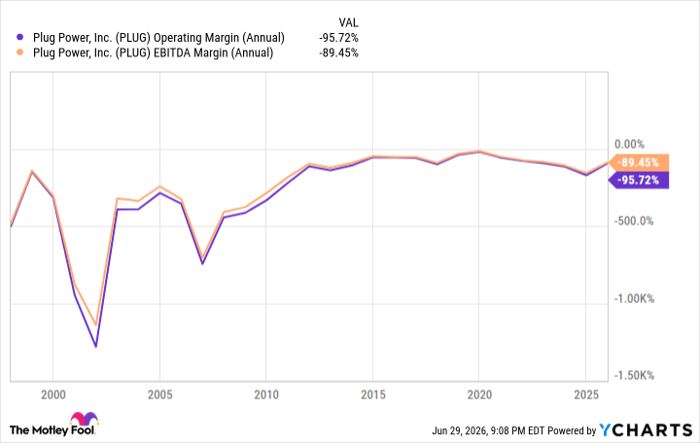
PLUG Operating Margin (Annual) data by YCharts.
Plug plans to pull a lot of levers to post profits
In an April 2026 investor presentation, management outlined a range of steps the company will take to achieve profitability. From raising prices throughout its material handling business to improving its service costs to consolidating its operating sites, the company sees a variety of opportunities to reduce expenses.
The problem, however, is that these numerous opportunities are far from guaranteed to succeed. While some of the steps the company is taking may yield benefits, there's no certainty they will be sufficient to result in overall profitability.
And while the company is continually incurring losses, it still needs to service its $1 billion in debt -- something it must do from its dwindling cash position of $223 million at the end of March 2026. Moreover, while it's servicing its debt, it still requires cash to maintain its operations. As a result, the company will likely raise capital by issuing equity, subjecting investors to shareholder dilution, as it has done many times before.
Take the forecast with a heaping tablespoon of salt
Rather than buying this hydrogen stock on the belief that the company is on the precipice of posting profits, investors would be better served by looking for Plug to meet near-term targets, such as achieving positive EBITDA by the end of 2026. Should it succeed, the company could start to rebuild trust with investors, making its 2028 forecast seem more credible.
Should you buy stock in Plug Power right now?
Before you buy stock in Plug Power, consider this:
The Motley Fool Stock Advisor analyst team just identified what they believe are the 10 best stocks for investors to buy now… and Plug Power wasn’t one of them. The 10 stocks that made the cut could produce monster returns in the coming years.
Consider when Netflix made this list on December 17, 2004... if you invested $1,000 at the time of our recommendation, you’d have $400,101!* Or when Nvidia made this list on April 15, 2005... if you invested $1,000 at the time of our recommendation, you’d have $1,212,683!*
Now, it’s worth noting Stock Advisor’s total average return is 911% — a market-crushing outperformance compared to 208% for the S&P 500. Don't miss the latest top 10 list, available with Stock Advisor, and join an investing community built by individual investors for individual investors.
See the 10 stocks »
*Stock Advisor returns as of July 2, 2026.
Scott Levine has no position in any of the stocks mentioned. The Motley Fool has no position in any of the stocks mentioned. The Motley Fool has a disclosure policy.
Recommended Articles


