


The U.S. Economy Added an Underwhelming 57,000 Jobs in June. Here's the Takeaway for Investors.
Key Points
Weak job growth could suggest the labor market has not rebounded, as some had believed.
However, it could also suggest that core inflationary pressures are set to slow.
The report should give the Fed added flexibility regarding monetary policy.
- 10 stocks we like better than Jefferies Financial Group ›
In a highly anticipated jobs report ahead of the July 4th holiday weekend, the U.S. economy added a seasonally adjusted 57,000 jobs in June, roughly half of what economists expected.
The unemployment rate fell to 4.2% and average hourly earnings rose 0.3% from the prior month, in line with estimates.
Missed Nvidia in 2009? This Rare Signal Is Flashing Again. In 2009, a "Double Down" signal flashed for a little-known chipmaker called Nvidia. For the first time in years, that same "Total Conviction" signal is flashing for a company 1/100th the size of Nvidia. Continue »
As of 12:44 p.m., the Dow Jones Industrial Average traded roughly 347 points higher, while both the S&P 500 Index and Nasdaq Composite were slightly in the red.
The report is a bit of a mixed bag. On one hand, it strays from the narrative suggesting the labor market has rebounded.
On the other hand, the soft data also gives the Federal Reserve more flexibility regarding the trajectory of interest rates.
Here’s the takeaway for investors.

Image source: Getty Images.
The bad news
On the negative side of the spectrum, the economy had been coming off three consecutive jobs reports showing solid gains.
Investors had been worried about the labor market, so the string of positive reports suggested that the economy may be on better footing.
Not only did the economy add far fewer jobs in June than expected, but the May jobs forecast got revised down to 129,000, indicating the picture hadn’t been as rosy as some had hoped.
Additionally, while the unemployment rate fell to 4.2%, the main driver was a decline in the labor force participation rate, which fell by 0.3% to 61.5%, the lowest level since March 2021.
This means the number of people working or actively seeking work declined, so it isn’t necessarily a good sign.
The good news
Due to high inflation, largely driven by the Iran war, the economy was getting to a point where it looked like the Fed may have no choice but to hike interest rates again.
This also put the economy in a position where bad news once again became good news.
A weaker labor market can suggest inflation will slow because demand is often driven by a healthy labor market, where people have disposable income to spend.
Additionally, this report gives the Fed added flexibility with interest rates, specifically the ability to continue holding them steady.
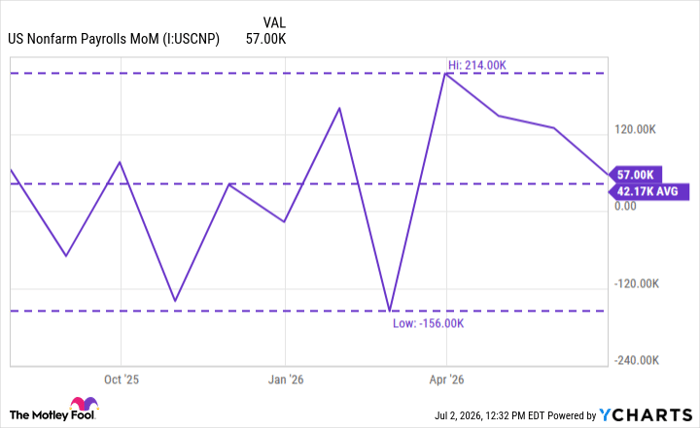
US Nonfarm Payrolls MoM data by YCharts
“For the Fed, this number is fine,” Jefferies Senior Economist Thomas Simons wrote in a research note, according to CNBC. “The pace of job growth is plenty strong enough to maintain a steady unemployment rate and average hourly earnings are solid, but not accelerating. There is no imperative on their part to do anything with rates immediately, and the softening in the pace of job growth suggests that rate hikes are very unlikely to be necessary this year.”
Yesterday, the market placed a roughly 36% chance on the Fed keeping rates steady at its September meeting. As of this writing, the likelihood of the Fed holding rates steady in September increased to over 46%.
Higher interest rates tend not to be as bullish for stocks. Ultimately, this is good news for the Fed, which likely wanted to avoid rate hikes if possible.
However, I don’t see this as an overly impactful report. The major indexes are most certainly being impacted by other factors on a day likely characterized by weak overall trading volume.
Inflation is still an issue, while the labor market remains a mystery.
Should you buy stock in Jefferies Financial Group right now?
Before you buy stock in Jefferies Financial Group, consider this:
The Motley Fool Stock Advisor analyst team just identified what they believe are the 10 best stocks for investors to buy now… and Jefferies Financial Group wasn’t one of them. The 10 stocks that made the cut could produce monster returns in the coming years.
Consider when Netflix made this list on December 17, 2004... if you invested $1,000 at the time of our recommendation, you’d have $400,101!* Or when Nvidia made this list on April 15, 2005... if you invested $1,000 at the time of our recommendation, you’d have $1,212,683!*
Now, it’s worth noting Stock Advisor’s total average return is 911% — a market-crushing outperformance compared to 208% for the S&P 500. Don't miss the latest top 10 list, available with Stock Advisor, and join an investing community built by individual investors for individual investors.
See the 10 stocks »
*Stock Advisor returns as of July 2, 2026.
Bram Berkowitz has no position in any of the stocks mentioned. The Motley Fool has positions in and recommends Jefferies Financial Group. The Motley Fool has a disclosure policy.
Recommended Articles


