


Wall Street Thinks the Space Economy Is a Buy. Here's Why I Disagree
Key Points
High valuations leave little room for execution mistakes.
Capital-intensive businesses often require years of heavy spending.
Government contracts create opportunity but also political risk.
- These 10 stocks could mint the next wave of millionaires ›
Governments are spending more on defense. Satellite launches continue setting records. Demand for broadband, Earth observation, navigation, and space-based communications continues to grow, as industry forecasts routinely project that the global space economy will surpass $1 trillion annually by 2034, up from roughly $626 billion today.
These data points all affirm that the long-term case for the space economy is solid.
Where to invest $1,000 right now? Our analyst team just revealed what they believe are the 10 best stocks to buy right now, when you join Stock Advisor. See the stocks »
But a growing industry doesn't automatically make it a good investment.
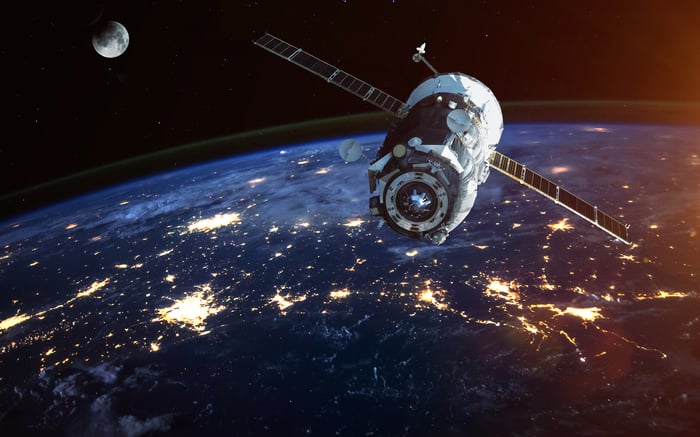
Image source: Getty Images.
Valuations matter
The market has a habit of getting ahead of itself whenever a new secular growth story emerges. We saw this during the internet boom, in renewable energy, cannabis, and electric vehicles. The underlying trends were real, but the valuations were not always realistic.
The space economy may be entering a similar phase. One reason is that much of the industry's projected growth is still years away.
While commercial launch activity has expanded rapidly, many of the largest revenue opportunities, including in-orbit manufacturing, space infrastructure, and lunar development, remain in their early stages. As a result, you could be paying today for cash flows that may not materialize for years.
Space ain't cheap
Space is one of the most expensive industries in the world. Designing satellites, building rockets, launching payloads, maintaining ground infrastructure, and complying with regulatory requirements require enormous up-front investment.
For instance, consider Amazon (NASDAQ: AMZN), which has committed more than $10 billion to build out its Project Kuiper satellite internet constellation. Even after those satellites are built, the company will still have to pay for launches, insurance, ground stations, network operations, and eventual satellite replacements.
Economic uncertainty
While it's true that launch costs have fallen dramatically over the past decade, largely because of reusable rockets, lower launch costs can also encourage more competitors to enter the market.
Growing demand doesn't necessarily translate into higher profits if competition expands just as quickly. Then there's government spending, which presents another risk.
Defense and civil space budgets have been important drivers of industry growth. NASA's budget is roughly $24 billion annually, while the U.S. Space Force continues to increase procurement of satellites, launch services, and missile-warning systems. Those contracts have provided significant support to the industry. But that government funding is also political.
Changes in administrations, shifting defense priorities, budget negotiations, or procurement delays could erase that support with the stroke of a pen.
Make no mistake: there is inherent risk when investing in an industry that depends heavily on government customers.
Expectations in check
Over the years, I have found that an awful lot of investors overestimate how quickly new industries can mature and underestimate how many companies fail along the way. Emerging industries rarely develop in a straight line.
Technical setbacks, regulatory delays, financing challenges, and slower-than-expected customer adoption are all common during the early stages of commercialization. Do not ignore this reality.
Of course, this doesn't mean the space economy is a bad long-term story. Satellites are becoming increasingly important for communications, agriculture, defense, weather forecasting, logistics, and navigation. Those trends should continue for decades.
But right now, there are just too many folks assuming the industry's best-case scenario. So until valuations become more grounded in current fundamentals rather than long-term possibilities, be cautious about treating the entire space economy as an automatic buy.
Where to invest $1,000 right now
When our analyst team has a stock tip, it can pay to listen. After all, Stock Advisor’s total average return is 911%* — a market-crushing outperformance compared to 208% for the S&P 500.
They just revealed what they believe are the 10 best stocks for investors to buy right now, available when you join Stock Advisor.
See the stocks »
*Stock Advisor returns as of July 2, 2026.
Jeff Siegel has no position in any of the stocks mentioned. The Motley Fool has positions in and recommends Amazon. The Motley Fool has a disclosure policy.
Recommended Articles


